
Shipping from Chicago connects you to one of North America’s most powerful logistics networks. Whether you’re sending personal belongings, commercial goods, or specialized cargo to Europe, Chicago’s central location and world-class infrastructure make it an ideal starting point for international shipments.
Quick Overview: Shipping from Chicago to Europe
| Shipping Method | Best For | Transit Time |
|---|---|---|
| Ocean Freight (FCL) | Full containers, household moves, vehicles | 4-6 weeks |
| Ocean Freight (LCL) | Smaller shipments, partial loads | 5-7 weeks |
| Air Freight | Urgent, high-value, or time-sensitive items | 3-7 days |
| Intermodal | Connecting to coastal ports for overseas shipping | Varies by route |
Chicago isn’t just another shipping origin—it’s a global logistics powerhouse. The city processes over 19 million tons of cargo annually through the Port of Chicago alone, while O’Hare International Airport serves as one of the world’s busiest cargo hubs. Major highways like I-90, I-55, and I-94 converge here, and the city’s intermodal terminals are among the largest and most modern globally.
For individuals and families shipping to Poland or other European destinations, Chicago’s infrastructure means reliable connections, multiple carrier options, and efficient routing through established international corridors. The city’s strategic Midwest position reduces inland transportation time and connects seamlessly to both East Coast and West Coast ports for ocean freight, or offers direct air cargo routes to Europe.
This guide walks you through everything you need to know about shipping internationally from Chicago—from understanding your transportation options to navigating customs documentation and choosing the right service for your specific needs.
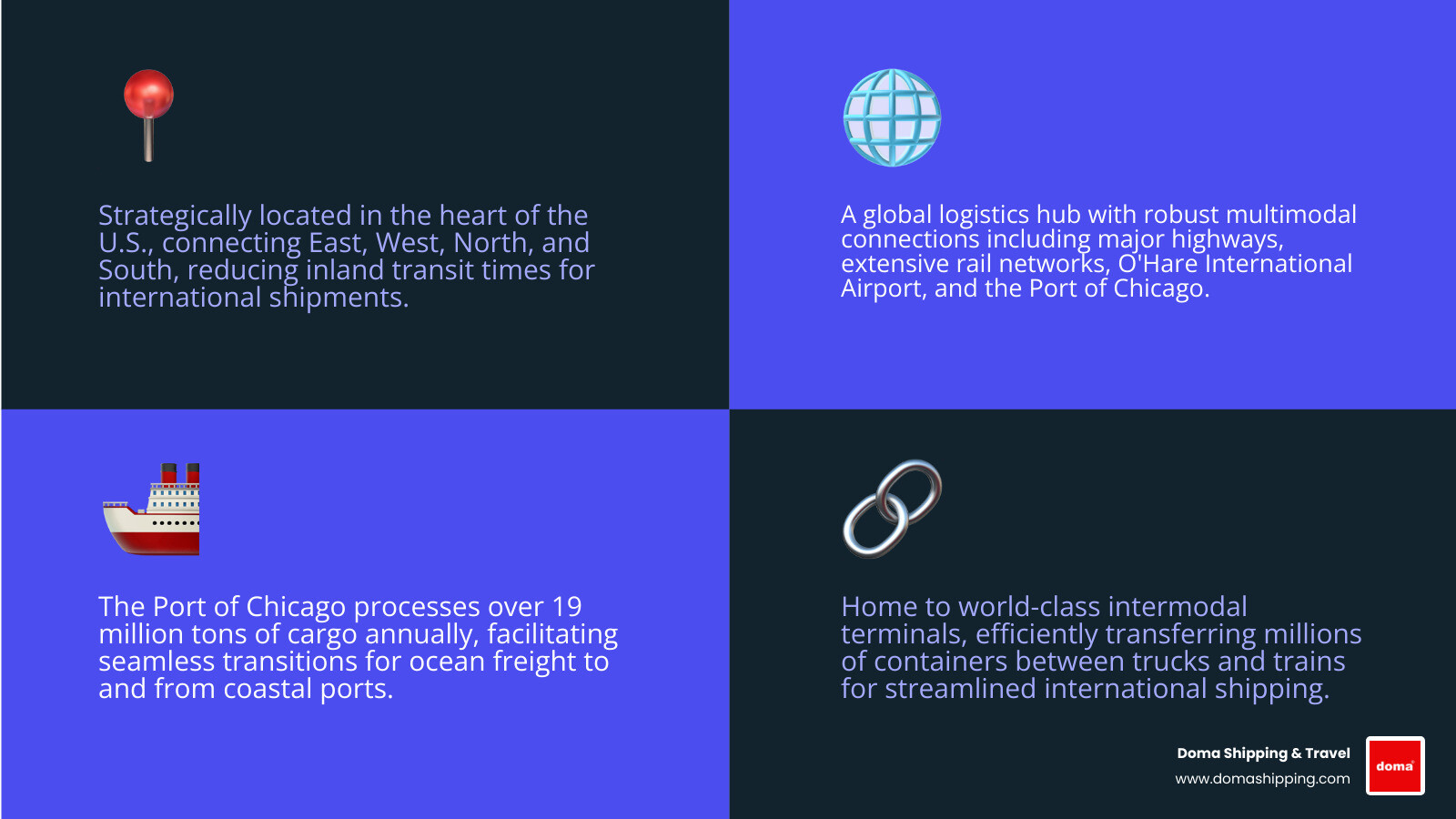
Chicago’s strategic location at the heart of the United States positions it as an unparalleled nexus for freight shipping. Its central position effortlessly connects the East Coast to the West Coast and the North to the South, making it a critical area for efficient regional and long-distance shipping operations. This geographical advantage means that whether your shipment originates from Illinois, Indiana, Ohio, Iowa, Missouri, or neighboring states, Chicago serves as a natural consolidation point before its journey across the Atlantic.
The city boasts an extensive network of major highways, including vital arteries like I-90, I-94, and I-55, ensuring smooth ground transportation for cargo moving in and out of the metropolitan area. This robust road infrastructure is complemented by some of the world’s largest and most modern intermodal facilities. These terminals efficiently transfer cargo between different transportation modes, such as trucks and trains, handling millions of containers each year. This intermodal capability is crucial for streamlining the journey of goods from inland America to international ports.
When it comes to waterborne commerce, the Port of Chicago stands out. It moves more general cargo than any other port in the Great Lakes, with over 19 million tons of cargo transported annually. This significant volume underscores its role as a vital gateway for goods heading to and from international destinations. For air cargo, O’Hare International Airport (ORD) is a global powerhouse, recognized as one of the world’s largest airports with dedicated cargo infrastructure. It provides direct access to international air routes, making it ideal for time-sensitive shipments.
Chicago’s comprehensive logistics ecosystem, supported by its strategic location and advanced infrastructure, makes it a premier hub for businesses and individuals looking to ship goods internationally. It’s not just a city; it’s a carefully engineered launchpad for global trade. You can learn more about the critical role of the Information on the Port of Chicago in facilitating this movement.
When considering international shipping from Chicago to Europe, you have several primary transportation modes at your disposal, each with distinct advantages depending on your shipment’s nature, urgency, and dimensions. These include ocean freight, air freight, and the essential intermodal connections that link Chicago’s heartland to global trade routes.
Ocean freight is often a suitable option for international shipments, particularly when time is not the most critical factor. Goods are transported by ship in large containers, making it an incredibly efficient method for moving substantial volumes. For shipments from Chicago, this typically involves inland transport to a coastal port (such as on the East Coast) before starting on the transatlantic voyage.
We offer two main types of ocean freight services:
Full Container Load (FCL): This option is ideal when your goods are sufficient to fill an entire shipping container. With FCL, your items occupy the whole container, which is sealed at the origin and opened at the destination. This method significantly lowers the risk of damage as your cargo is not handled multiple times or mixed with others. FCL is often chosen for large household moves, commercial inventory, or vehicles. You can learn more about this comprehensive option on our Full Container Load Shipping page.
Less-Than-Container-Load (LCL): If your shipment doesn’t fill an entire container, LCL is an excellent, flexible solution. With LCL, your goods share container space with shipments from other individuals or businesses heading to the same destination. This makes it an efficient choice for smaller volumes, such as a few boxes, furniture pieces, or consolidated items. Explore the advantages of this flexible option on our Less Than Container Load Shipping page.
Choosing between FCL and LCL depends entirely on the volume of your goods and your specific requirements. Both methods provide reliable pathways for your cargo to reach its European destination.
When speed is paramount, air freight offers the quickest transit times for international shipments from Chicago. This mode is particularly advantageous for time-sensitive goods, high-value items, or products with a short shelf life. Chicago’s O’Hare International Airport (ORD) is a major global cargo hub, providing extensive capabilities for air freight operations.
Air freight services from Chicago leverage O’Hare’s vast network of international routes, ensuring that your cargo can reach various European destinations within days rather than weeks. The benefits of expedited delivery, improved security, and precise scheduling often make it the preferred choice for critical shipments. For businesses managing tight supply chains or individuals needing urgent delivery of important items, air freight provides peace of mind and rapid transit. You can find more details about O’Hare’s cargo operations at Information on O’Hare Cargo operations.
While ocean and air freight handle the transatlantic leg of your shipment, rail and trucking play a foundational role in what’s known as “the first mile” and “the last mile” of international logistics originating in Chicago. Given Chicago’s inland location, integrating these ground transportation modes is crucial for efficiently moving cargo to and from ports and airports.
Trucking: The extensive network of highways surrounding Chicago (I-90, I-94, I-55) facilitates the efficient pickup of goods from various Doma Shipping locations across Chicago and its suburbs, including Melrose Park, Mount Prospect, Roselle, Palos Hills, Algonquin, Niles, Park Ridge, Des Plaines, Glenview, Franklin Park, Schiller Park, Bensenville, and Schaumburg. Trucks transport shipments from their origin points to consolidation centers, intermodal terminals, or directly to O’Hare for air freight. They also handle drayage, the short-distance transport of goods from rail yards or ports to their final local destinations.
Rail: Chicago is a major railroad hub, with significant lines operated by Union Pacific, BNSF, CSX, and Norfolk Southern. These rail networks are essential for long-distance inland transportation, moving full containers or large volumes of goods from Chicago’s intermodal facilities to major coastal ports on the East or West Coasts, where they are then loaded onto ocean vessels bound for Europe. Chicago’s world-class intermodal terminals are designed to seamlessly transfer cargo between rail and truck, optimizing the efficiency of this multi-modal journey.
The combination of robust trucking and rail services ensures that your international shipment from Chicago begins its journey smoothly, connecting the heartland of the USA to the global shipping lanes with precision and reliability. Local logistics hubs serve to consolidate parcels from Illinois and neighboring states for efficient air or sea delivery, highlighting the importance of these initial ground connections.
Once you’ve chosen your transportation mode, understanding the intricate logistics of international shipping is key to a smooth process. From proper documentation to specialized handling, every detail contributes to the successful delivery of your goods from Chicago to Europe.

Several crucial factors influence the process and successful transit of your international shipment. Being aware of these elements helps us tailor our services to your specific needs, ensuring efficiency and compliance.
Understanding these factors allows us to provide a comprehensive and transparent shipping plan custom to your international needs.
International shipping, especially from Chicago to Europe, requires meticulous attention to documentation. Proper paperwork is not just a formality; it’s a necessity for smooth customs clearance and preventing delays. We guide you through preparing all required documents, ensuring your shipment complies with both U.S. export regulations and European import laws.
Key documents typically include:
For individuals relocating or sending personal effects, additional documents may be required. For instance, when shipping immigrant property from the USA to Poland, you might need to provide a Driver’s License or State ID, a detailed list of items being shipped, documents confirming U.S. residence for over a year, and proof of Polish residency (Polish passport or ID, and a document from an authorized government office). This specific documentation ensures a smoother process for your Immigrant Property from USA to Poland.
We understand that navigating these requirements can be complex, which is why our expertise in international logistics is invaluable. We ensure all necessary paperwork is correctly prepared and submitted, streamlining your shipment’s journey.
Not all shipments are created equal, and some require extra care and expertise. From fragile antiques to oversized machinery, we offer specialized services to ensure your unique items are handled with the utmost precision and security when shipping from Chicago to Europe.
These specialized services ensure that no matter how unique or challenging your shipment, it receives the professional attention it deserves, guaranteeing a safe and efficient journey from Chicago to its European destination.
We understand you likely have questions about shipping your valuable goods from Chicago to Europe. Here are some of the most common inquiries we receive, along with detailed answers to help clarify the process.
Chicago’s diverse economy and strategic location mean a wide array of goods are shipped internationally from the city and its surrounding areas to Europe. These shipments cater to various needs, from commercial enterprises to individuals relocating or sending gifts to loved ones.
Common types of goods include:
Chicago’s robust infrastructure supports the movement of these diverse items, ensuring that almost any type of cargo can be prepared and dispatched for its journey across the Atlantic.
The transit time for your international shipment from Chicago to Europe largely depends on the chosen mode of transportation and the specific destination.
Several factors can affect these typical transit times:
We work to provide realistic transit estimates and keep you informed throughout your shipment’s journey.
Navigating the complexities of international shipping from Chicago to Europe can be a daunting task, especially with varying regulations, multiple carriers, and intricate logistics. This is where a freight forwarder, like us, becomes an invaluable partner. Engaging a freight forwarder offers several significant advantages:
Using a freight forwarder streamlines the entire international shipping process, saving you time, effort, and potential headaches. We act as your single point of contact, managing the intricate details so you can focus on what matters most.
Chicago’s unparalleled position as a central U.S. logistics hub makes it an ideal starting point for any international shipment destined for Europe. With its vast network of highways, state-of-the-art intermodal facilities, significant Port of Chicago, and the global reach of O’Hare International Airport, the city offers robust infrastructure for both ocean and air freight. Whether you’re sending personal belongings, commercial goods, or specialized cargo, Chicago provides the essential connections to bridge continents.
Navigating the complexities of international shipping—from choosing the right transportation mode (FCL, LCL, or air freight) to carefully preparing documentation and arranging specialized handling—requires expertise. That’s where we come in. Our comprehensive services, backed by over 30 years of experience, ensure that your goods are handled with care, precision, and efficiency from Chicago to their European destination. We are committed to making your international shipping experience as smooth and straightforward as possible.
When you choose to ship from Chicago with us, you’re not just selecting a service; you’re partnering with experts dedicated to connecting you to Europe seamlessly. Find how we can facilitate your next international shipment.