Why Understanding Freight to Poland Matters for Your International Shipment

Freight to Poland from the United States involves navigating multiple shipping methods, customs regulations, and documentation requirements. Whether you’re sending personal belongings, commercial goods, or vehicles across the Atlantic, understanding the process ensures your shipment arrives safely and without unnecessary delays.
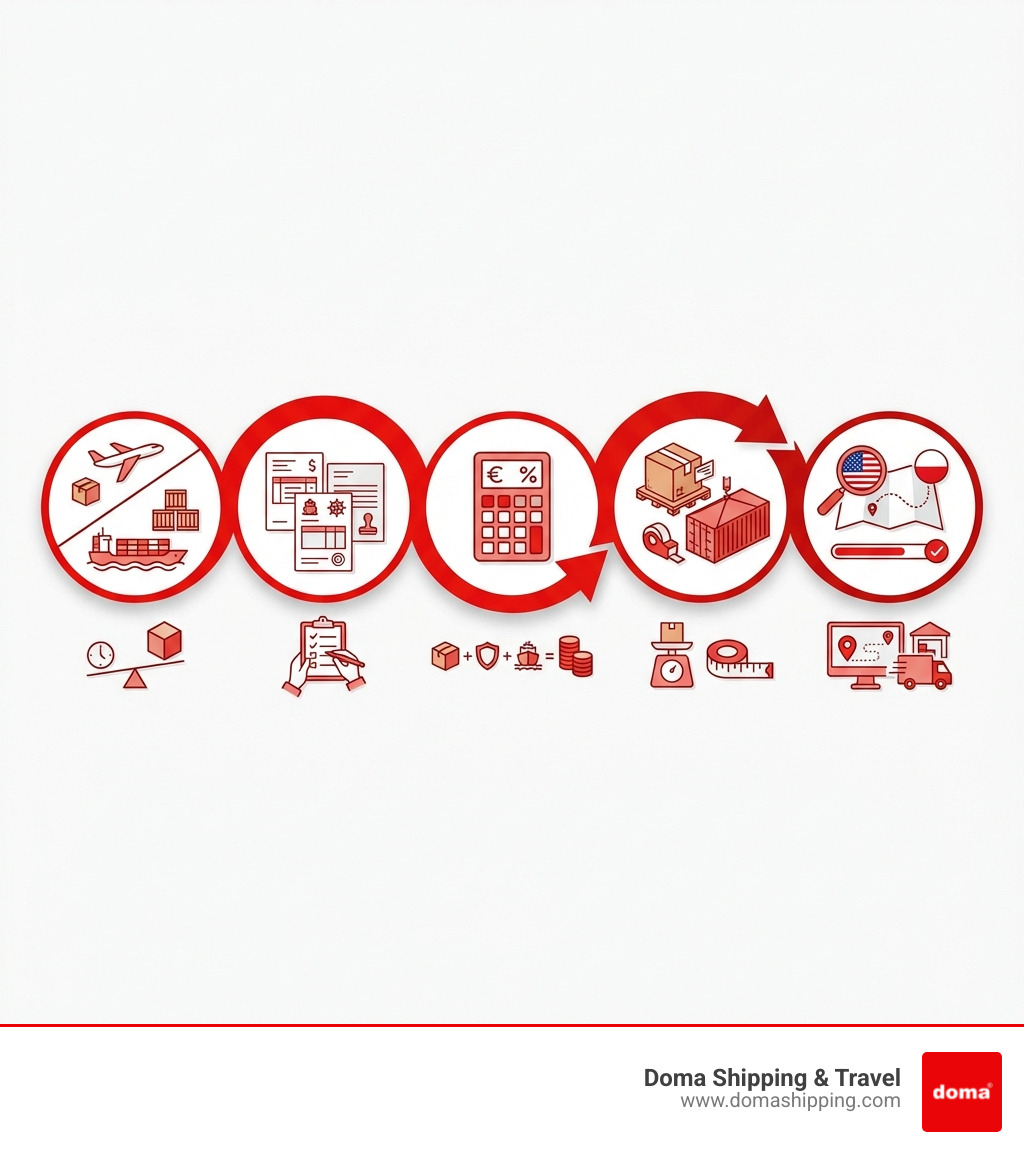
Quick Answer: Key Steps for Shipping Freight to Poland
- Choose Your Shipping Method – Air freight (2-5 days) for urgent shipments or sea freight (15-40 days) for larger, bulk loads
- Prepare Documentation – Commercial Invoice, Bill of Lading/Air Waybill, Packing List, and potentially Certificate of Origin
- Understand Customs – Poland uses EU customs rules; shipments over €150 face both VAT (23%) and import duties
- Package Properly – Use sturdy materials, secure pallets, and meet carrier standards for weight and dimensions
- Track Your Shipment – Monitor your freight through customs clearance and final delivery to your Polish destination
Poland ranks as one of Europe’s largest logistics markets and serves as a strategic gateway to the broader European Union. With over 40 million people and a thriving e-commerce sector, the country has become an increasingly important trade partner for American businesses and individuals alike.
Yet shipping internationally isn’t as simple as handing off a package to your local courier. The journey from Chicago to Warsaw involves crossing an ocean, clearing customs under EU regulations, and coordinating multiple carriers and handlers. Missing documents, incorrect classifications, or improper packaging can result in significant delays, rejected shipments, or unexpected fees.
This guide walks you through everything you need to know about sending freight to Poland from the United States. You’ll learn about shipping methods, transit times, customs requirements, documentation essentials, and how to prepare your shipment for a smooth journey across the Atlantic.
Quick freight to Poland terms:
Understanding Shipping Methods from the USA to Poland
When considering freight to Poland, selecting the appropriate shipping method is paramount. Your choice typically boils down to a balance between urgency, volume, and overall investment. The two primary options for transatlantic shipping are air freight and sea freight, each with distinct advantages.
Air Freight
Air freight offers the fastest transit times for your shipments. If time is of the essence, this method ensures your goods reach Poland swiftly. Air freight typically takes between 3 to 7 days, including customs processing and handling, with expedited options potentially delivering in as little as 2 to 5 days. This makes it ideal for urgent consignments, valuable items, or smaller, time-sensitive parcels. For instance, a direct flight from Chicago to Warsaw can significantly reduce transit times. We often use both dedicated cargo-only flights for larger, heavier shipments, which might operate once or twice a week, and “belly cargo” space on passenger flights for smaller parcels, tucking them efficiently alongside passenger luggage. For businesses, participating in programs like the U.S. Transportation Security Administration’s (TSA) Known Shipper Management System can further streamline air freight processes, potentially speeding up customs and enhancing efficiency.
Sea Freight
For larger volumes, heavy items, or when time is less critical, sea freight presents an efficient solution for larger volumes. While transit times are longer, typically ranging from 15 to 40 days, it offers significant efficiencies for bulky or substantial inventory. Port-to-port transit from the U.S. East Coast to Poland often takes around 21 to 25 days.
There are no direct ocean freight services from the U.S. to Poland. Transatlantic shipments first arrive at major European ports such as Hamburg or Rotterdam. From these busy hubs, your cargo is then transloaded onto smaller “feeder” vessels for the final leg across the Baltic Sea to Polish ports like Gdańsk or Gdynia. This extra step is a standard part of the process and is accounted for in our logistics planning.
Transit Times and Shipment Volume Suitability
| Characteristic |
Air Freight |
Sea Freight |
| Typical Transit |
2-7 days (including customs) |
15-40 days (including transshipment and final delivery) |
| Best For |
Urgent, high-value, smaller consignments |
Large, heavy, bulky shipments; efficient for non-urgent goods |
| Volume Suitability |
Smaller packages, valuable items, time-critical documents |
Full containers, vehicles, household goods, large commercial orders |
Container Options
When opting for sea freight, you generally have two main container options, custom to the volume of your goods:
- Full Container Load Shipping: If your shipment is large enough to fill an entire 20-foot or 40-foot container, FCL is often the most efficient and secure option. Your goods are the sole contents of the container, minimizing handling and potential for damage.
- Less Than Container Load Shipping: For smaller shipments that don’t require an entire container, LCL allows your goods to share container space with other shipments bound for Poland. This method optimizes space and resources, making international shipping more accessible for smaller volumes.
Specialized Shipments
Beyond general cargo, we specialize in handling various unique items. For instance, shipping vehicles requires particular expertise in documentation, customs, and specialized loading techniques. Our services extend to:
Navigating Polish Customs: Documentation and Regulations
The journey of your freight to Poland culminates in customs clearance, a critical phase governed by strict European Union regulations. As Poland is a member of the EU Customs Union, once your goods successfully clear customs there, they can move freely throughout the rest of the EU without incurring additional customs duties. This strategic position makes Poland an efficient entry point for broader European distribution. The EU’s Union Customs Code (UCC) works to modernize and simplify these procedures, but meticulous preparation remains essential. Polish customs authorities retain the right to inspect goods to ensure that declarations match the actual contents and to accurately assess any applicable VAT and duties.
Navigating these complexities requires precision. This is where the expertise of a customs broker becomes invaluable. A knowledgeable customs broker, especially one experienced in U.S.-Poland shipping, can guide you through the intricate documentation and ensure compliance, helping to prevent significant delays or penalties.
Required Documents
The foundation of a smooth customs clearance process is accurate and complete documentation. As the shipper, you are responsible for providing all necessary documents. These typically include:
- Commercial Invoice: This is a mandatory document for all non-document shipments. It must clearly state the reason for export (e.g., “Gift Shipment,” “Personal Effects,” “Commercial Samples”), provide accurate descriptions of each item, and specify their declared values.
- Bill of Lading (for sea freight) or Air Waybill (for air freight): These are the contracts of carriage between the shipper and the carrier, detailing the type, quantity, and destination of the goods being shipped.
- Packing List: A comprehensive list detailing the contents of each package within your shipment.
- Certificate of Origin: Required for certain goods to qualify for preferential tariff treatment under trade agreements.
- Customs Value Declaration: May be necessary for higher-value goods, typically exceeding €20,000.
Understanding Duties, Taxes, and Exemptions
When shipping freight to Poland, understanding potential duties, taxes, and available exemptions is crucial for managing your overall investment.
- Import Duties: Shipments with a value exceeding €150 are generally subject to import duties. The specific duty rate depends on the type of goods, determined by their Harmonized System (HS) code classification.
- Value Added Tax (VAT): All shipments, regardless of value, are subject to VAT since July 1st, 2021. The standard VAT rate in Poland is 23%, though reduced rates of 8% or 5% may apply to certain categories of goods.
- De Minimis Thresholds: For duty exemption, the de minimis value for shipments into Poland is €150 (approximately $160 USD, though this fluctuates with exchange rates). However, for VAT, the de minimis value is €0, meaning VAT is applicable to all commercial imports.
- CIF Value Calculation: Polish Customs calculates import duties and taxes based on the CIF (Cost, Insurance, and Freight) value. This means the duties and taxes are levied on the total value of the goods, plus the cost of insurance and the freight charges to bring them to Poland.
- EORI Numbers for Businesses: If you are a business importing goods into the EU, an EORI (Economic Operators Registration and Identification) number is mandatory. This unique identification code is required for companies to lodge a customs declaration or an Entry/Exit Summary declaration. The consignee’s EORI number must be included on all shipping paperwork.
Shipping Different Types of Goods
The specific requirements for your freight to Poland can vary significantly depending on the nature of the goods being shipped.
- Personal Effects: For individuals relocating to Poland, personal effects can often be imported duty-free. To qualify, these items typically must have been owned and used for at least six months and the shipper must have resided outside the EU for a specified period (e.g., 12 months). Meticulous documentation to prove residence transfer is essential to benefit from these customs relief provisions. These shipments can often clear customs within hours, usually no more than two business days. We provide specialized services for:
- Gifts: Gifts sent between individuals for personal use may be exempt from duty if their value does not exceed €45 (approximately $48 USD). VAT is still generally applicable. To qualify, the shipment must be infrequent, contain items for personal use, and be sent without payment. A commercial invoice clearly marked “Gift Shipment” is required.
- Commercial Samples: Businesses sending product samples for promotional purposes can often import them duty-free as temporary imports. These samples must typically be rendered unusable or clearly marked as “Commercial Samples – Not for Resale.”
- Temporary Imports: Items imported into Poland for a specific period (e.g., for trade shows, exhibitions, or professional equipment) can be considered temporary imports. These can often enter duty-free and remain in Poland for up to 24 months, with possible extensions up to 10 years, subject to customs permission. An application for inward processing permission is usually required before importation.
- Goods for Repair: If you’re sending items to Poland for repair and intend for them to be returned to the U.S., you can apply for inward processing permission. This procedure allows for the temporary import of goods for repair or processing without incurring duties and taxes, provided they are re-exported within a specified timeframe.
For the most precise and up-to-date information, we always recommend consulting the official Polish Customs website.
Specifics for Commercial Freight to Poland
For businesses engaging in freight to Poland, the process involves additional considerations beyond personal shipments.
- Business-to-Business Shipments: Commercial shipments often entail more extensive customs scrutiny and can take longer to clear. It’s critical to ensure all paperwork, including commercial invoices, packing lists, and transport documents, is carefully prepared and accurate. We strongly advise partnering with experienced freight forwarders and customs brokers to steer these complexities effectively.
- E-commerce Orders: Poland’s e-commerce market is experiencing robust growth, ranking 17th globally. A significant portion of its population actively shops online, with projections indicating continued expansion, especially in social commerce. For businesses selling directly to Polish consumers, the Import One-Stop Shop (IOSS) system for orders under €150 allows for VAT collection at the point of sale, streamlining import into the EU. Additionally, considering “Delivered Duty Paid” (DDP) shipping terms can make the delivery process smoother for your customers, as all duties and taxes are handled upfront.
- Formal Entry Requirements: Beyond standard documentation, commercial shipments require businesses to have an EORI number. Furthermore, accurate Harmonized System (HS) code classification for each product is paramount. This code directly determines the applicable duty rate and VAT, and errors can lead to customs delays, overpayments, or penalties.
Preparing and Tracking Your Shipment for Freight to Poland
Careful preparation and effective tracking are the final pillars of successful freight to Poland. Ensuring your goods are correctly packaged and that you can monitor their journey provides peace of mind and helps mitigate potential issues.

Packaging Guidelines for Freight to Poland
Proper packaging is crucial for protecting your goods during their long journey across the Atlantic and through various handling stages.
- Packaging Standards: We recommend using robust delivery boxes, preferably made from double-walled, chemically-strengthened cardboard. Securely seal all boxes with multiple layers of overlapping parcel tape.
- Crating: For exceptionally fragile, heavy, or unusually shaped items, crating offers superior protection. Custom wooden crates can be designed to fit your specific goods, providing a rigid outer shell.
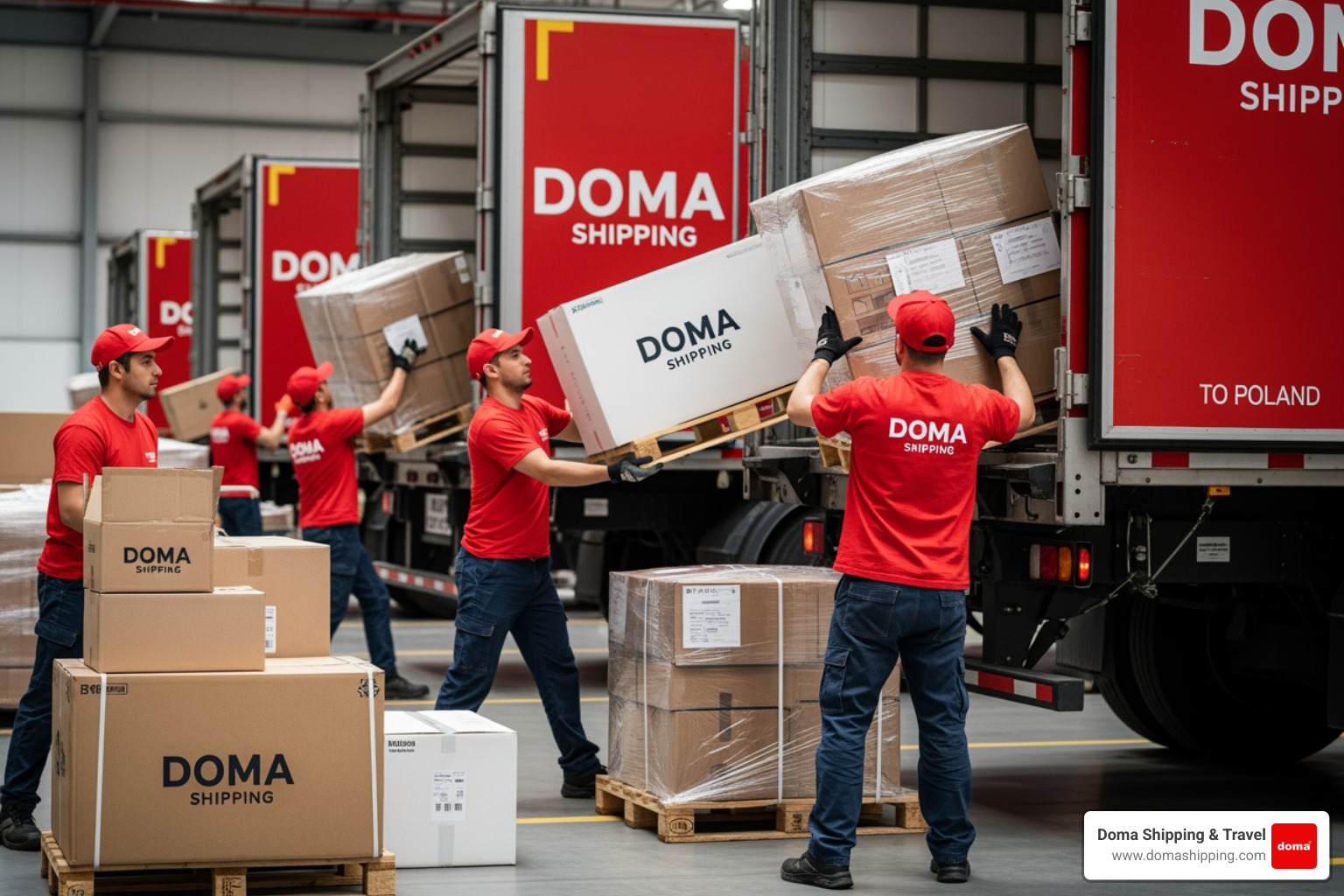
- Palletizing: For larger commercial shipments or multiple boxes, palletizing is essential. Correctly packing and wrapping your goods onto a sturdy pallet ensures stability, facilitates mechanical handling, and often leads to more efficient transport. Palletized shipments are generally more secure and less prone to damage.
- Protecting Fragile Items: Wrap delicate items with at least two layers of bubble wrap. Place heavier items at the bottom of boxes and lighter items towards the center and top. Fill any empty spaces within the box with soft materials like packing peanuts or crumpled paper to prevent items from shifting during transit.
Weight, Dimensions, and Prohibited Items
Understanding the physical parameters of your shipment and what cannot be shipped is vital.
- Actual Weight vs. Volumetric Weight: For air freight, the shipping investment is often determined by the greater of either the actual weight of your package or its volumetric (or dimensional) weight. This method accounts for the space a package occupies in relation to its physical weight, as larger but lighter packages still take up valuable room on an aircraft.
- How to Calculate Dimensional Weight: The formula for calculating dimensional weight varies slightly by carrier and unit of measurement. A common calculation for air shipments is:
- Dimensional Weight {lbs} = L (in) x W (in) x H (in) / 139
- Dimensional Weight {kg} = L (cm) x W (cm) x H (cm) / 5000
- Weight and Size Limitations: While specific limitations can vary, a standard package is typically capped at around 70 lbs. Packages exceeding this (by either actual or dimensional weight) are often classified as cargo shipments, which may involve different handling procedures. For parcels, maximum weight is generally 30 kg for both air and sea, and no single side of a parcel should exceed 1.05 meters (41 inches).
- List of prohibited articles: Certain items are strictly prohibited from entering Poland. These commonly include illegal drugs, firearms, obscene materials, and counterfeit goods. It is crucial to review the comprehensive list to avoid severe penalties.
- Restricted Goods: Other items are restricted, meaning they can enter Poland but are subject to specific quantity limits, special permits, or strict regulations. Examples often include certain food products (like honey or powdered infant milk) and specific animal products. Always verify these restrictions before shipping.
Tracking Your Shipment’s Journey
Once your freight to Poland starts on its journey, staying informed about its progress is reassuring.
- How Tracking Works: We provide comprehensive tracking services that allow you to monitor your shipment from pickup in the U.S. to final delivery in Poland. Using your unique tracking number, you can access real-time updates on its status.
- Tracking Parcels: Our online tracking system offers detailed insights into your shipment’s journey, including its current location, transit milestones, and estimated delivery date.
- Information Provided: You’ll typically receive updates on key events such as departure from the U.S. facility, arrival at the port/airport, customs clearance status, and local delivery progress. For sea freight, this might even include updates on the vessel’s positioning.
- Importance of Shipment Insurance: While we take every precaution to ensure safe transit, unforeseen circumstances can occur. We strongly recommend comprehensive shipment insurance. This protects you against financial losses due to damage, loss, or theft during transit. Carriers typically have limited liability, so robust insurance provides invaluable peace of mind.
Frequently Asked Questions about Shipping to Poland
What documents are essential for shipping from the USA to Poland?
The core documents required for shipping freight to Poland from the USA include a Commercial Invoice (detailing goods, values, and reason for export), a Packing List (itemizing contents), and either a Bill of Lading (for sea freight) or an Air Waybill (for air freight). For businesses, an EORI number for the consignee is mandatory. Depending on the goods, a Certificate of Origin or a Customs Value Declaration (for shipments over €20,000) may also be necessary. For personal effects, meticulous documentation proving residency transfer is critical for potential duty relief.
How are duties and taxes determined for goods imported into Poland?
Duties and taxes for goods imported into Poland are primarily determined by the CIF (Cost, Insurance, and Freight) value of the shipment. This means the assessment is based on the value of the goods plus the insurance and freight charges to bring them to Poland. Shipments with a value exceeding €150 are subject to import duties, with specific rates tied to the Harmonized System (HS) code of the goods. Value Added Tax (VAT) is applicable to all imports, with the standard rate in Poland being 23%, though reduced rates apply to certain products. There is no de minimis threshold for VAT, meaning it applies regardless of value, while the duty de minimis threshold is €150.
What is the difference between shipping personal effects and commercial goods?
The key difference lies in purpose and customs treatment. Personal effects are items owned and used by an individual moving their residence, typically qualifying for duty-free entry if specific conditions (e.g., items owned for over six months, residency transfer) are met and carefully documented. Commercial goods, on the other hand, are imported for sale, business use, or other commercial purposes. These are generally subject to import duties and VAT, require formal customs entry, and for businesses, an EORI number is mandatory. The documentation and clearance processes are typically more extensive for commercial shipments.
Conclusion: Ensuring a Smooth Shipment to Poland
Navigating the complexities of sending freight to Poland from the United States might seem daunting, but with the right approach and an experienced partner, it can be a seamless process. We’ve explored the primary shipping methods—air and sea freight—each offering unique advantages depending on your shipment’s urgency and volume. We’ve also digd into the crucial customs regulations, documentation requirements, and the nuances of duties, taxes, and exemptions that define successful international delivery.
The importance of proper documentation cannot be overstated. An accurate Commercial Invoice, a detailed Packing List, and the correct Bill of Lading or Air Waybill are not just bureaucratic problems; they are the keys to avoiding delays and ensuring compliance. Understanding how duties and VAT are calculated on the CIF value, and recognizing the significance of HS codes and EORI numbers for commercial operations, empowers you to make informed decisions.
Whether you’re moving personal belongings, shipping a vehicle, or expanding your business into Poland’s thriving market, partnering with an experienced freight forwarder is invaluable. With over 30 years of experience, we pride ourselves on providing comprehensive logistics solutions. Our expertise extends beyond transportation to include online shopping assistance, money transfers, and travel booking, ensuring safe and efficient delivery of your most valued possessions.
Let us help you connect with Poland. Explore our International Parcel Shipping services to begin your journey.