Understanding Transatlantic Shipping Logistics
When people ask how much to ship a package from USA to Europe, the right approach is to think in terms of what drives international shipping requirements rather than expecting a single universal answer. International parcels moving from the USA to Poland and other European countries are typically assessed based on the shipment’s weight and dimensions, the destination, the selected service level (economy, standard, or express), and any customs-related fees assessed by the destination country.
What determines the overall scope of your shipment
- Package weight and dimensions (including dimensional/volumetric weight)
- Destination country and delivery area (including potential remote-area delivery considerations)
- Service speed and features (tracking, delivery confirmation, included insurance where applicable)
- Customs duties and import taxes, where assessed by the destination country
- Documentation accuracy (which affects clearance time and the risk of holds)
Customs requirements are often the most intimidating part for first-time shippers. In practice, most delays happen because of incomplete paperwork or unclear item descriptions. Official guidance from U.S. Customs and Border Protection is a helpful reference when preparing international shipments and understanding export-related responsibilities: U.S. Customs and Border Protection.
This guide breaks down the main elements that influence transatlantic shipping planning from the USA to Europe: how to estimate shipment characteristics accurately, how to prepare documentation that supports smooth clearance, and how to select an appropriate service level for your timeline.
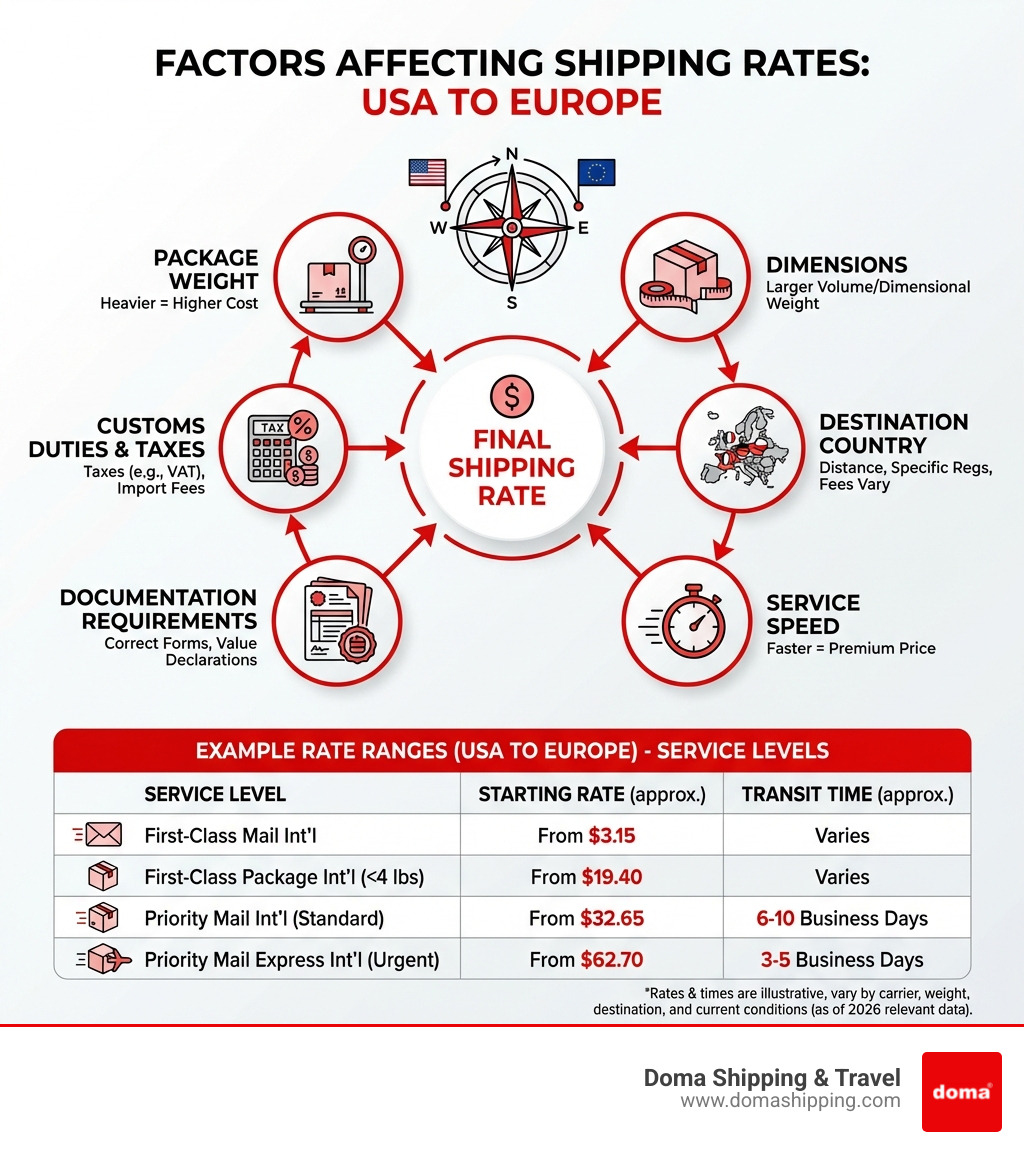
How much to ship a package from usa to europe terms to learn:
Key Factors Determining How to Ship a Package from USA to Europe
When we consider how much to ship a package from USA to Europe, we quickly find that it’s a dynamic equation influenced by several core elements. Understanding these factors is the first step toward planning your international shipment and making informed decisions. The primary influences include the physical characteristics of your package (weight and dimensions), the specific destination within Europe, and the urgency of your delivery.
Weight and Dimensions
The physical attributes of your package – its weight and dimensions – are paramount in determining how your shipment is assessed. Carriers use these measurements to calculate either the actual weight or the dimensional (or volumetric) weight, with the greater of the two being used as the basis for the shipment.
- Actual Weight: This is the measurement you get when you place your package on a scale. We recommend using a reliable postage scale for precision. For larger items, a bathroom scale can be used by weighing yourself with and without the package and subtracting the difference.
- Dimensional Weight: This accounts for the space a package occupies on a truck or airplane. It’s calculated using a formula that considers the package’s length, width, and height. For example, a very light but bulky item might have a higher dimensional weight than its actual weight, leading to a higher shipment classification. To measure accurately, use a tape measure or ruler. Measure the longest side for length, the shorter side for width, and place the ruler vertically for height. Ensure these measurements are taken once the package is fully packed and sealed.
Accurate measurement and weighing are crucial. Incorrect information can lead to unexpected adjustments or delays once your package is in transit. Our goal is to ensure your package is ready for its journey across the Atlantic.
Destination and Distance
Europe is a vast continent, and the specific country – or even region within a country – to which you’re shipping significantly impacts the logistics involved. Factors here include:
- European Zones: International shipping providers often categorize European countries into different zones based on distance, accessibility, and operational considerations. Shipping to a major logistics hub in Western Europe might differ from shipping to a more remote location in Eastern Europe.
- Remote Areas: Deliveries to remote or less accessible areas can involve additional handling requirements. These remote-area considerations reflect the extra time and resources required to reach these locations.
- Logistics Infrastructure: Countries with highly developed logistics infrastructure may offer more efficient international routing options. Conversely, areas with less developed networks might see longer transit windows and additional handling.
The further and more complex the delivery route, the more it will generally influence the overall logistics involved in sending your package from the USA to Europe. For more information on shipping parcels internationally, you can explore our services dedicated to international parcel services.
Navigating International Service Levels and Transit Times
Beyond the physical characteristics of your package and its destination, the speed at which you need your package to arrive, and the service level you choose, are major determinants of how much to ship a package from USA to Europe. Different service tiers offer a spectrum of options, balancing speed with convenience.
Selecting the Right Service for Shipping a Package from USA to Europe
We understand that one size doesn’t fit all when it comes to international shipping. Here’s a look at common service categories:
- Air Freight: This is the fastest and most reliable method for shipping packages internationally. It’s ideal for urgent documents, high-value goods, or time-sensitive merchandise. Air freight typically offers express options with delivery in a matter of days, often within 3-5 business days for express-level services.
- Sea Freight: For larger, heavier, or less time-sensitive shipments, sea freight offers a practical solution. While significantly slower, it’s the preferred method for bulk shipments, furniture, or personal belongings when time is not a critical factor. This is often leveraged for Less Than Container Load (LCL) or Full Container Load (FCL) shipments.
- Standard Parcel Services: These services strike a balance between speed and practicality. They are suitable for many everyday packages, often offering delivery within 6-10 business days. These services frequently include features like tracking and limited insurance.
- Economical Services: For lightweight packages where transit speed is less critical, economy-level options are available for items meeting specific weight thresholds. Delivery times for these services can vary significantly.
When evaluating your options, consider not just the transit speed, but also included tracking, insurance, and the reliability of the delivery network to your specific European destination. At Doma Shipping & Travel, we help you steer these choices to find the service level that best fits your shipment’s requirements.
Transit Time Expectations
Understanding transit times is crucial for planning your international shipment. Here’s what to expect:
- Express Delivery: Typically ranges from 3-5 business days. These options often come with improved tracking and delivery confirmation features, indicating their commitment to speed.
- Standard Delivery: Generally takes 6-10 business days. While reliable, these services do not always have date-certain guarantees.
- Economy Options: Delivery times can vary widely, often ranging from 2-4 weeks, and sometimes even longer (4-6 weeks for some economy options). These are suitable when flexibility on delivery timing is acceptable.
- Sea Freight: This method can take several weeks to a few months, depending on the origin, destination, and shipping route.
- Customs Clearance: All quoted transit times are estimates and do not typically include potential delays at customs. Customs processing can add days or even weeks to the overall delivery schedule, especially during peak seasons or if documentation is incomplete.
- Seasonal Delays: Peak shipping seasons (e.g., holidays) can lead to increased volumes and potential delays across all service levels.
We always advise our clients to factor in potential delays and choose a service that comfortably meets their deadline, rather than cutting it too close.
The Impact of Customs Duties and Documentation on International Shipments
One of the most significant – and often overlooked – components of how much to ship a package from USA to Europe is the complexity associated with customs duties, taxes, and documentation. Navigating international borders requires adherence to specific regulations of both the originating and destination countries.
Documentation Requirements for Shipping a Package from USA to Europe
Accurate and complete documentation is not just a formality; it’s a necessity to ensure smooth transit and avoid delays or additional assessments.
- Electronic Customs Declarations: For almost all international packages, you must prepare customs documentation. This typically involves an electronic customs declaration form, which requires detailed descriptions of the items, their value, and the purpose of the shipment (e.g., gift, sale, personal effects). More-detailed descriptions of contents are now required in all packages sent internationally. Generic descriptions like “clothes” are often insufficient; “men’s cotton shirts, 3 pcs” would be more appropriate.
- Commercial Invoices: For business shipments, a commercial invoice is mandatory. This document provides a detailed record of the transaction, including the seller and buyer information, description of goods, quantity, unit value, total value, and terms of sale.
- Item Descriptions and Value Assessment: Be carefully honest and accurate when declaring the contents and value of your package. Undervaluing items to reduce potential duties is illegal and can lead to severe penalties, including seizure of your shipment.
- Harmonized System (HS) Codes: These are internationally standardized numerical codes for classifying traded products. Including the correct HS code for each item on your customs declaration can help customs officials quickly identify the goods and apply the correct duties and taxes, speeding up the clearance process.
- Country of Origin: You will also need to declare the country where the goods were manufactured. This information is important for trade agreements and duty calculations.
Incomplete or inaccurate documentation is a leading cause of delays and additional complications, as packages may be held in customs until the correct information is provided. We guide our clients through this process to ensure compliance. For more details on shipping to various European destinations, please refer to our International Parcel Shipping Destinations page.
Understanding DDP vs. DDU
When shipping to Europe, you’ll encounter two important terms related to who pays for duties and taxes: Delivered Duty Paid (DDP) and Delivered Duty Unpaid (DDU).
- Delivered Duty Paid (DDP): With DDP, the sender (you) takes responsibility for all obligations, including shipping fees, customs duties, and import taxes, before the package reaches the recipient. This ensures a seamless experience for the recipient, as they won’t be assessed any charges upon delivery. While it increases the sender’s upfront responsibilities, it provides clarity and avoids unexpected fees for the recipient.
- Delivered Duty Unpaid (DDU): In a DDU scenario, the recipient is responsible for paying any customs duties, taxes, and other fees levied by the destination country’s customs authorities. These charges are collected upon arrival or before delivery. The standard customs duty rate can be as high as 32.5% of the item’s value in some cases. However, some countries offer exceptions; for Polish residents, for example, no duties apply to shipments under 45 EUR. If these fees are not paid by the recipient, the package may be held, returned to the sender, or even abandoned.
Choosing between DDP and DDU depends on your relationship with the recipient and your preference for managing obligations. For gifts or items where you want to ensure a hassle-free experience for the receiver, DDP might be preferable. For commercial shipments, the choice often depends on the agreed-upon terms of sale.
It is the sender’s responsibility to know and comply with the customs regulations of the destination country. This includes understanding what can and cannot be shipped (prohibited items) and being aware of any specific import thresholds or duties. Generally, items like flammable materials, pressurized containers, weapons, monetary instruments, and certain food items are prohibited. Specific restrictions can vary significantly by country, so always check the regulations for your exact destination.
Strategic Logistics: Optimizing Large and Specialized Shipments
While individual packages are common, we also specialize in larger, more complex international shipments that require a strategic approach. When considering how much to ship a package from USA to Europe for items like household goods, personal belongings, or even vehicles, the logistics become more intricate, but we ensure a smooth process.
Container Shipping Solutions
For significant volumes of goods, container shipping offers an efficient and secure solution.
- Full Container Load (FCL) Logistics: This option is ideal when you have enough items to fill an entire shipping container. You get exclusive use of the container, which can streamline customs clearance and reduce handling, potentially minimizing transit damage. FCL is highly suitable for large-scale relocations or commercial shipments. You can learn more about this on our Full Container Load Shipping page.
- Less Than Container Load (LCL) Consolidation: If your shipment isn’t large enough to fill an entire container, LCL is an excellent alternative. Your goods are consolidated with other shipments heading to the same region, allowing you to share container space efficiently. This is a practical solution for substantial personal belongings or smaller commercial inventories. Explore our Less Than Container Load Shipping services for more details.
- Overseas Relocation: Moving an entire household across the Atlantic requires meticulous planning. We assist with packing, loading, customs documentation, and delivery, ensuring your transition to Europe is as smooth as possible. This service is often part of our Household & Personal Belongings Shipping offerings.
- Bulk Transport: Beyond household goods, container shipping is essential for transporting large quantities of commercial products, machinery, or other bulk items efficiently.
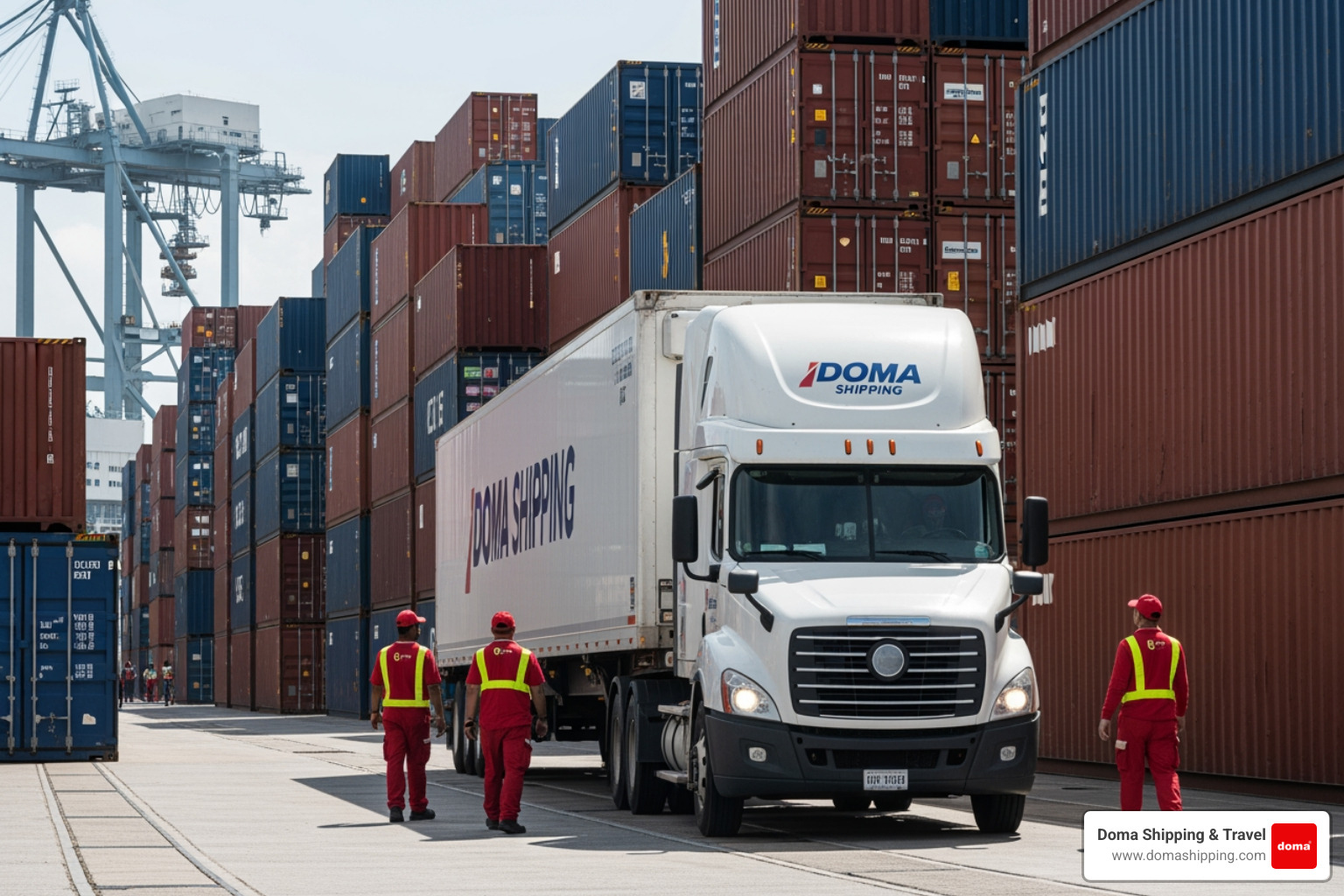
Door-to-Door Logistics
Our comprehensive approach extends to providing seamless door-to-door logistics services, making international shipping convenient and reliable.
- Last-Mile Delivery: We coordinate the entire journey, from pickup at your location in the USA to the final delivery at the recipient’s doorstep in Europe. This includes managing all intermediate steps, such as customs clearance, port handling, and local transportation. Our Door to Door Shipping service embodies this comprehensive approach.
- Warehouse Handling: Our network includes strategically located warehouses in the USA for consolidation, temporary storage, and preparation of shipments destined for Europe. This ensures efficient processing before overseas transit.
- Professional Logistics: With over 30 years of experience, our team of experts manages the complexities of international freight forwarding, providing comprehensive services that cover every aspect of your shipment. This includes online shopping assistance for items purchased in the USA, money transfers, and even travel booking services, all designed to ensure safe and efficient delivery.
Preparing Your Shipment for Safe International Transit
Regardless of whether you’re sending a small package or a full container, proper preparation is critical for safe and successful international transit. This not only protects your items but can also influence the overall efficiency of your shipment and prevent delays.
Measuring and Weighing Accuracy
As we discussed, accurate measurement and weighing are foundational to determining how much to ship a package from USA to Europe.
- Postage Scales: For smaller packages, a digital postage scale provides the most accurate weight, which is essential for correct shipment classification.
- Dimensional Accuracy: Remember to measure the length, width, and height of your fully packed box. Carriers use these dimensions to calculate dimensional weight, which could be the basis for your shipment assessment if it’s greater than the actual weight. Always use a tape measure or ruler to get precise figures.
- Carrier Requirements: Each shipping service may have slightly different rules or calculators for dimensional weight, so it’s always best to have accurate measurements ready.
- Labeling Standards: Ensure your package is clearly labeled with the recipient’s full name, complete address, and contact phone number, as well as your return address. Clear labeling, along with accurate customs forms, minimizes the chance of misdirection or delays.
Prohibited and Restricted Items
Understanding what you can and cannot ship internationally is vital. Regulations vary by country and service provider, but some general categories are universally restricted or prohibited:
- Hazardous Materials: This includes items that are flammable, corrosive, explosive, or radioactive. Examples are aerosols, paints, certain chemicals, and batteries not properly packaged.
- Perishable Goods: Food items, plants, and other perishables often have strict regulations or are outright prohibited due to spoilage risks and potential for introducing pests or diseases.
- Restricted Electronics: Certain electronics, especially those containing lithium-ion batteries, may have specific packaging and labeling requirements or quantity limits.
- Illegal Items: Weapons, illicit drugs, and counterfeit goods are strictly prohibited.
- Monetary Instruments: Cash, gold, and other monetary instruments are generally not allowed.
- Country-Specific Bans: Each European country may have its own unique list of prohibited or restricted items. For instance, some countries might restrict certain types of alcohol, tobacco, or cultural artifacts. Always check the specific regulations for your destination country before shipping.
Failing to comply with these restrictions can lead to your package being seized, returned, or destroyed, often with no recovery of shipping fees. We provide guidance on navigating these complex regulations to ensure your shipment complies with all necessary requirements. For deeper insights into preparing your international shipments, our guide on Shipping Smarter: Everything You Need to Know About International Container Transport offers valuable information.
Frequently Asked Questions about Transatlantic Shipping
Navigating international shipping can raise many questions. Here, we address some of the most common inquiries regarding transatlantic shipping from the USA to Europe.
What factors influence the total assessment of a shipment?
The total assessment of a shipment, which can influence how much to ship a package from USA to Europe, is shaped by several key factors:
- Actual weight and dimensional weight (shipments may be assessed based on whichever is greater).
- Package dimensions (larger packages, even if light, can be assessed at a higher tier due to dimensional weight rules).
- Destination country and delivery area within Europe.
- Chosen international service level (economy, standard, or express) and included features (such as tracking).
- Declared value of the goods and any optional insurance you choose to add.
- Additional services that may apply to international delivery (for example, signature confirmation where available).
- Customs duties and import taxes assessed by the destination country, which may be influenced by the item type and declared value.
How do customs duties affect European deliveries?
Customs duties and import taxes can be a substantial part of the total obligations associated with shipping from the USA to Europe. These are fees levied by the destination country’s government on imported goods.
- Calculation: Duties and taxes are generally determined by the destination country based on the declared value of the goods and their classification.
- Thresholds: Many countries have de minimis thresholds below which duties and taxes may not apply. These thresholds vary by country and by the type of goods.
- Who Pays: Whether the sender or recipient pays depends on the Incoterms used (DDP or DDU). In DDU shipments, the recipient is typically contacted to pay the assessed charges before delivery can be completed.
- HS Codes: Harmonized System (HS) Codes help customs authorities classify goods and apply the appropriate duty/tax treatment. Using accurate HS codes can support smoother clearance.
Understanding these obligations beforehand helps reduce surprises and supports a smoother delivery process.
What are the typical transit times for transatlantic shipping?
Typical transit times for shipping from the USA to Europe vary significantly based on the chosen service level and shipping method:
- Express air services: Often delivered in a matter of business days, depending on the origin, destination, and clearance process.
- Standard air parcel services: Commonly delivered within a broader business-day window that depends on the lane, service tier, and local delivery network.
- Economy international options: Delivery windows can be longer and less predictable, particularly during peak periods.
- Sea freight: The slowest method but appropriate for larger shipments, with transit commonly ranging from several weeks to longer depending on routing.
These are estimated transit times and do not account for potential delays at customs, which can add additional days or weeks to the overall delivery schedule. Factors like weather, peak shipping seasons, and national holidays can also influence actual delivery timelines.
Conclusion
Understanding how much to ship a package from USA to Europe is a multi-faceted challenge, but with the right knowledge and a trusted logistics partner, it becomes a manageable process. From the moment you measure your package to its final delivery, every step contributes to the overall planning and efficiency of your international shipment.
We have explored the critical factors that influence shipping logistics, including package weight and dimensions, destination specifics, and your chosen service level. We’ve also explored the intricacies of customs duties, taxes, and the essential documentation required to ensure your package clears borders smoothly. For larger needs, we highlighted how container shipping solutions and comprehensive door-to-door logistics can simplify complex moves.
With over 30 years of experience in international logistics and freight forwarding, Doma Shipping & Travel is dedicated to providing comprehensive services for shipping from the USA to Poland and other European countries. We offer specialized solutions for international parcel shipping, Less Than Container Load (LCL) and Full Container Load (FCL) shipping, household and personal belongings shipping, and even vehicle transport. Our expertise ensures that whether you’re sending a small gift or an entire household, your items are handled with care and delivered efficiently.
We are committed to making your transatlantic shipping experience as clear and straightforward as possible. For detailed information on how we can assist with your specific shipping needs to Europe, please visit our International Parcel Shipping page.