Why Sending Packages to Europe Matters for Thousands of Americans
Whether you’re send a package to europe from usa for family gifts, business shipments, or personal belongings, you’re not alone. Thousands of Americans steer this process every year, and while it might seem complex at first, the right approach makes it straightforward.
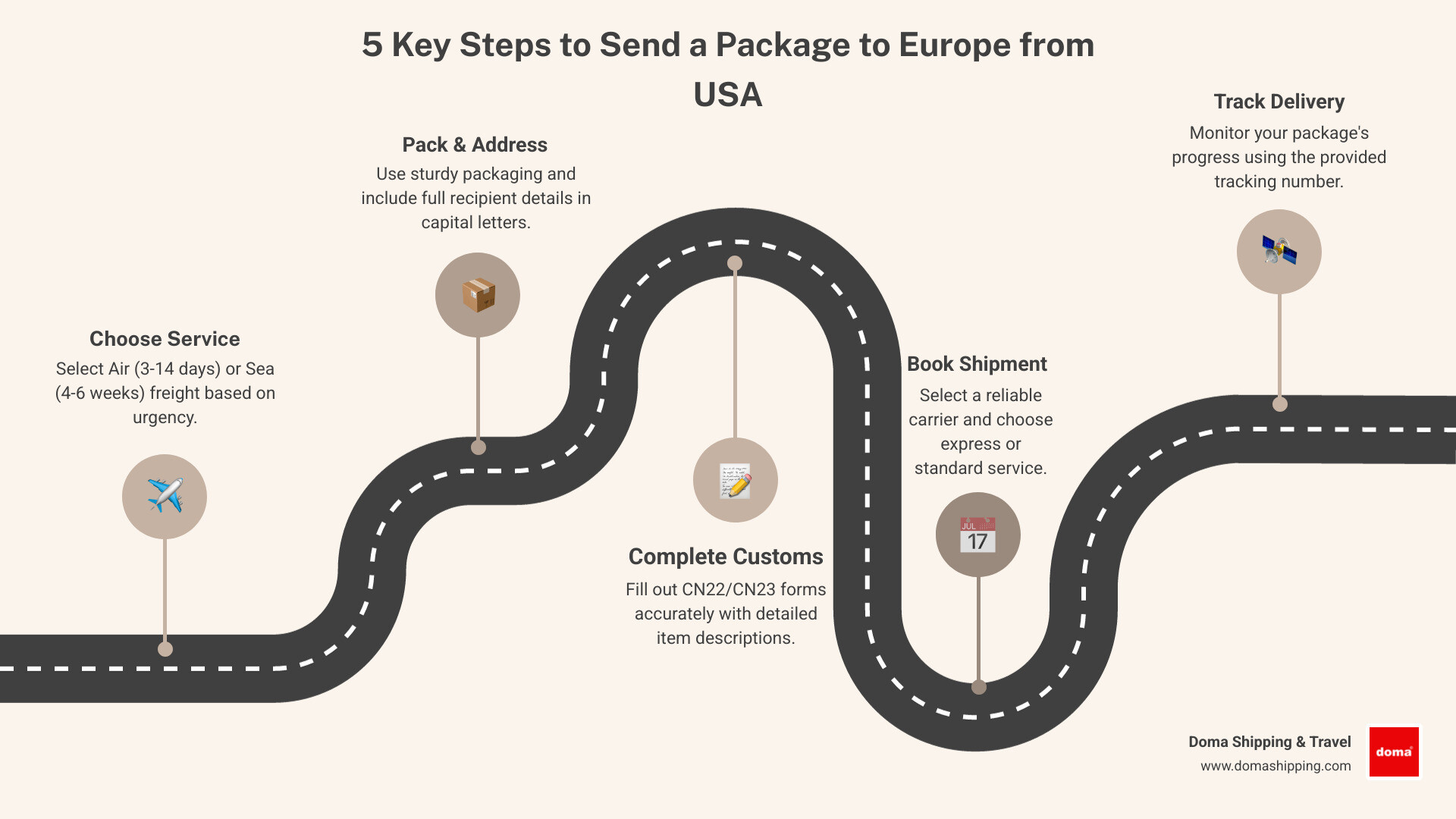
Quick Answer: How to Send a Package to Europe from the USA
- Choose your shipping method – Air freight (3-14 days) or sea freight (4-6 weeks)
- Pack your items properly – Use sturdy boxes, bubble wrap, and strong tape
- Address your package correctly – Include full recipient details in capital letters
- Complete customs documentation – Fill out CN22/CN23 forms with accurate item descriptions
- Book with a reliable carrier – Select express or standard service based on your timeline
- Track your shipment – Monitor progress using your tracking number
The reality is that international shipping has become more accessible than ever. You don’t need to be a logistics expert to successfully send packages across the Atlantic. What you do need is a clear understanding of the basics: packaging requirements, customs procedures, and documentation.
The challenges are real. Customs forms can feel overwhelming. Addressing formats differ from domestic mail. And the fear of your package getting lost or damaged is valid. But these obstacles become manageable when you know what to expect.
This guide breaks down the entire process into simple, actionable steps. You’ll learn how to choose between air and sea freight, prepare your package to survive the journey, steer customs without headaches, and track your shipment every step of the way.
Whether you’re shipping a birthday present to relatives in Poland, sending business samples to clients in Germany, or relocating personal belongings to your new European home, the fundamentals remain the same.
Understanding Your Shipping Options: Speed and Method
When you decide to send a package to Europe from USA, one of the first decisions you’ll face is selecting the right shipping method. This choice largely depends on two critical factors: how quickly your package needs to arrive and the nature of its contents. We offer a range of services designed to meet diverse needs, from urgent express deliveries to more economical options for less time-sensitive shipments.
Our comprehensive services include both air and sea freight, each with distinct advantages. Understanding these options is key to making an informed decision that aligns with your timeline and budget. For more detailed information on these methods, we invite you to explore our Sea and Air Parcels page.
Choosing Between Air and Sea Freight
The choice between air and sea freight fundamentally impacts the delivery timeframe and the overall investment for your shipment.
Air Freight: This method is the fastest and often the most reliable way to send a package to Europe from USA. It’s ideal for urgent documents, high-value items, or perishable goods where speed is paramount. Air freight ensures your package reaches its European destination much quicker, often within days. While it generally involves a higher service charge, the expedited delivery and improved security can be invaluable for certain shipments.
Sea Freight: For larger, heavier, or less time-sensitive shipments, sea freight presents a more economic solution. Shipping to Europe by sea is not as fast as air freight, but it significantly reduces the financial considerations, especially for bulkier items. This option is particularly well-suited for individuals relocating personal belongings, businesses shipping large inventories, or anyone looking for a more budget-conscious approach. We facilitate both Less Than Container Load Shipping (LCL) for smaller volumes that don’t fill an entire container, and Full Container Load Shipping (FCL) for substantial shipments, providing flexibility for various needs.
Express vs. Standard Delivery
Beyond the mode of transport, you’ll also choose a service level: express or standard.
- Express Delivery: If your package needs to reach Europe swiftly, express services are your best bet. These services prioritize speed, often utilizing air freight, and can deliver your package in as little as a few business days, typically ranging from 3 to 7 business days. This option is perfect for last-minute gifts, critical business documents, or time-sensitive samples.
- Standard Delivery: For shipments where a few extra days won’t make a difference, standard services offer a balanced approach between speed and service charges. Standard packages are generally expected to arrive in 7 to 14 business days on average. This is a popular choice for many personal and commercial shipments.
- Sea Shipping: For the most economical solution, particularly for large volumes, sea shipping typically takes 4 to 6 weeks. While this is the longest transit time, it represents a significant value proposition for non-urgent, heavy, or bulky items.
The delivery times can vary slightly depending on the specific European destination and the chosen service provider. However, these general timeframes provide a solid expectation for planning your international shipment.
Preparing Your Package for a Safe Journey
Ensuring your package is properly prepared is a crucial step to guarantee its safe arrival when you send a package to Europe from USA. The journey across the Atlantic and through various logistics networks can be demanding, so robust packaging is not just a recommendation—it’s a necessity.
We always advise packaging your items as if you were to receive them yourself, prioritizing protection against potential impacts, moisture, and handling during transit. Our experience in shipping household and personal belongings underscores the importance of this step. For comprehensive guidance on preparing various items, refer to our Shipping Household and Personal Belongings information.
Here’s how to safeguard your shipment:
- Packaging Materials: Always use high-quality, durable boxes or padded envelopes that haven’t been used before. Old boxes can lose their structural integrity, increasing the risk of damage. For rigidity and protection, thick cardboard boxes are highly recommended.
- Securing Fragile Items: For anything delicate, generous use of cushioning materials is essential. Secure fragile items with bubble wrap, ensuring multiple layers, and use foam inserts or packing peanuts to fill any empty spaces within the box. This prevents items from shifting and absorbing impacts.
- Sealing the Box: Once packed, wrap the closed box with high-strength adhesive packing tape. Seal all seams thoroughly to prevent accidental opening and protect contents from dust or moisture. Consider using water-repellent film for an extra layer of protection against environmental factors.
For additional tips on preparing international shipments, you can consult resources like How to Send a Package: International .
How to Properly Address Your Package for Europe
Correct addressing is paramount for timely delivery to Europe. International address formats can differ from what you’re accustomed to in the USA, so attention to detail is vital.
- Recipient Address Format: Generally, the delivery address should be written clearly in English, typically in the center of the label or package. Include the recipient’s full name (or company name), complete street address, city, subdivision (like province, state, or county), postal code, and the country on separate lines. Optionally, you can include a translation in the local language after each line, which can further aid local postal services.
- Sender Return Address: Your return address in the USA should be printed clearly in the top-left corner of the package. This should include your full name (or company name), apartment or suite number, full street address, City, State, ZIP+4 Code, and “USA” on separate lines.
- Clarity is Key: Print all addresses neatly in capital letters using a pen or permanent marker. It’s a common international shipping practice to avoid commas or periods within the address lines to prevent misinterpretation by automated sorting systems.
- Country-Specific Formats: Many European countries use different address formats; for example, the postal code might go before the city. To ensure accuracy, you can get specific information about other countries’ postal addresses by going to the Universal Postal Union and clicking “Postal Addressing Systems (PAS).”. This resource is invaluable for navigating the nuances of international addressing. For more general guidelines, refer to International Address Format Tips.
- Inside the Package: As a best practice, always write the recipient’s full name and address on a piece of paper and place it inside your package. This serves as a backup in case the external label becomes damaged or unreadable.
Navigating Customs: Documentation and Regulations
Customs procedures are often seen as the most daunting aspect of how to send a package to Europe from USA. However, with proper preparation and accurate documentation, this process can be smooth and efficient. Customs establishments regulate all shipments according to national laws, ensuring goods comply with import regulations and that applicable duties and taxes are collected.

The core of customs compliance lies in your documentation. You will need to prepare an electronic customs declaration form, such as a CN22 or CN23, depending on the value and contents of your package. For business shipments, a commercial invoice detailing the value of the goods is also mandatory. These forms require precise information, including detailed item descriptions, their declared value, purpose (e.g., gift, sale, sample), and the country of origin. For commercial goods, including Harmonized System (HS) Codes can further streamline the process.
It’s also critical to be aware of prohibited items and restricted items. These vary by destination country within Europe. Common prohibited items often include alcohol and tobacco, explosives, flammables, certain prescription medications, and perishable goods. Always check the specific prohibited goods list for your destination country to avoid delays, confiscation, or fines.
Understanding Duties, Taxes, and Delivery Terms
When you send a package to Europe from USA, your shipment may be subject to various import fees, including Value Added Tax (VAT) and import duties. These fees are determined by the destination country, the type of goods, and their declared value.
For instance, the standard rate for duties and taxes can be significant, often around 32.5% of the item’s value. However, some exceptions exist; for example, for Polish residents, no duties apply to shipments under 45 EUR. These thresholds, often called “de minimis” values, vary by country and can impact whether duties are levied.
You’ll also encounter terms like DDP (Delivered Duty Paid) and DDU (Delivered Duty Unpaid), which dictate who is responsible for paying these fees:
- DDP (Delivered Duty Paid): With DDP, the sender (you) pays all applicable duties and taxes upfront. This ensures the recipient receives the package without any unexpected charges or delays, providing a seamless delivery experience.
- DDU (Delivered Duty Unpaid): With DDU, the recipient is responsible for paying any duties and taxes upon the package’s arrival in Europe. While this can sometimes present a lower upfront investment for the sender, it can lead to delays if the recipient is unaware of the charges or unable to pay them promptly.
Choosing the right option depends on your preference and the recipient’s ability to handle potential charges. For those relocating personal property, specific regulations may allow for exemptions from duties and taxes. Our services for Relocating personal property to avoid duties can provide further assistance in this area.
Completing Your Customs Declaration
Accuracy is paramount when completing your customs declaration. Any discrepancies or vague descriptions can lead to significant delays, additional inspections, or even the return of your package.
- Electronic Forms: Most carriers now prefer or require electronic customs declarations. These forms prompt you for all necessary information, helping to ensure completeness.
- Detailed Descriptions: Instead of a generic term like “clothes,” specify “3 cotton t-shirts, new” or “1 pair of used leather shoes.” Clearly state the quantity, material, and condition (new or used) of each item.
- Declared Value: Accurately declare the value of your goods. Under-declaring can result in penalties, while over-declaring can lead to higher duties for the recipient.
- Harmonized System (HS) Codes: For business shipments, including the correct HS Codes is highly recommended. These international codes classify products, making customs processing more efficient.
- Avoiding Delays: Providing accurate and complete information upfront is the best way to ensure hassle-free customs clearance and avoid unnecessary delays. Many online tools are available to help with this process. For example, you can use resources that assist with filling out customs forms, including guidance on writing detailed item descriptions required by international customs rules.
How to send a package to europe from usa: A Step-by-Step Guide
Successfully sending a package to Europe from the USA involves a methodical approach. By following these steps, you can ensure a smooth and efficient process, from preparation to delivery. Our goal is to simplify international logistics, making it straightforward for you to connect with recipients across the Atlantic.
This section provides a summary of the entire process, guiding you through how to choose a reliable carrier, book your shipment, and monitor its journey.
Step 1: Determine Your Shipment Details
Before anything else, gather all the essential information about your package. This forms the foundation of your shipping plan.
- Package Weight and Dimensions: Accurately measure the weight and dimensions (length, width, height) of your fully packed box. These figures are critical as they directly influence the shipping rates and the types of services available.
- Destination Country: Clearly identify the specific European country and city you are shipping to. Different countries have varying regulations, transit times, and service charges.
- Service Type: Consider whether you need express air freight for urgent delivery or a more economical sea freight option for less time-sensitive items. This choice will shape the rest of your shipping decisions.
Once you have these details, you can use our online calculator for a shipment quote. This tool provides an estimate of your shipping expenses based on your specific requirements.
Step 2: Book Your Shipment and Prepare Documents
With your shipment details in hand, it’s time to book your service and get your paperwork in order.
- Online Booking: Our online portal allows you to conveniently register your shipment, select your preferred service, and arrange payment.
- Printing Labels: Once booked, you’ll be able to print your shipping labels and any necessary customs forms directly from our portal. Ensure these are securely attached to your package, facing outwards.
- Attaching Customs Forms: As discussed, accuracy on customs forms is vital. Double-check all details before attaching them.
- Arranging Pickup or Drop-off: We offer flexible options for getting your package into our system. You can register your parcels online and then drop them off at one of our convenient locations in the Chicago area, including Melrose Park, Mount Prospect, Algonquin, Niles, and Park Ridge. Alternatively, for added convenience, we offer options for package pickup from home in many areas, allowing us to collect your package directly from your doorstep.
Step 3: Track Your Shipment to its Destination
Once your package is on its way, staying informed about its journey provides peace of mind.
- Tracking Number: Upon booking, you will receive a unique tracking number. This number is your key to monitoring your package’s progress.
- Real-time Updates: Use our dedicated tracking portal to receive real-time updates on your shipment’s status. You can see when it leaves the USA, passes through customs, and moves through the European logistics network.
- Estimated Delivery Date: The tracking system will also provide an estimated delivery date, allowing you and your recipient to anticipate its arrival.
You can easily track your international parcel using our online tools.
Frequently Asked Questions about Shipping to Europe
We understand that sending packages internationally can raise many questions. Here, we address some of the most common inquiries about how to send a package to Europe from USA.
How long does it take to send a package to Europe from the USA?
The delivery timeframe for a package sent from the USA to Europe depends heavily on the chosen shipping method and service level:
- Express Services: For urgent shipments, express air freight typically delivers within 3 to 7 business days. This is the fastest option for those needing prompt delivery.
- Standard Services: A more balanced option, standard air freight usually takes between 7 to 14 business days. This is a common choice for many personal and commercial parcels.
- Sea Freight: For larger, heavier, or non-urgent shipments, sea freight is the most economical choice, with transit times ranging from 4 to 6 weeks.
These are average estimates, and actual delivery times can vary based on the specific European destination, customs processing times, and unforeseen logistical circumstances.
What documentation is required to send a package to Europe from the USA?
To ensure your package clears customs smoothly, several key documents are required:
- Customs Declaration Form (CN22/CN23): This is mandatory for all international shipments and details the contents, value, and purpose of your package.
- Commercial Invoice: For business-related shipments (e.g., goods for sale, samples), a commercial invoice is essential. It provides a detailed breakdown of the transaction.
- Detailed Item Description: On your customs forms, provide clear, specific, and accurate descriptions of each item, including quantity and material. Vague descriptions can lead to delays.
- Value and Quantity: Accurately declare the monetary value and exact quantity of each item in your package.
- Harmonized System (HS) Codes: For commercial goods, including the relevant HS Codes can significantly expedite customs clearance.
Accurate and complete documentation is crucial to avoid delays and ensure your package reaches its destination without complications.
How does shipment insurance work for European deliveries?
Shipment insurance provides vital protection for your package against loss, damage, or theft during its international journey. While we take every precaution to ensure safe delivery, unforeseen events can occur.
- Coverage: Insurance coverage is typically based on the declared value of your items. It’s designed to reimburse you for the financial value of the goods should they be lost or damaged in transit.
- Included Coverage: Some basic insurance coverage may be included with certain services, often up to a specific value (e.g., $60). This provides a baseline of protection for most shipments.
- Additional Coverage: For higher-value items or peace of mind, additional insurance can be purchased. This typically involves a small percentage of the declared value (e.g., +5% of the value), offering extended protection for your valuable goods.
- Claim Process: In the unfortunate event of loss or damage, a claim process is initiated with the shipping provider. Having accurate documentation, including proof of value and detailed item descriptions, is essential for a successful claim.
We recommend considering additional insurance, especially for fragile or high-value items, to fully protect your investment when you send a package to Europe from USA.
Conclusion: Ship to Europe with Confidence
Navigating the complexities of international shipping to send a package to Europe from USA might seem challenging at first, but with the right knowledge and a reliable partner, it becomes a straightforward process. We’ve walked through the essential steps, from choosing the appropriate shipping method and carefully preparing your package to mastering customs documentation and understanding tracking.
The key takeaways are clear: thoughtful preparation, accurate paperwork, and an informed choice of service are your best allies. Whether you opt for the speed of air freight or the economic advantages of sea freight, understanding these elements ensures a smoother journey for your parcels.
At Doma Shipping & Travel, with over 30 years of experience, we are dedicated to providing comprehensive and trustworthy international logistics services. We understand the nuances of shipping from the USA to Europe, particularly to Poland and other European countries, and are here to guide you every step of the way. Our commitment to safe and efficient delivery, combined with our expertise in overseas logistics and customs handling, ensures your packages arrive securely.
Ready to connect across the Atlantic? Begin your international parcel shipment with us today, and experience the confidence that comes with expert international shipping.