
How long time send a package from USA to Europe depends on your shipping method and destination. Whether you’re sending gifts to family in Poland, shipping personal belongings overseas, or fulfilling business orders, knowing what to expect helps you plan better and set realistic expectations.
Quick Answer: USA to Europe Shipping Times
Most people find international shipping confusing. You’re not alone if you’ve wondered whether your package will take days or weeks to arrive. The answer isn’t simple because multiple factors affect delivery speed—from the shipping method you choose to how quickly customs processes your package.
The good news? Once you understand the basics, you can make informed decisions about how to ship your items. Express services get packages there faster but work differently than economy options. Air freight moves quickly while sea freight takes longer but handles larger shipments. Your destination country matters too—shipping to major European cities typically goes faster than rural areas.
This guide breaks down everything that affects how long your package takes to reach Europe from the USA. You’ll learn about different shipping methods, what slows packages down, and how to prepare your shipment for the smoothest possible journey.
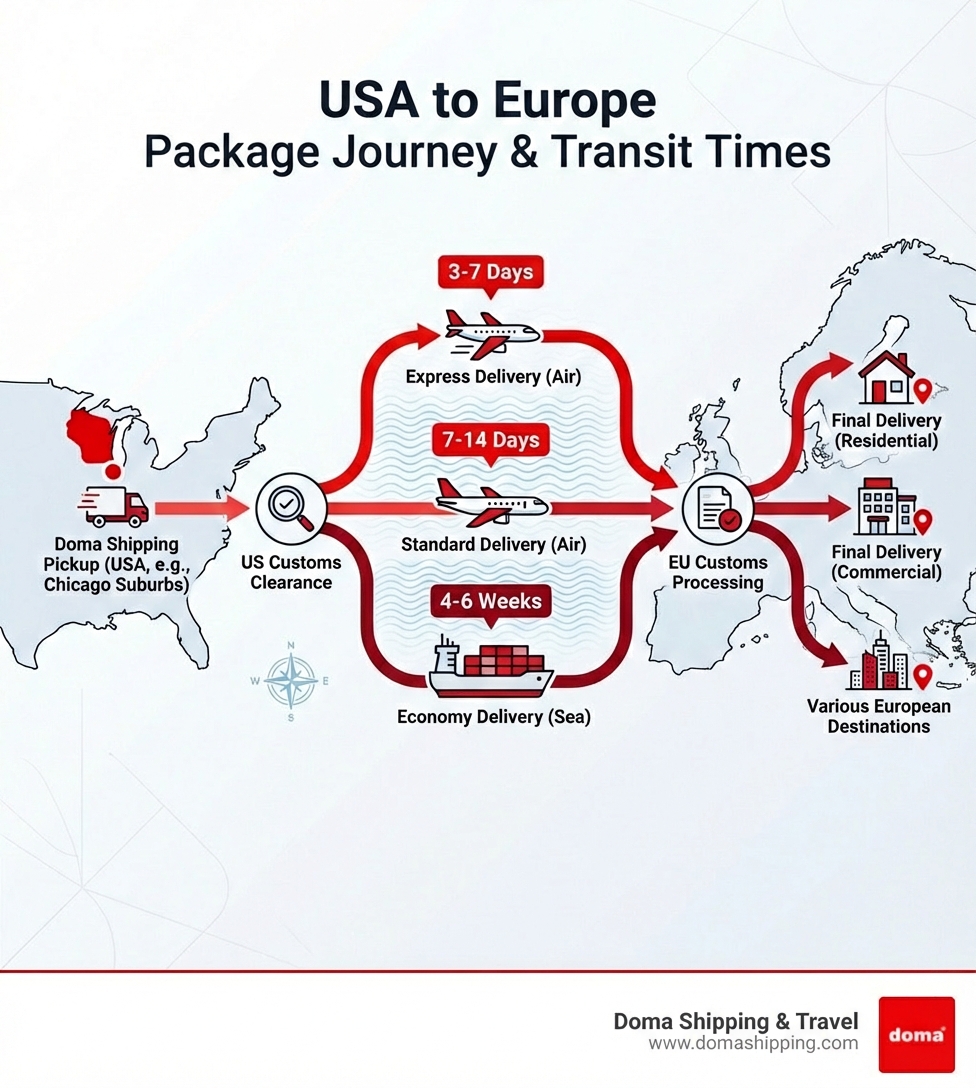
When considering how long time send a package from USA to Europe, the primary determinant is the shipping method you select. Doma Shipping & Travel offers various services designed to meet different needs for speed and capacity, from urgent documents to large cargo. Understanding these options is crucial for planning your international shipment effectively.
Generally, international shipping methods fall into two main categories: air freight and sea freight. Within these, there are often express and economy options, further refining the delivery timeline.
These are average estimates, and the actual time can fluctuate based on specific routes, destination countries, and unforeseen delays.
Choosing between air and sea freight involves weighing speed against volume and the nature of your shipment. Both methods have distinct advantages, and understanding them helps Doma Shipping & Travel recommend the best fit for your needs.
| Feature | Air Freight | Sea Freight |
|---|---|---|
| Speed | Fast (3-14 business days) | Longer (4-6 weeks) |
| Typical Use Case | Urgent documents, small packages, high-value items, time-sensitive goods | Large cargo, personal belongings, bulk shipments, non-perishable goods |
| Volume Suitability | Smaller, lighter packages | Larger, heavier, or bulkier shipments |
Air freight is often the preferred method for parcels requiring swift delivery. Its speed makes it suitable for anything that needs to reach its European destination within a few days or weeks. However, air cargo space is limited, and its logistics are optimized for speed, which means it works best for smaller, individual packages or less voluminous shipments.
Sea freight, on the other hand, is the workhorse of international logistics. While it requires patience due to longer transit times, its capacity is significant, making it a strong option for shipping large quantities of goods, vehicles, or full container loads (FCL) and less than container load (LCL) shipments. If you’re moving household items or arranging large commercial deliveries, sea freight provides a structured and reliable solution.
The distinction between express and standard delivery options primarily applies to air freight services, offering different tiers of speed to match your urgency.
The choice between express and standard often comes down to your specific needs. If you have a clear deadline or a time-sensitive item, express is usually the more appropriate option. If you are looking for a dependable service without the highest priority tag, standard delivery offers a sound solution. Regardless of the option you choose, Doma Shipping & Travel focuses on careful handling and efficient international delivery. You can find More info about international shipping services on the company website.
While Doma Shipping & Travel strives for consistent and timely deliveries, several external factors can influence how long time send a package from USA to Europe. Understanding these elements helps manage expectations and proactively address potential issues.

The journey of an international package is complex, involving multiple checkpoints and processes. From the moment your package leaves a Doma Shipping & Travel facility in the Chicago area to its final destination in Europe, its speed can be affected by:
Doma Shipping & Travel carefully prepares every shipment to help minimize the impact of these factors, but some are beyond direct control. More than 30 years of experience in international logistics allows the team to anticipate and steer these challenges effectively.
Customs clearance is an unavoidable and critical step in any international shipment. It is where government authorities inspect packages to ensure compliance with import regulations, assess duties and taxes, and check for prohibited items. This process significantly influences the overall delivery time for your package from the USA to Europe.
When your package arrives at a European border, it undergoes a customs inspection. This involves:
An efficient customs process relies on complete and accurate documentation. Doma Shipping & Travel guides you through preparing all necessary paperwork, including Harmonized System (HS) Codes for proper classification, to support a smooth transition through customs. The door-to-door shipping service means the company manages this complex process for you, from pickup in the USA to final delivery in Europe, aiming for a seamless Door to Door Shipping.
The specific European country your package is headed to also plays a significant role in how long time send a package from USA to Europe. Europe is a vast continent with diverse logistical infrastructures and regulations.
Doma Shipping & Travel has extensive experience shipping to various European destinations, particularly Poland, where specialized services for Zakupy w USA i wysyłka do Polski mean the team understands the local logistics in detail. This allows the company to address country-specific challenges and support efficient delivery speeds.
Proper preparation is not just about protecting your items; it is a critical step in supporting efficient and timely international delivery. When discussing how long time send a package from USA to Europe, the way a package is prepared can significantly impact its journey. A well-prepared shipment is less likely to encounter delays due to damage or incorrect documentation.
Decades of international logistics experience have shown that attention to detail in packaging and documentation can save valuable time and prevent complications. Doma Shipping & Travel guides clients through these essential steps, ensuring their packages are ready for the rigors of international travel.
The physical integrity of your package and the accuracy of its accompanying paperwork are two sides of the same coin when it comes to timely international delivery.
Proper Packaging:
Accurate Documentation:
Proper packaging protects your goods from external factors, while accurate documentation helps them move smoothly through customs. For more general guidance on addressing, you might find external resources helpful, such as Tips for addressing international mail.
A correctly addressed package is fundamental to ensuring your shipment reaches its European destination without delay. Even a small error can lead to misrouting or returns, adding significant time to the delivery process.
Here is what you need to know for correctly addressing your international package:
Doma Shipping & Travel services for Paczki morskie i lotnicze do Polski mean the team is familiar with addressing nuances for shipments to Poland and other European nations, helping to prevent common addressing errors.
International parcel shipping often raises questions, especially regarding transit times. Below are answers to some of the most common inquiries about how long time send a package from USA to Europe.
Getting an estimate for your specific shipment is important for planning. While general guidelines exist, the exact delivery time depends on the details of your package and destination.
Use Shipping Calculators: An effective way to get an estimate is to use an online shipping calculator. You will need to provide key details:
Based on these inputs, you will receive an estimated transit time that reflects established routes and service levels.
Consult with Doma Shipping & Travel experts: For complex or unique shipments, or if you have specific concerns, you can contact the Doma Shipping & Travel team directly. With over 30 years of experience, they can provide informed guidance and more precise expectations, especially for larger shipments like containers or vehicles.
Track Your Package: Once your package is en route, you can monitor its progress using the company’s tracking system. While tracking does not change the delivery time, it provides updates and helps you anticipate its arrival. You can access tracking services at Tracking paczek.
Even with careful preparation, international shipping can encounter unforeseen delays. Being aware of these potential issues helps in setting realistic expectations.
While Doma Shipping & Travel works diligently to mitigate these risks, some factors are beyond operational control. The Sledzenie paczki service allows you to monitor your package’s journey and stay informed of any potential delays.
Yes, delivery times can vary across different European countries, even with the same shipping method. This is due to a combination of geographical, infrastructural, and regulatory factors.
Doma Shipping & Travel’s expertise in shipping to Poland and across Europe means the team is familiar with these regional differences. Established networks and local partnerships are used to support efficient international delivery, regardless of the specific European destination.
Understanding how long time send a package from USA to Europe involves several factors, but it becomes manageable with the right logistics support. The key takeaways from this guide are clear: planning ahead, careful preparation, and choosing the appropriate shipping service are essential for a smooth and timely international delivery.
This article explored how different shipping methods—from express air freight to economy sea freight—influence transit times, and how important elements like customs clearance, destination country specifics, and the accuracy of your packaging and documentation can affect the journey. It also outlined potential delays and how to obtain realistic time estimates for your specific shipment.
Doma Shipping & Travel is an experienced partner for international logistics. With over 30 years of experience, the company specializes in comprehensive international shipping services from the USA to Poland and the broader European continent. Whether you’re sending individual packages, container loads, vehicles, or personal belongings, Doma Shipping & Travel offers structured services designed to support safe and efficient delivery. The presence in the Chicago area, including locations like Niles, Melrose Park, Mount Prospect, Palos Hills, Algonquin, Park Ridge, Des Plaines, Glenview, Franklin Park, Schiller Park, Bensenville, Schaumburg, and Roselle, allows the team to serve the surrounding communities with focus on international needs.
Doma Shipping & Travel manages the complexities of international logistics, customs processing, and delivery so you can concentrate on what matters most at your destination. The goal is to make your international shipping experience as straightforward and well-organized as possible.
When you are ready to send your next package or shipment from the USA to Europe, you can start the process and let Doma Shipping & Travel guide you through every step. Begin your international parcel shipment today and make use of the company’s long-standing experience in overseas logistics.