Why Finding the Best International Shipping Matters for Your Business
Best international shipping from the USA to Europe is not about chasing the lowest possible rates. It is about choosing a carrier and service level that align with your priorities for speed, reliability, customs compliance, and network coverage between your U.S. origin and your customers in Poland and other European countries. Whether you are sending documents, parcels, or full containers overseas, the right partner helps you avoid delays, unnecessary complications, and damaged goods.
Quick Answer: Top Considerations for Best International Shipping
| Factor |
What to Look For |
| Speed |
Express (1-3 days), Standard (5-10 days), or Economy (2-4 weeks) depending on your delivery needs |
| Coverage |
Carrier reliably serves your specific European destination, including regional and remote areas |
| Tracking |
End-to-end, real-time visibility from pickup in the USA to delivery in Europe |
| Customs Support |
Practical help with documentation, duties, and clearance procedures |
| Reliability |
Consistent on-time delivery, careful handling, and clear communication |
International shipping is a major driver of growth for many businesses. The global marketplace continues to expand, opening up new markets and opportunities for companies of all sizes. A significant share of global small and medium-sized enterprises report that a meaningful portion of their revenue comes from international sales. At the same time, many shippers find cross-border logistics challenging. They need to understand customs regulations, choose appropriate services, and ensure that parcels and containers arrive on time and in good condition.
The challenge is not only selecting a carrier. It is also understanding how delivery speed affects your customer experience, how much customs support you require, and whether the service you choose regularly reaches your destination in Europe without disruptions. Different providers and service levels offer varying strengths, so matching those capabilities to your specific shipping profile is essential.
This guide focuses on routes from the USA to Poland and wider Europe. You will learn how to evaluate carriers based on what actually matters for your shipments, understand the critical role of customs documentation, and recognize when working with a freight forwarder brings additional value. Whether you are shipping lightweight parcels or managing Full Container Load Shipping to European ports, you will find practical insights to support more informed international shipping decisions.
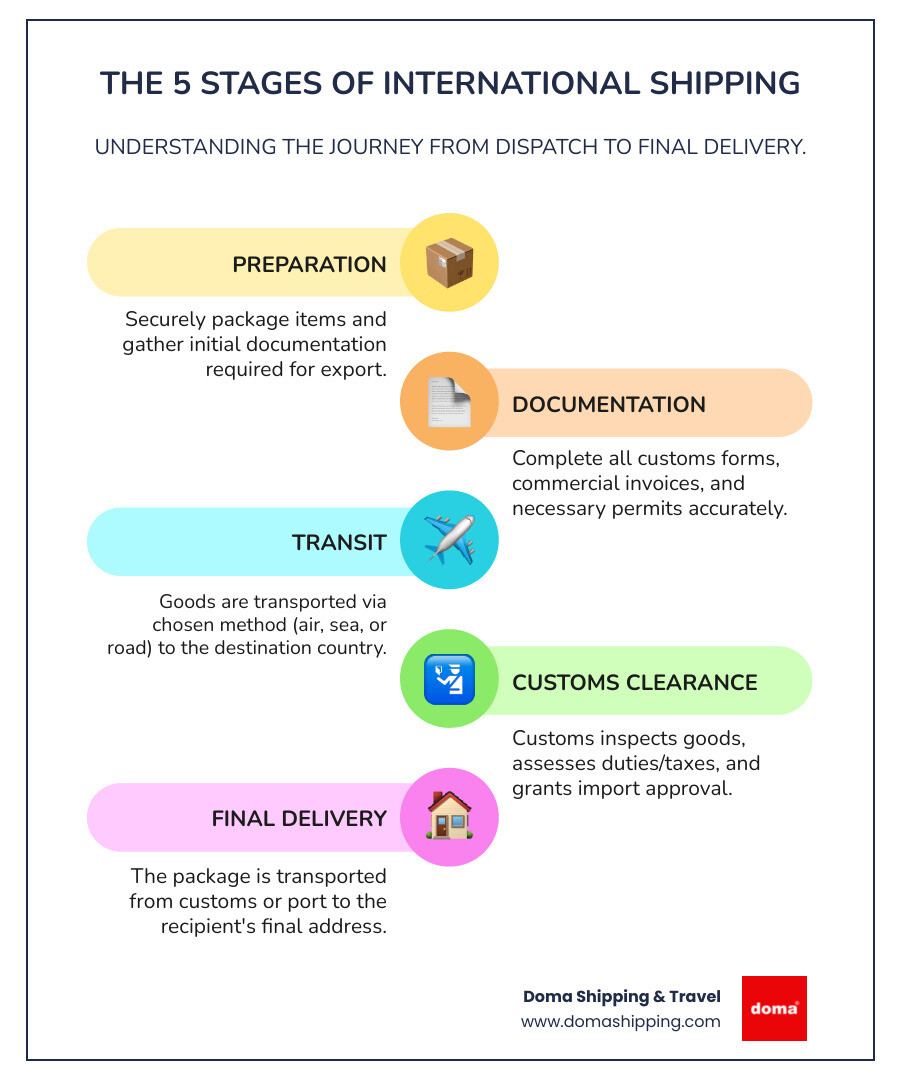
Key Factors in Choosing an International Shipping Partner
When arranging international shipping from the USA to Europe, selecting the right partner is a strategic decision. It is not a one-size-fits-all choice; instead, it requires a careful evaluation of several factors that match your specific shipping objectives. Doma Shipping & Travel applies a comprehensive approach to help ensure that your goods arrive safely, in compliance with regulations, and within the expected timeframe.

The primary considerations include:
- Delivery Speed: How quickly do your parcels or containers need to reach their European destination? This will determine whether you select express, standard, or economy services.
- Global Network Coverage: Does the carrier reliably serve your specific destination in Europe, including both major cities and more remote areas?
- Shipment Tracking & Visibility: Can you monitor your shipment’s journey in real time from the USA to the final destination, enabling proactive communication with recipients?
- Customs Clearance Support: Does the shipping partner assist with the often-complex customs processes, helping to prevent delays and ensure compliance with U.S. export and European import rules?
- Insurance & Liability Options: Are your shipments appropriately protected against loss or damage during international transit?
- Service for Specialized Items: Do you require specific handling for unique items, such as household goods, vehicles, or personal belongings? For instance, shipping Household & Personal Belongings Shipping from the USA to Poland or elsewhere in Europe requires specialized planning and care.
Understanding Service Speed vs. Reliability
The choice between service speed and reliability is central to international shipping. While rapid delivery is often important, it should align with consistent performance and clear communication.
- Express Services: These are designed for urgent shipments, typically aiming for delivery within a few business days on major routes between the USA and Europe. These services are well suited to time-sensitive documents or high-value items where quick arrival supports your business or personal objectives.
- Standard Services: Standard services balance speed and broader suitability, usually with delivery timeframes of about one to two weeks. This option is appropriate for many business-to-consumer (B2C) and business-to-business (B2B) shipments where a moderate transit time is acceptable.
- Economy Services: When urgency is not the primary concern, economy services focus on efficient movement of goods with longer transit times that can extend to several weeks. These options are often chosen for less time-sensitive goods or larger, consolidated shipments.
Regardless of the service speed you choose, reliability remains essential. Actual delivery times can be influenced by origin and destination specifics, weather conditions, peak shipping periods, labor disruptions, and other operational factors. A dependable partner provides transparent communication about potential delays and applies contingency planning to keep your shipments moving.
A robust tracking system is also vital. Comprehensive tracking allows both sender and recipient to follow the shipment’s progress in real time. This visibility supports better customer communication, makes it easier to respond to unexpected events, and helps minimize uncertainty around cross-border deliveries.
Evaluating Carrier Network and Destination Coverage
For international shipping from the USA to Europe, the depth and structure of a carrier’s network are critical. Your shipping partner should effectively reach not only major European hubs, but also specific locations within countries such as Poland.
Carriers with extensive global networks can serve many destinations across Europe, while regional partners bring local expertise. For USA-to-Europe routes, factors such as airport and seaport access, inland connections, and last-mile arrangements all influence delivery performance.
Regional knowledge is a major advantage. When shipping to Europe, success depends not just on reaching the continent, but on efficient transit and reliable delivery within the destination country. Doma Shipping & Travel focuses specifically on facilitating shipments from the USA to Poland and other European nations, coordinating routing, documentation, and local delivery through established logistics partnerships.
For businesses and individuals seeking comprehensive logistics solutions, a provider that offers Door to Door Shipping from the USA to Europe adds significant convenience. This service manages the entire process from pickup at your location in the USA to final delivery at the recipient’s address in Europe, including international transport, customs formalities, and last-mile delivery. This integrated approach simplifies complex international shipments and supports a smoother experience for both senders and receivers.
A Guide to Customs, Duties, and Documentation
Navigating international customs regulations is often the most intricate part of global shipping. For routes from the USA to Europe, careful preparation and accurate documentation are critical to avoiding delays, unexpected charges, and potential penalties.

The role of customs is to control and regulate the flow of goods into and out of a country, ensuring compliance with national laws and collecting applicable duties and taxes.
- Duties vs. Taxes: Duties are fees imposed by customs on imported merchandise, typically based on the item’s value, gross weight, or commodity type. Taxes, such as Value Added Tax (VAT) in Europe, are consumption taxes applied to goods and services. The shipper or recipient can be designated as responsible for applicable duties and fees, depending on the agreed terms.
- Harmonized System (HS) Codes: These are standardized numerical codes used worldwide to classify traded products. Using the correct HS code on your customs forms is essential for accurate duty and tax assessment and for speeding up customs clearance. An incorrect HS code can lead to delays or incorrect charges.
- Delivered Duty Paid (DDP) vs. Delivered Duty Unpaid (DDU):
- DDP (Delivered Duty Paid): Under this arrangement, the sender takes responsibility for international transport and all applicable customs duties, taxes, and import fees. The recipient receives the package without additional customs-related payments at delivery. This can improve the recipient’s experience by eliminating unexpected charges.
- DDU (Delivered Duty Unpaid): In a DDU scenario, the sender arranges transport, but the recipient is responsible for paying import duties, taxes, and customs clearance fees upon arrival. While this may simplify initial arrangements for the sender, it can lead to delays and dissatisfaction if the recipient is unaware of these obligations.
- Required Documents: The foundational documents for most international shipments include:
- Commercial Invoice: This document provides details about the transaction, including the seller and buyer, a description of the goods, quantity, value, and terms of sale. It is crucial for customs valuation.
- CN22/CN23 Forms: These are customs declaration forms required by postal services for international mail. The CN22 is for lower-value items, while the CN23 is for higher-value goods, requiring more detailed information. These forms help customs officials understand the contents of your package.
Ensuring every detail on these forms is accurate and complete is essential. Any discrepancies or omissions can lead to significant delays at customs, potentially holding up your shipment for days or even weeks.
How to Correctly Address International Shipments
Beyond the contents and customs forms, correct addressing of your international shipment is a seemingly simple yet critical detail. Address formats can differ significantly from those used in the USA, and errors can cause misrouting or non-delivery.
- Address Formatting Differences: Many countries use unique address structures. For example, some place the postal code before the city, or include a province or region on a separate line. The Universal Postal Union (UPU) provides detailed information on postal addressing systems for various countries. It is helpful to consult their resources for specific guidance: Universal Postal Union.
- Recipient Information: Always include the recipient’s full legal name or company name. Ambiguous or incomplete names can cause issues, especially for business deliveries.
- Country-Specific Requirements: While general guidelines exist, verify specific requirements for your destination country in Europe. Some countries may require additional identifiers or have strict rules regarding street numbers or building names.
- Following Official Guidelines:
- Print addresses neatly in capital letters using a pen or permanent marker if handwritten.
- Avoid using commas or periods within the address lines to reduce misinterpretation by automated sorting systems.
- The delivery address should be written in English. Including a translation in the local language of the destination country, if known, can assist local postal workers.
- Ensure all necessary components are present: recipient’s full name or company, full street address, city, subdivision (for example, province or county), postal code, and the country name written in full.
- Importance of a Return Address: Always include your complete return address in the top-left corner of the package. This ensures that if, for any reason, the package cannot be delivered, it can be returned to you rather than being lost or disposed of. It is also a good practice to place a duplicate copy of the recipient’s full name and address, along with your return address, inside the package. This can be invaluable if the outer label becomes damaged or unreadable during transit.
Preparing for Shipments to Europe
Shipping from the USA to Europe, particularly to countries within the European Union, involves specific considerations due to harmonized regulations and tax structures. Thoughtful preparation helps your goods move smoothly through ports and customs.
- EU VAT Regulations: For shipments entering the European Union, Value Added Tax (VAT) is a major consideration. Businesses shipping B2C goods into the EU must understand the Import One-Stop Shop (IOSS) scheme for goods up to a defined value threshold, or manage standard VAT procedures for higher-value items. Correctly managing VAT helps avoid delays and reduces the risk that the recipient will face unexpected charges.
- EORI Numbers: If you are a business importing or exporting goods to or from the EU, you will likely need an EORI (Economic Operators Registration and Identification) number. This is a unique identification number used by customs authorities across the EU.
- Specifics for Shipping to Poland: When shipping Parcels by Sea and Air to Poland, it is important to follow Polish customs requirements and understand local delivery networks. Whether you choose the speed of air freight or the extended transit times typical of sea freight, accurate documentation and correct addressing are key.
- Handling Personal Effects: For individuals organizing Relocation to Poland, there are often special customs procedures for “Mienie Przesiedlencze” (relocation property). This can allow certain personal belongings to be imported with specific duty and tax treatment, provided conditions are met, such as proof of residency change and adherence to defined timelines. Doma Shipping & Travel supports clients with Mienie Przesiedlencze from USA to Poland, guiding them through documentation and customs formalities so that household goods are processed correctly.
How to Find the Best International Shipping for Your Needs
Finding the best international shipping solution from the USA to Europe is not about identifying a single universally superior carrier. It is about matching your shipment type, timing, and compliance needs with the right service and logistics partner. This requires a clear understanding of your goods and your expectations for transit time, handling, and customs support.
- Matching Service to Shipment Type: A small, urgent document requires a different solution than a pallet of commercial goods or an entire household moving overseas. Consider the nature of your items: Are they fragile, regulated, or high-value? Do they require special packaging or documentation?
- Evaluating Carrier Expertise: Different providers excel in different lanes and shipment profiles. While global networks handle many express and parcel movements, specialized partners may focus on routes such as USA-to-Europe or on particular cargo types such as vehicles, household goods, or containers.
- The Value of a Logistics Partner: For businesses shipping regularly or individuals managing complex moves, working with an experienced logistics provider such as Doma Shipping & Travel can be highly beneficial. A knowledgeable partner can coordinate transport, documentation, and customs handling, so you can focus on core operations or personal planning.
- Strategies for Efficiency: Proper packaging is not only about protection; it also supports efficient handling. Selecting the right box size, internal cushioning, and labeling helps reduce damage risk. Consolidating multiple items into a single shipment when appropriate can streamline customs processing and physical handling. Equally important, accurate and complete documentation, as discussed earlier, is a primary strategy for preventing delays and supporting smooth movement through ports and customs.
Choosing the Right Service for Your Parcel Size
The size and weight of your shipment significantly influence the choice of international shipping service. What works well for a small parcel is not suitable for heavy, bulky cargo, and vice versa.
- Small Parcels: For lighter, smaller items, international postal and parcel services can provide options for shipments below certain weight thresholds. These services may involve longer delivery times and different tracking features compared with express solutions, but they often fit well for non-urgent, compact items.
- Bulkier Items: As items become heavier or bulkier, services designed for larger packages and freight become more relevant. These options support improved tracking, transit predictability, and handling capabilities for substantial parcels and pallets, particularly on transatlantic routes.
- Container Shipping: For significant volumes of goods, such as commercial cargo, multiple pallets, or a full household, container shipping typically offers the most practical structure.
- Less Than Container Load Shipping: Ideal when your goods do not fill an entire shipping container. Your items are consolidated with other shipments heading to the same region in Europe, providing structured space usage for medium-sized cargo.
- Full Container Load Shipping: When you have enough goods to fill an entire container, FCL shipping offers dedicated space, direct transit between ports, and consistent handling for your cargo.
- Packaging for International Transit: Regardless of size, proper packaging is essential for international shipments. Items must be securely packed to withstand long-distance transport, multiple handling points, and varying environmental conditions. This includes using sturdy boxes, adequate internal cushioning, strong tape, and clear labels. For larger items or containers, professional crating or palletizing may be necessary to ensure maximum protection and safe loading.
The Role of a Freight Forwarder in Securing the Best International Shipping
While direct booking with major carriers can work for many standard parcels, the complexity of international logistics, especially for larger or specialized shipments, often calls for the expertise of a freight forwarder.
- What Is a Freight Forwarder? A freight forwarder acts as an intermediary between the shipper (you) and various transportation services (ocean carriers, air cargo, trucking, and rail). The forwarder organizes and coordinates the safe, compliant movement of goods from origin in the USA to destination in Europe. Instead of operating the transport equipment directly, the forwarder manages the logistics chain, documentation, and communication.
- Benefits of Using a Forwarder:
- End-to-End Management: A freight forwarder can handle all aspects of your shipment, from pickup and packaging guidance to documentation, customs clearance, and final delivery. Having a single point of contact simplifies international shipping.
- Expertise in Specific Regions: Forwarders with a strong focus on USA-to-Europe routes understand regional regulations, customs requirements, and optimal routing. This regional focus supports smoother transit and better risk management.
- Handling Complex Shipments: For non-standard or high-value items, a freight forwarder’s expertise is especially valuable. This includes managing special handling requirements, oversized cargo, or regulated materials. Doma Shipping & Travel, for example, specializes in shipping Cars from USA to Poland and Motorcycles from USA to Poland, coordinating the logistics and customs steps required for vehicle imports.
- Documentation Assistance: Freight forwarders help ensure all necessary export and import documents are correctly prepared and submitted, minimizing the risk of customs delays or compliance issues.
- Logistics Optimization: By drawing on carrier relationships and routing experience, a freight forwarder can identify suitable transport modes and schedules for your cargo, balancing overall transit time, routing reliability, and handling requirements.
A freight forwarder such as Doma Shipping & Travel effectively becomes your international shipping department, providing structured solutions and reassurance for your shipments from the USA to Poland and the rest of Europe.
Frequently Asked Questions about International Shipping
How can I ensure my shipment clears customs without delays?
Ensuring a smooth customs clearance process is one of the most important steps in avoiding delays in international shipping from the USA to Europe. The key lies in careful preparation and adherence to each country’s regulations.
- Accurate Documentation: Provide complete and precise information on all required forms, including the commercial invoice and customs declarations (CN22/CN23 where applicable). Missing details or inconsistencies can trigger a review or hold.
- Detailed Item Descriptions: Avoid vague descriptions such as “gifts” or “goods.” Instead, provide specific, clear descriptions of each item, including quantity, material, and intended use. For example, instead of “electronics,” write “5 units of stainless steel coffee makers, model XYZ.”
- Correct HS Codes: Use the appropriate Harmonized System (HS) codes for your products. These international codes classify goods and influence applicable duties and taxes. An incorrect code can lead to misclassification, delays, or incorrect charges.
- Understanding Prohibited/Restricted Items: Research what items are prohibited or restricted from import into your destination country in Europe. Shipping a prohibited item can result in seizure and extended processing times.
- Working with an Experienced Shipping Partner: A knowledgeable freight forwarder or logistics provider can guide you through these complexities, verify that paperwork is in order, and advise on specific country requirements. Doma Shipping & Travel has decades of experience in coordinating shipments from the USA to Europe and supports customers with documentation and customs questions.
What is the difference between air freight and sea freight for parcels?
The choice between air freight and sea freight depends primarily on your priorities regarding speed, shipment size, and overall logistics planning. Both methods play important roles in international parcel and cargo shipping.
- Air Freight Overview:
- Speed: Air freight is significantly faster, with transit times often measured in days for transatlantic routes. It is the preferred option for urgent shipments, sensitive goods, or high-value items where shorter transit reduces risk and supports tight deadlines.
- Suitability: Best for smaller, lighter packages, high-value goods, or time-sensitive documents. It supports structured timelines but typically involves more limited capacity for very large or heavy shipments.
- Sea Freight Overview:
- Efficiency for Volume: Sea freight is well suited to transporting large volumes of goods, including Less Than Container Load Shipping and Full Container Load Shipping.
- Speed Considerations: Transit times for sea freight are considerably longer, typically ranging from several weeks depending on the U.S. port of departure, European destination, and specific route.
- Suitability: Ideal for non-urgent shipments, heavy or bulky items, raw materials, or large commercial cargo where structured container capacity is more important than rapid delivery. Sea freight is often used for shipping Cars from USA to Poland or Household & Personal Belongings Shipping.
When to Choose Each Method: If your priority is shorter transit time and predictable delivery within a matter of days, air freight is generally the better fit. If you are shipping larger volumes, can work with longer timelines, and need containerized solutions, sea freight is typically the more suitable choice.
What is the most important factor for reliable international delivery?
Speed, tracking, and customs support all matter, but the most important factor for reliable international delivery is consistent, well-managed performance from an experienced logistics partner.
Reliability includes several elements:
- On-Time Performance: Your shipments regularly arrive within the anticipated delivery window, supporting your business or personal plans.
- Comprehensive Tracking: Real-time, accurate tracking offers visibility and control, allowing you to monitor your shipment’s journey and address any potential issues proactively.
- Proactive Communication: A reliable partner keeps you informed about your shipment’s status, including any unforeseen delays, and provides clear guidance on next steps.
- Secure Handling: Your goods are handled carefully throughout the process, from pickup in the USA to final delivery in Europe, helping them arrive in the condition they were sent.
- Expertise in Customs: An experienced partner understands export and import procedures, prepares correct documents, and coordinates with customs authorities to help prevent delays.
It is the combination of these factors, delivered consistently by a trusted logistics partner, that defines dependable international delivery from the USA to Poland and the rest of Europe.
Conclusion: Your Partner in Global Logistics
Navigating the complexities of international shipping from the USA to Europe requires more than just selecting a carrier. It calls for a structured approach focused on reliability, documentation, and coordinated logistics. This guide has explored key considerations, from understanding service speed and network coverage to preparing customs documentation and choosing between air and sea freight. The best international shipping experience is one where your specific needs are clearly defined and met with appropriate, well-managed solutions.
The value of a trusted partner is significant. With over 30 years of experience in international logistics, Doma Shipping & Travel provides comprehensive services that support safe, compliant, and efficient delivery. The company understands the nuances of shipping parcels, containers, vehicles, and personal belongings from the USA to Poland and other European destinations, and coordinates each step of the journey with attention to detail.
For a well-organized shipping experience, explore our International Parcel Shipping solutions from the USA to Europe. Our teams in the Chicago area, including locations such as Melrose Park, Mount Prospect, Niles, Park Ridge, Des Plaines, Glenview, Franklin Park, Schiller Park, Bensenville, Schaumburg, Roselle, Algonquin, and Palos Hills, are ready to assist with planning and preparing your next international shipment.