
Pallet shipping USA Poland is one of the most practical ways to move heavy or bulky goods across the Atlantic — whether you’re sending commercial cargo, household goods, or industrial equipment.
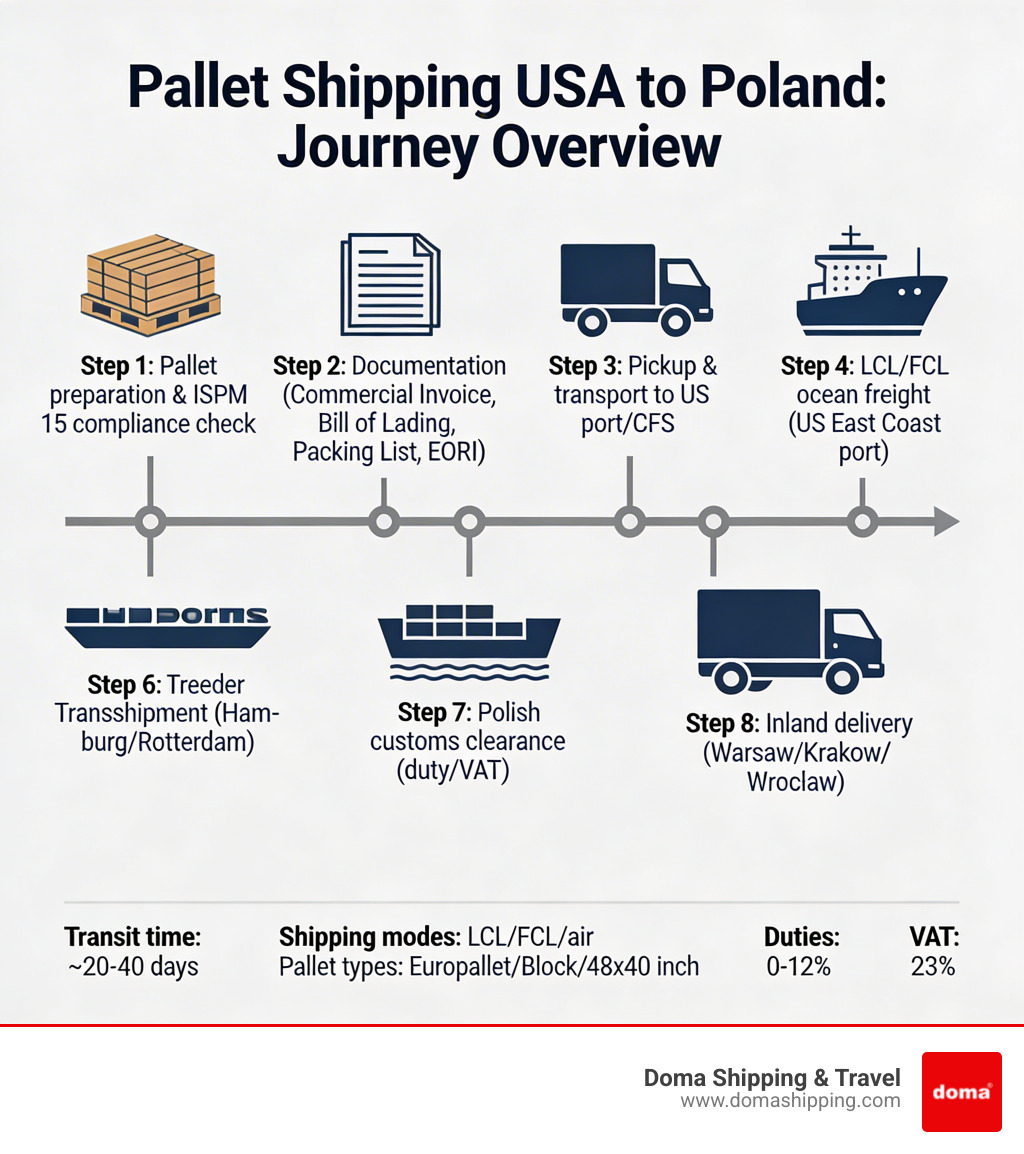
Here’s a quick overview of what’s involved:
| Factor | Key Details |
|---|---|
| Transit time (sea) | ~20-40 days (East Coast to Polish ports) |
| Main shipping modes | LCL sea freight, FCL sea freight, air freight |
| Common pallet types | Europallet (80x120cm), Block pallet, 48×40 inch (US standard) |
| Key documents | Commercial Invoice, Bill of Lading, Packing List, EORI number (businesses) |
| Polish customs duties | 0-12% depending on product category |
| VAT on imports to Poland | 23% standard rate (applied to CIF value plus duty) |
| Wood packing rule | Pallets must meet ISPM 15 treatment standards |
The US-Poland trade corridor has grown significantly — US imports of Polish goods have risen roughly 10% per year, reaching nearly $10.9 billion in 2023. That growth has made the route busier and more complex.
There’s no direct ocean service from US ports straight to Polish ports like Gdańsk or Gdynia. Shipments typically route through major European hubs like Hamburg or Rotterdam first, then transfer onto smaller feeder vessels. That adds a step — and time — to every shipment.
Getting palletized freight to Poland right means understanding container options, documentation, packing rules, and customs compliance before your goods ever leave the loading dock.
When we talk about pallet shipping USA Poland, we are entering heavy-lift logistics. Unlike sending a small parcel, pallets require specialized equipment, such as forklifts and lift-gate trucks, and a deep understanding of ocean and air freight systems. At Doma Shipping, with over 30 years of experience serving the Chicago area—from our hubs in Palos Hills and Schiller Park to our offices in Algonquin and Roselle—we’ve seen how proper planning turns a complex transatlantic move into a routine delivery.
The two primary methods for sea freight are LCL and FCL.
For more details on how these containers move across the ocean, you can read our guide on Shipping Smarter: Everything You Need to Know About International Container Transport.
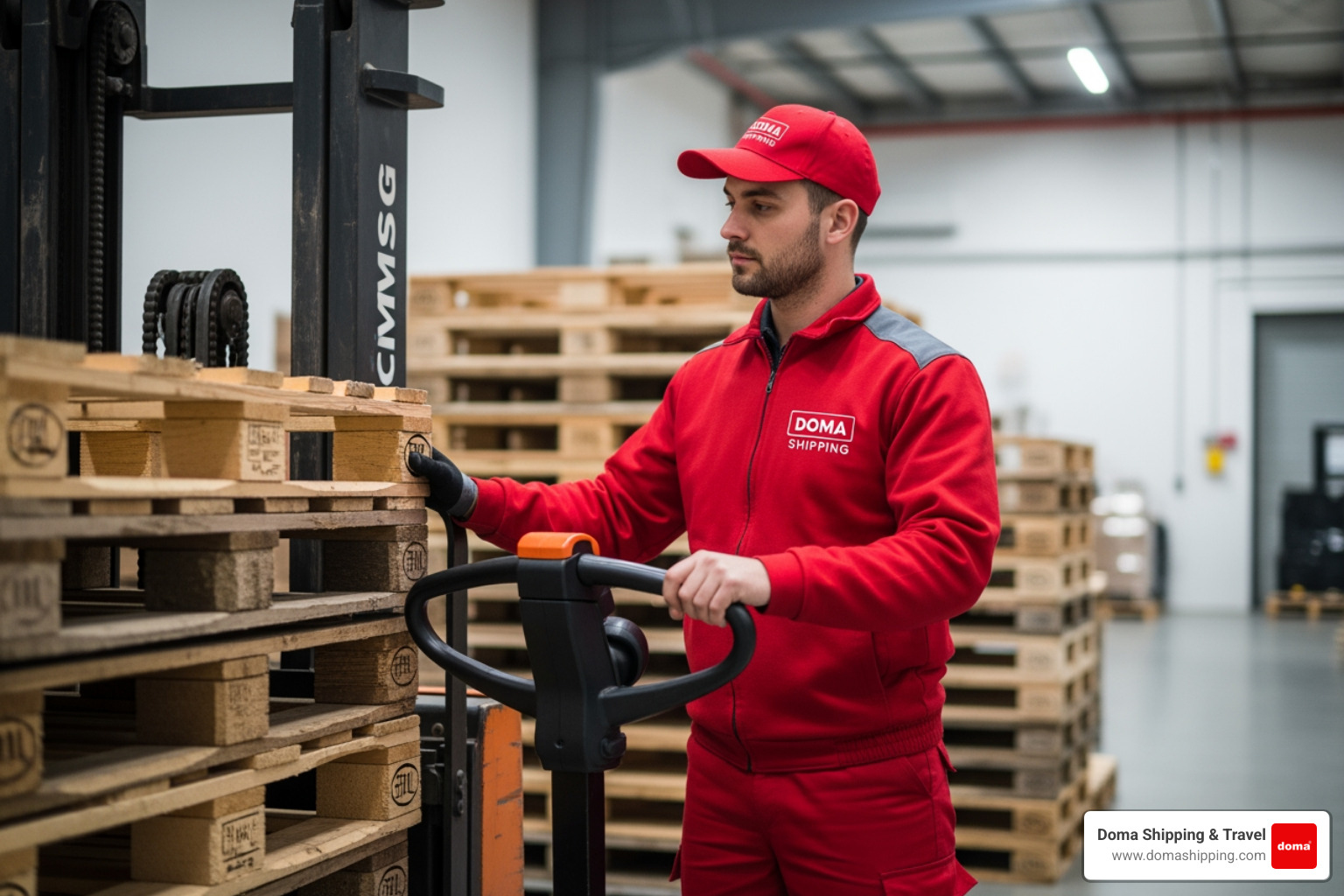
One of the first hurdles in transatlantic shipping is the “battle of the dimensions.” In the United States, the standard pallet size is 48×40 inches. However, Poland, as part of the European Union, primarily uses the Europallet (EPAL).
When preparing your shipment in locations like Des Plaines or Niles, we recommend using high-quality wood or plastic pallets that can withstand the rigors of being moved multiple times during the journey.
Once your shipment arrives at the port of Gdańsk or Gdynia via a feeder vessel from Rotterdam or Hamburg, it enters the Polish domestic infrastructure. Poland has become the fourth largest logistics market in Europe, thanks to its strategic location.
Our network ensures that whether your pallet is destined for a business in the heart of Warsaw or a residential address in a quiet Krakow suburb, the “last mile” delivery is handled with the same care as the transatlantic leg.
Shipping across borders involves a fair amount of paperwork. For pallet shipping USA Poland, the documentation must be precise to avoid delays at the Polish border. The Krajowa Administracja Skarbowa (KAS) oversees all imports into Poland and they are known for their attention to detail.
For a deeper dive into the manufacturing standards and regulatory environment, you can consult the Poland Import Regulations provided by the US government.
Poland applies a standard VAT rate of 23% on imports. This is calculated based on the CIF value (Cost, Insurance, and Freight) plus any applicable duties. Customs duties themselves typically range from 0% to 12%, though certain items—like those containing raw steel or aluminum—might be subject to higher rates depending on current trade proclamations.
If you are relocating to Poland, you might be eligible for a “Duty-Free” exemption for your personal belongings. To qualify, you generally need to have owned the items for at least six months and be moving your primary residence to Poland.
We handle the complexities of these filings for our clients in the Chicago area, ensuring all forms like the SAD (Single Administrative Document) are completed accurately. You can find more information about our specific Sea & Air Parcels to Poland services on our dedicated service page.
Not everything can be loaded onto a pallet and sent overseas. Poland has strict regulations on:
The secret to a successful shipment lies in the preparation. Because your pallet will be moved by forklifts, loaded into containers, and potentially transloaded at European ports, it must be “sea-worthy.”
ISPM 15 Compliance is the most critical rule for wood pallets. All wood packaging materials must be heat-treated or fumigated and marked with the official IPPC stamp. If you use a non-compliant pallet, Polish customs may reject the entire shipment or require expensive on-site fumigation.
When we assist customers in Melrose Park or Mount Prospect with their palletizing, we follow a strict set of best practices:
For a step-by-step guide on the physical preparation of your goods, check out this resource on how to pack and secure a pallet.
Once the pallet is wrapped, it needs to be labeled correctly. We recommend placing labels on at least two opposite sides of the pallet.
The choice between air and sea freight usually comes down to your timeline.
| Feature | Sea Freight (Ocean) | Air Freight |
|---|---|---|
| Transit Time | 20-40 Days | 3-7 Days |
| Best For | Large, heavy, or non-urgent loads | Urgent, high-value, or smaller pallets |
| Reliability | Subject to port congestion | Highly reliable schedules |
| Volume Limit | Virtually unlimited (FCL/LCL) | Restricted by aircraft dimensions |
Ocean freight is the standard for pallet shipping due to its ability to handle massive weight. However, if you have a critical business shipment that needs to be in Warsaw by next week, air freight is the only viable option.
You can learn more about our specific Less Than Container Load shipping details to see if sea freight is the right fit for your needs.
For those shipping from our locations in Schaumburg or Bensenville, understanding the 40-foot container is helpful. A standard 40-foot sea freight container has internal dimensions of approximately 12 meters (39’5″) in length and 2.35 meters (7’5″) in width.
While a standard Europallet can hold up to 700kg-875kg depending on the type, for international shipping, we generally look at the total weight of the cargo. Packages over 70 lbs are automatically considered cargo and must be palletized for safety. Most standard maritime containers can handle pallets up to 1,500kg, but local delivery trucks in Poland may have lower limits (often 700kg-1000kg) if they require a lift-gate for unloading.
From the time the ship leaves a US East Coast port, it takes about 20 days to reach the European coast. However, the total “door-to-door” time is usually 30-40 days. This includes trucking from our Chicago-area warehouses to the port, the transshipment time in Hamburg or Rotterdam, and finally, the feeder vessel trip to Gdańsk followed by customs clearance and local delivery.
No. If you are shipping personal effects—such as when you are moving back to Poland—you do not need an EORI number. This requirement is strictly for registered businesses. However, you will need to provide a detailed inventory and proof that you are establishing residency in Poland to benefit from duty-free relocation allowances.
Navigating the waters of pallet shipping USA Poland doesn’t have to be an overwhelming task. By focusing on proper pallet dimensions, ensuring ISPM 15 compliance, and meticulously preparing your customs documentation, you can ensure your heavy goods arrive safely and efficiently.
At Doma Shipping, we bring over 30 years of specialized experience to every shipment. Whether you are in Chicago, Palos Hills, or Franklin Park, our team is here to manage the heavy lifting for you. From securing your goods on a pallet to navigating the final customs checks in Gdynia, we provide a seamless bridge between the USA and Poland.
Ready to make your next big move? Start your international relocation to Poland today with the experts who know the route best.