
Efficient shipping USA Europe is something millions of Americans navigate every year — whether they’re sending personal belongings to family in Poland, shipping business goods overseas, or relocating to Europe entirely.
The transatlantic route is one of the world’s busiest trade corridors. It powers over $1.1 trillion in annual trade between the US and Europe. And yet, for most individuals and small businesses, the process still feels overwhelming.
Here’s a quick overview of your main options:
| Method | Best For | Typical Transit Time |
|---|---|---|
| Express courier | Small parcels, documents | 2-7 business days |
| Air freight | Urgent, medium shipments | 5-10 business days |
| LCL ocean freight | Partial loads, boxes, pallets | 25-45 days |
| FCL ocean freight | Full household moves, large cargo | 10-20 days |
The challenge isn’t just picking a method. It’s understanding customs rules, preparing the right documents, choosing the right port, and making sure your goods actually arrive safely.
Miss one step — a wrong HS code, missing commercial invoice, or poor packaging — and your shipment can be delayed, held at customs, or damaged in transit.
This guide walks you through everything you need to know to ship from the USA to Europe without unnecessary stress or surprises.
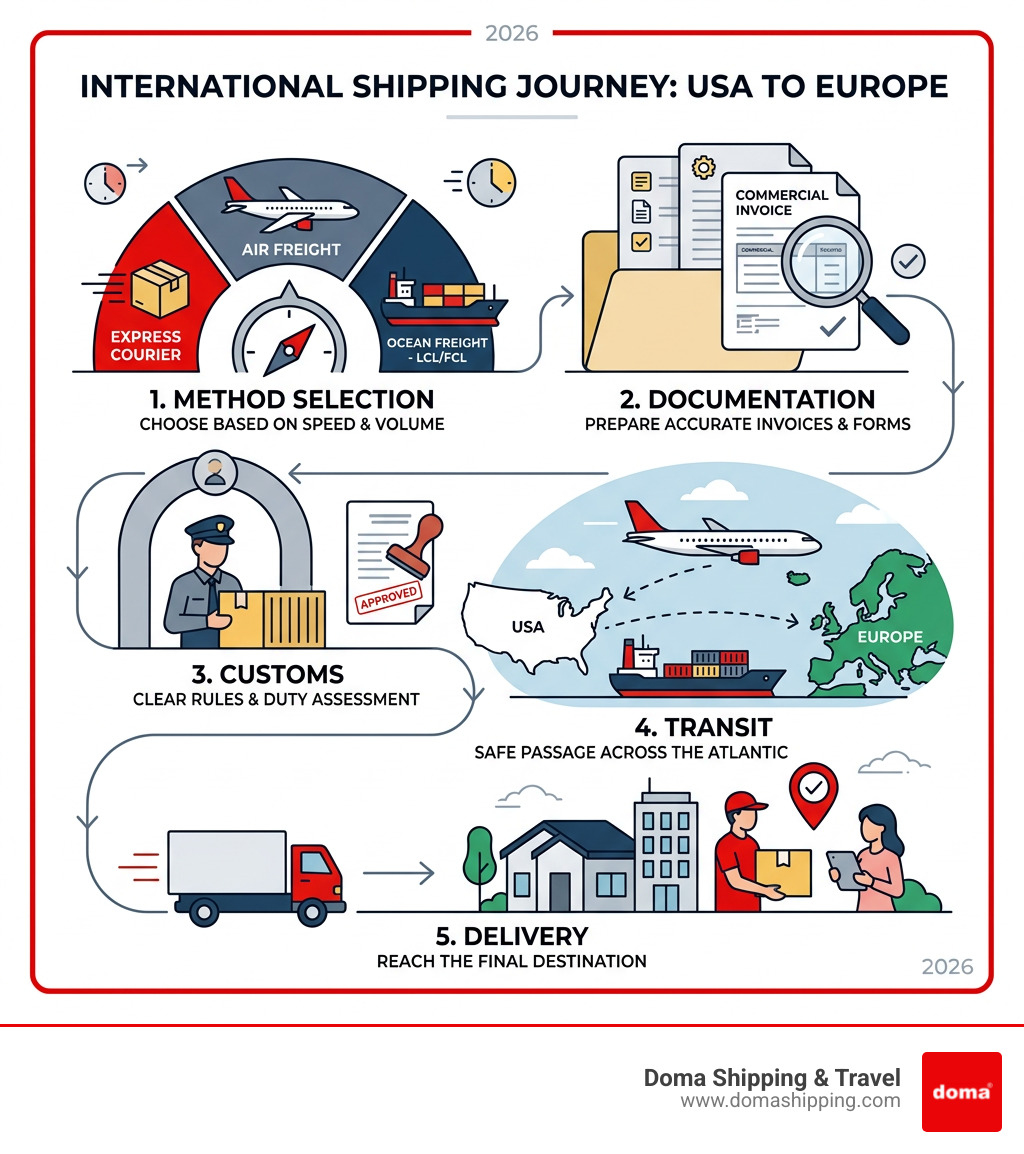
Choosing the right transport mode is the first step toward a successful transatlantic journey. While the distance remains the same, the “how” significantly impacts your timeline and the safety of your goods. In logistics, we generally categorize shipments into air and ocean, but the nuances within those categories are what define an efficient strategy.

For those looking to move goods across the Atlantic, the choice often comes down to the volume of the cargo and the urgency of the delivery.
Air Freight and International Parcels When time is of the essence, International Parcel Shipping is the go-to solution. This method is ideal for smaller boxes, documents, or urgent business samples. We often distinguish between Express and Economy options here. Express services can reach major European hubs in as little as 24 to 72 hours, while economy air options typically take 7 to 10 business days. For many, the convenience of Door-to-Door Shipping is the ultimate stress-reducer, as it eliminates the need for the sender or recipient to handle port-side logistics.
Ocean Freight: FCL vs. LCL For larger shipments, ocean transit is the backbone of the industry. Understanding the difference between container types is essential for efficient shipping USA Europe.
Customs is often where the “losing your mind” part of shipping happens. Every item that crosses an international border is subject to the laws of the destination country. In Europe, these regulations are strict and increasingly digital.
To ensure your shipment doesn’t get stuck in a warehouse in Rotterdam or Warsaw, you must prepare a comprehensive “paper trail.” The essential documents usually include:
The landscape of efficient shipping USA Europe changed significantly in 2025. The European Union has fully implemented the Import Control System 2 (ICS2). This mandates that all goods entering the EU must have their safety and security data submitted electronically before they even leave the United States.
Furthermore, the accuracy of HS Codes (Harmonized System codes) has never been more critical. With over 300 new codes introduced in the 2025 updates, misclassifying an electronic component or a textile can result in immediate customs holds. Digital verification systems now flag discrepancies in real-time, meaning the “close enough” approach to paperwork no longer works. We recommend utilizing electronic declarations to ensure all data aligns with the latest EU Combined Nomenclature.
Efficiency isn’t just about speed; it’s about predictability. Knowing that your shipment will arrive in 22 days is often more valuable than a “10 to 15 day” estimate that ends up taking 30.
| Route Type | Origin | Primary European Gateways | Avg. Transit Time |
|---|---|---|---|
| Sea (FCL) | US East Coast | Rotterdam, Antwerp, Hamburg | 10-20 Days |
| Sea (LCL) | US Midwest Hubs | Gdynia, Rotterdam, Bremerhaven | 25-45 Days |
| Air Freight | Chicago (ORD) | Warsaw, Frankfurt, London | 5-10 Days |
The route your cargo takes depends heavily on its starting point. For residents in the Chicago area and surrounding suburbs like Roselle, Palos Hills, or Des Plaines, the journey often begins with Midwest consolidation.
By Shipping Smarter: Everything You Need to Know About International Container Transport, we can bypass some of the congestion seen at major US West Coast ports. Most European-bound cargo from the Midwest is trucked or railed to East Coast ports like New York/New Jersey or Savannah before crossing the Atlantic.
Major European Hubs
To maintain efficient shipping USA Europe, we leverage technology such as GPS monitoring and predictive AI analytics. These tools allow us to monitor port congestion in real-time and adjust routes if a particular gateway is experiencing labor strikes or weather delays.
Your package’s greatest enemy isn’t the distance; it’s the handling. An ocean container will be moved by cranes, trucks, and forklifts multiple times before it reaches its destination.
When preparing Household & Personal Belongings Shipping, follow these professional standards:
Not everything fits in a box. Shipping vehicles requires a completely different set of protocols to ensure they arrive without a scratch.
For Cars from USA to Poland, the process involves more than just driving the car into a container. We must drain the fuel to a minimum level, disconnect the battery, and utilize professional-grade blocking and bracing. This prevents the vehicle from moving even an inch during rough seas. Similar care is taken with Motorcycles from USA to Poland, which often require custom-built wooden skids to remain upright and secure throughout the journey.
For FCL (Full Container), you can expect a port-to-port time of 10 to 20 days from the East Coast. However, for LCL (Less than Container Load), the total “door-to-door” time is usually 25 to 45 days. This accounts for the time needed to consolidate multiple shipments at the origin and deconsolidate them at the destination port, plus customs clearance.
At a minimum, you will need a Commercial Invoice (or a Valued Inventory for personal moves), a Packing List, and a Bill of Lading. If you are moving Household Goods Relocation from USA to Poland, you may also need documentation proving you have lived in the US for at least 12 months to qualify for an exemption from customs duties on your used belongings.
Start with a heat-treated pallet. Stack the heaviest boxes at the bottom and ensure no items overhang the edges. Use “column stacking” rather than interlocking for better strength. Finally, wrap the entire pallet in at least three layers of stretch film, ensuring the film is anchored to the pallet base itself.
Shipping across the Atlantic doesn’t have to be a source of anxiety. By understanding the methods available, staying ahead of 2025’s digital customs requirements, and packing your goods with the rigors of ocean travel in mind, you can ensure a smooth transition for your cargo.
At Doma Shipping & Travel, we bring over 30 years of experience to every shipment. Whether you are sending a single gift box to family, moving a vintage car, or managing a full-scale Relocation to Poland, our team handles the complexity so you don’t have to. From our roots in Chicago and suburbs like Melrose Park and Schaumburg to the ports of Europe, we bridge the gap with professional, comprehensive logistics.
Ready to take the next step? Start your relocation to Poland with a team that knows the route by heart.