
Shipping a car from Chicago to Poland is a straightforward process — if you know what to expect before you start.
Here’s a quick overview of the key facts:
| Factor | Details |
|---|---|
| Typical total transit time | ~21 days (6 days ground + 15 days ocean) + ~10 days for document processing |
| Main shipping methods | Container shipping (FCL/LCL) or Roll-on/Roll-off (RoRo) |
| Destination ports | Port of Gdynia, Port of Gdańsk |
| Key documents required | Original vehicle title, Bill of Sale, passport, Power of Attorney |
| Polish import duties | 10% customs duty + 23% VAT (exemptions available for relocating residents) |
| Vehicle modifications | US cars typically need EU compliance changes (lights, emissions, speedometer) |
Chicago is home to one of the largest Polish communities in the United States, which means thousands of families and individuals face this exact journey every year — moving a car they love across the Atlantic to start a new chapter in Poland.
The good news? It’s more manageable than most people expect. Whether you’re relocating permanently, sending a vehicle to family, or importing a car you purchased at a US auction, understanding the process from start to finish makes all the difference.
This guide walks you through every step — from picking up your vehicle in Chicago to clearing customs at a Polish port.
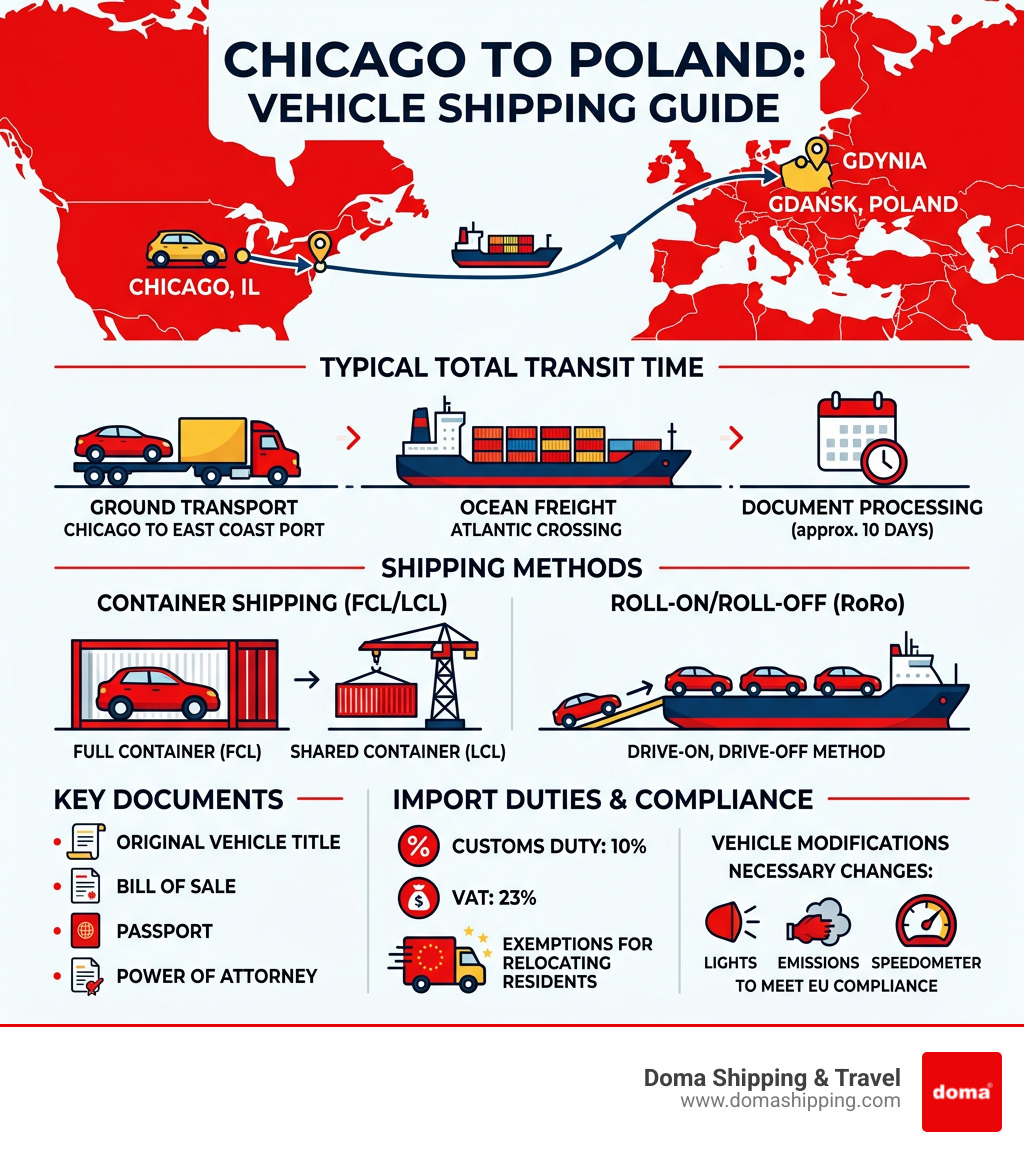
When we talk about moving a vehicle from the heart of the Midwest to the shores of the Baltic Sea, we are looking at a highly coordinated logistical dance. Chicago serves as the primary hub for this activity due to its massive Polish population and its role as a central transport node in the United States. Whether you are in Melrose Park, Schaumburg, or Niles, the process begins with local coordination.
The journey typically involves moving the vehicle from Illinois to a major East Coast port, such as those in New Jersey or Maryland, before it begins its Atlantic crossing. The primary destination for most vehicles entering Poland is the Port of Gdynia, which is the most common arrival point for containerized shipments. The Port of Gdańsk also plays a significant role, handling millions of tons of cargo annually and offering specialized terminals for various types of vehicle transport.
For those interested in the specifics of the process, More info about vehicle shipping can help clarify how we handle these transitions. Transit duration is a key concern for many; generally, you can expect the ocean portion of the trip to take approximately 15 days, though total door-to-port time often extends to about three weeks when ground transport from Chicago is factored in.
Efficiency in shipping a car from Chicago to Poland depends heavily on timing and port logistics. The timeline is generally split into three phases:
Gdynia is often the preferred terminal because of its excellent trans-shipping capabilities and direct connections to the rest of Poland. Once the ship enters the Baltic Sea, the final leg of the maritime journey is relatively short, but the administrative work at the terminal is where expertise truly matters.
It is a common misconception that a car ready for Illinois roads is automatically ready for Polish ones. US-spec vehicles must undergo “homologation” to meet European Union standards. This isn’t just bureaucracy; it’s about safety and compliance.
Key modifications often include:
For official guidance on these transitions, the U.S. Embassy in Poland provides resources for American citizens moving abroad.
Choosing the right method for shipping a car from Chicago to Poland is a balance between protection and the specific needs of the vehicle. We primarily utilize two methods: Containerized shipping and Roll-on/Roll-off (RoRo).
| Method | Best For | Protection Level | Personal Items Allowed? |
|---|---|---|---|
| Container (FCL/LCL) | Luxury, Classic, Non-runners | High (Enclosed) | Yes (in FCL) |
| RoRo | Operable, Oversized vehicles | Moderate (Open deck) | No |
Container shipping is the gold standard for security. Your vehicle is placed inside a steel reinforced container, protecting it from the salt air, moisture, and potential handling damage.
We offer two main types of container service:
One of the biggest advantages of containerized transit is the ability to include personal belongings, provided they are securely packed and declared.
RoRo is a method where the vehicle is driven onto the ship’s deck (similar to a giant parking garage) and secured for the voyage. This method is often used for oversized cargo like trucks or heavy equipment that won’t fit in a standard container.
However, RoRo has strict requirements: the vehicle must be in good working order (it must “roll on” and “roll off” under its own power), and it must be completely empty of personal items. The Świnoujście terminal is one of the most modern facilities in the Baltic for this type of service. For more general information on these types of vessels, you can visit RORO VESSEL.
The paperwork is the engine that keeps your shipment moving. Without the correct documents, a vehicle can be held at the port, leading to delays.
The core documents we require include:
For a deeper dive into the specific weights and compliance-related limitations, the Poland Customs Page is an excellent resource.
One of the most significant benefits for those moving back to Poland is the mienie przesiedleńcze (resettlement property) exemption. If you are relocating permanently, you may be eligible to import your car duty-free.
To qualify, you generally must:
This can save a significant amount in taxes and duties. You can find a complete guide to this procedure at Mienie przesiedleńcze z USA do Polski.
If you do not qualify for a relocation exemption—for example, if you are importing a car you bought at an auction—standard rates apply. In Poland, this typically involves a 10% customs duty and a 23% Value Added Tax (VAT).
It is important to note that classic cars (those over 30 years old that meet specific criteria) may qualify for a significantly reduced VAT rate, often around 7-8%, and may be exempt from standard customs duties. Regardless of the status, all US titles must be translated into Polish by an authorized translator in Poland to be legally recognized.
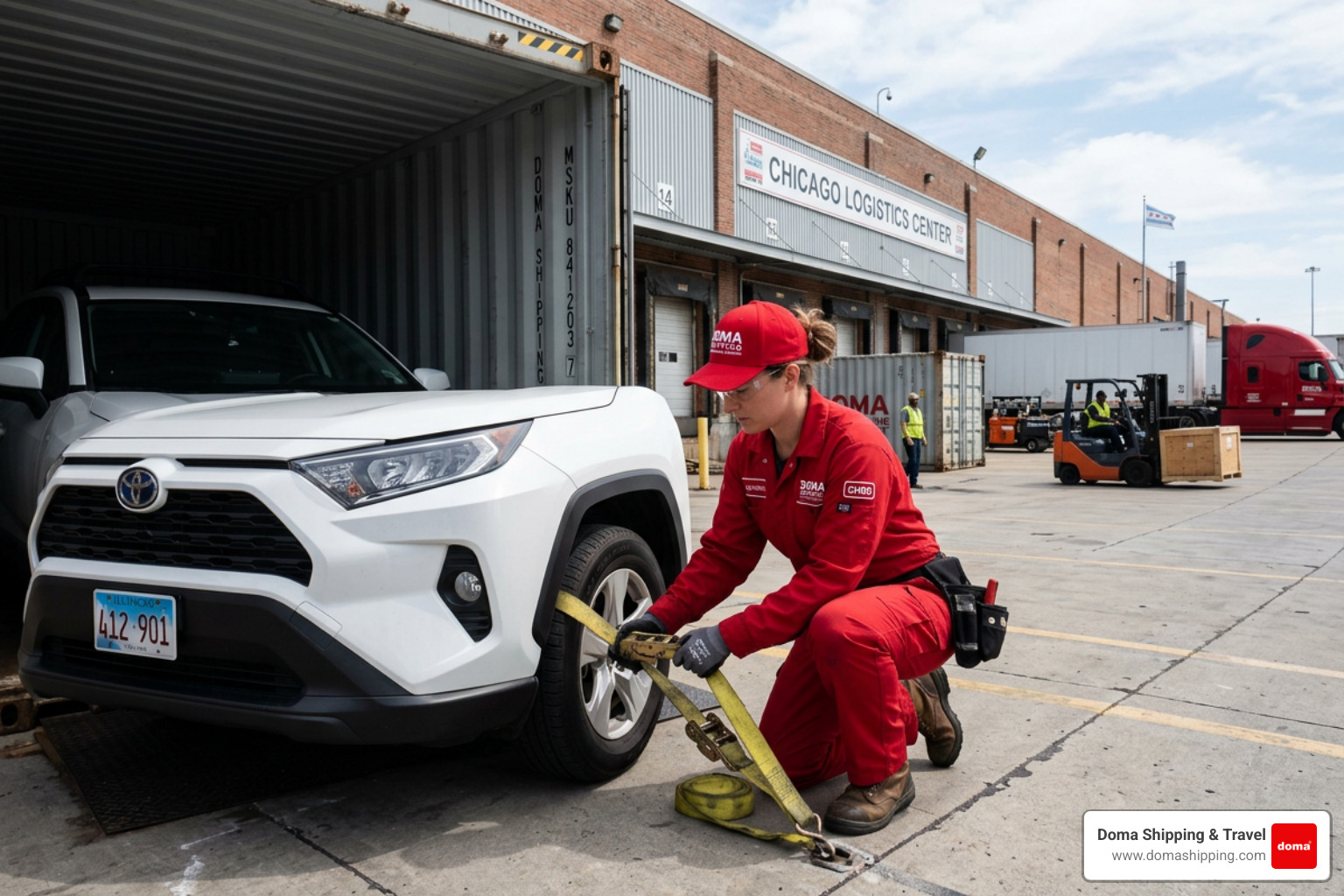
Preparation is key to a damage-free journey. We recommend a few essential steps before the car leaves your driveway in Chicago or our warehouse in Roselle.
Before the vehicle is loaded, a comprehensive condition report is created. This includes detailed photos of the car from all angles. While we take every precaution, international transit involves many moving parts.
We strongly recommend marine cargo insurance. Standard auto insurance policies typically do not cover your vehicle once it is on the ocean. “All-risk” coverage provides the most peace of mind, covering potential damage from loading, transit, and unloading. Without additional insurance, carrier liability is often limited to a much lower amount per the Carriage of Goods at Sea Act.
Yes, but only if you choose containerized transit. In a shared or dedicated container, you can pack belongings inside the trunk or cabin. However, these items must be inventoried for customs. For RoRo shipments, the car must be completely empty.
The entire process—from the moment we pick up the car in a suburb like Des Plaines or Algonquin to the moment it is ready for pickup in Gdynia—usually takes between 30 and 40 days. This includes ground transport, the ocean voyage, and the time required for customs clearance at both ends.
As mentioned earlier, the most common modifications involve the lighting system (amber turn signals and rear fog lights). After arrival, the car must pass a technical inspection (badanie techniczne) at a Polish diagnostic station before it can be registered.
Shipping a car from Chicago to Poland is a journey that spans thousands of miles and involves complex international regulations, but it doesn’t have to be stressful. With over 30 years of experience in international logistics, we have refined the process to ensure that your vehicle arrives safely and efficiently.
From our roots in the Chicago area—serving communities from Palos Hills to Schaumburg—to our deep connections with Polish ports, we provide a bridge across the Atlantic. Whether you are moving a family sedan, a luxury SUV, or a vintage classic, our team handles the heavy lifting so you can focus on your new journey in Poland.
If you are ready to start the process or simply have more questions about International Shipping Services, we are here to help every step of the way. Safe travels for you and your wheels!