
A reliable freight forwarder is an intermediary that organizes and coordinates the international movement of goods on your behalf — handling transport logistics, customs documentation, and carrier contracts so your shipment arrives safely and on time.
Quick answer — what makes a freight forwarder reliable?
Sending a package, personal belongings, or a vehicle from the USA to Poland or elsewhere in Europe sounds straightforward. It rarely is.
International shipping involves multiple transport modes, customs regulations in two or more countries, carrier contracts, documentation requirements, and a chain of handoffs where things can — and do — go wrong.
As real shippers have noted in online discussions, the quality of your experience often comes down less to the size of the company and more to who is actually handling your shipment and whether they treat your cargo like it matters.
The wrong partner can leave your goods sitting in a warehouse, stuck in customs, or simply unresponsive when you need answers most. The right one makes the process nearly invisible.
This guide breaks down exactly what to look for — and what to avoid.
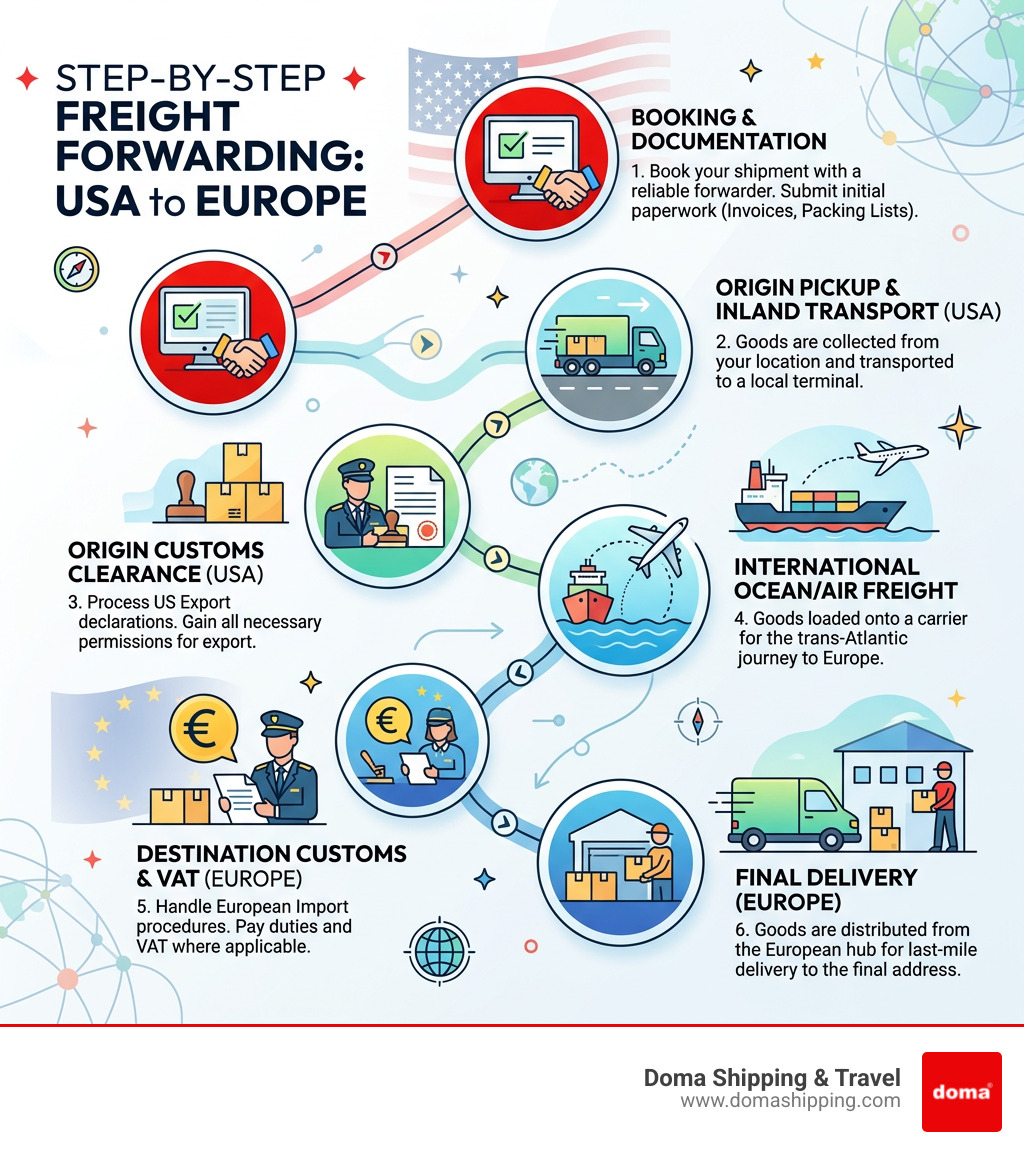
Basic reliable freight forwarder vocab:
At its core, a freight forwarder is a logistics architect. We don’t necessarily own the ships or the airplanes, but we are the ones who make sure your cargo gets on them. Think of us as the travel agent for your goods; we coordinate the entire journey from a Chicago suburb to a doorstep in Warsaw or Berlin.
International shipping is rarely a “one-step” process. It often involves multi-modal transport — a combination of trucking, rail, and ocean or air freight. For example, a typical shipment might travel by truck from a warehouse in Niles or Schiller Park to a major port, cross the Atlantic via a container ship, and then be loaded onto another truck for final delivery in Europe.
Shipping smarter means understanding how these modes interact. A reliable freight forwarder excels at this coordination, ensuring that the handoff between a truck driver in Illinois and a vessel operator at the port is seamless.
You may encounter the term NVOCC (Non-Vessel Operating Common Carrier). This is a specific type of freight forwarder that issues its own Bills of Lading and acts as a carrier to the shipper, despite not owning the physical ships. This status is a hallmark of a professional operation, as it requires specific licensing and financial bonding, providing an extra layer of security for your cargo.
One of the most complex parts of global trade is the paperwork. Every country has its own set of rules regarding what can enter, how it must be documented, and what duties apply. We specialize in preparing and processing this documentation, ensuring that your shipment doesn’t get “ghosted” by customs officials due to a missing form or an incorrect tariff code.
When you are looking for a partner to handle your personal belongings or commercial goods, scale isn’t the only metric that matters. While global giants handle millions of TEUs (20-foot equivalent units), smaller, specialized forwarders often provide a level of “service intimacy” that large corporations cannot match for individual shippers or small businesses.
A reliable freight forwarder is honest about timelines and potential challenges. If there is a congestion issue at a major port or a delay in vessel scheduling, you should hear it from your forwarder first. Transparency in operations is the foundation of trust.

A forwarder is only as strong as their network. Reliability depends on having established partners in destination countries who understand local regulations and last-mile delivery nuances. For shipments from the USA to Poland, for instance, having a deep-rooted network in both the Midwest (like Chicago and its suburbs) and European logistics hubs is essential.
To help you decide which mode fits your needs, consider the following reliability factors:
| Factor | Air Freight | Ocean Freight |
|---|---|---|
| Transit Time | High Predictability (1-5 days) | Variable (3-6 weeks) |
| Weather Impact | Minimal (except severe storms) | Moderate (sea conditions/seasonal) |
| Documentation | Strict but Standardized | Complex (Customs/Manifests) |
| Handling | Minimal (Lower risk of damage) | Frequent (Requires expert loading) |
| Best For | Urgent parcels, electronics | Large containers, vehicles, furniture |
Expertise in specific verticals—such as vehicle transport or household relocations—is a major indicator of reliability. A company that has spent 30 years refining the route from Chicago to Europe will have a much higher success rate than a generalist who occasionally ships to different continents.
In the logistics world, no news is rarely good news. A reliable freight forwarder prioritizes responsiveness. Whether it’s a quick email update or a phone call to explain a change in the schedule, communication should be proactive.
For those utilizing door-to-door shipping, communication becomes even more critical. You need to know exactly when the pickup will happen at your home in Palos Hills or Algonquin and when the delivery is expected at the final European destination. Professional standards dictate that updates should be provided in real-time, or at the very least, within a business day of any significant movement.
Licensing is the non-negotiable “ID card” of the shipping industry. You should never entrust your goods to an unlicensed entity.
A comprehensive service menu is a sign that a forwarder has the infrastructure to handle various needs. Whether you are sending a single box or an entire household, the process should be handled with the same level of professional care.
For larger shipments, containerization is the standard.
Not every shipment is a massive container. International parcel shipping is a core service for many, especially those sending gifts or smaller items to family in Poland. A reliable freight forwarder treats a small parcel with the same logistical rigor as a vehicle or a heavy machinery shipment.
Shipping a car or a motorcycle overseas requires specialized loading techniques and specific customs declarations. Reliable partners have the equipment—such as specialized ramps and bracing materials—to ensure vehicles are secured for the long ocean voyage.
Knowing what to avoid is just as important as knowing what to look for. The shipping industry, like any other, has its share of “ghosts” and “cowboys.”
A major red flag is a forwarder who is vague about the process. If they cannot explain how your goods will get from Bensenville to Gdynia, or if they refuse to provide a tracking number, proceed with extreme caution. Transparency isn’t just a buzzword; it’s an industry standard.
Reliability is often tied to ethical practices. This includes being honest about transit times. While everyone wants their cargo to arrive “yesterday,” a reliable freight forwarder will give you a realistic window based on current global shipping conditions rather than an overly optimistic date just to win your business.
Furthermore, look for regional strengths. A forwarder with a physical presence in the Chicago area—locations like Mount Prospect, Roselle, or Des Plaines—and a strong destination network in Europe is naturally more equipped to handle those specific trade lanes than a company located thousands of miles away from the point of origin.
Modern logistics relies on technology. Reliable forwarders use digital platforms to manage bookings, track shipments, and store documentation. This reduces human error and ensures that you have access to your shipment’s status whenever you need it.
A carrier (like a shipping line or airline) physically moves the cargo. A freight forwarder is the expert who organizes the entire process, chooses the best carriers, handles the paperwork, and manages the logistics. While carriers focus on moving their ships or planes, forwarders focus on moving your goods from point A to point Z.
Europe has strict regulations regarding VAT, duties, and safety standards. A customs broker ensures your shipment complies with the Union Customs Code (UCC) in the EU. Without this expertise, your cargo could be delayed for weeks, or worse, returned to the USA at your expense.
Through integrated tracking systems and digital manifests, technology allows us to see exactly where a container is on the ocean or which warehouse a parcel is currently sitting in. This data is shared with you, providing peace of mind and allowing you to plan for the arrival of your goods.
Choosing a reliable freight forwarder is the most important decision you will make in the international shipping process. It is the difference between a stress-free experience and a logistical nightmare.
At Doma Shipping & Travel, we bring over 30 years of experience to every shipment. From our deep roots in Chicago and suburbs like Melrose Park, Park Ridge, and Glenview, we have built a reputation for safely and efficiently moving cargo from the USA to Poland and throughout Europe. Whether you are looking for International Parcel Shipping, container transport, or vehicle relocation, our team ensures that your cargo never “ghosts” you. We are with you from the moment we pick up your package in Illinois until it is safely delivered across the Atlantic.