
Container shipping from Chicago opens a vital gateway for businesses and families sending goods overseas to Europe. Whether you’re relocating personal belongings to Poland, restocking European inventory, or sending equipment samples abroad, understanding your options helps you ship smarter and avoid logistical errors.
Quick Answer: Your Container Shipping Options from Chicago
Chicago sits at the heart of America’s freight network, making it a strategic starting point for international shipments. The city’s connections to major ocean ports via rail and truck, combined with its central location, mean you can consolidate cargo efficiently before it heads overseas.
Most Chicago shippers choose between two approaches: FCL (Full Container Load) for exclusive use of a container, or LCL (Less than Container Load) for sharing space and resources. Your choice depends on shipment size, timeline flexibility, and requirements—but both options provide secure, tracked transport to European destinations.
The process involves more than just booking space. You’ll need proper documentation, compliance with international packing standards, and an understanding of customs procedures on both sides of the Atlantic. Terminal handling charges, fuel surcharges, and customs brokerage fees add layers beyond the base freight logistics.
Choosing the right mode for container shipping from Chicago is the first and most important decision you will make. We often see clients struggle to decide whether they need an entire container or just a portion of one. The choice fundamentally changes how your goods are handled and how they travel across the Atlantic.
Full Container Load Shipping is the standard for those moving large volumes. When you choose FCL, you are renting the exclusive use of a 20-foot or 40-foot container. This is the preferred method for full household relocations, shipping vehicles, or large commercial consignments. Because the container is dedicated to your goods, there is less handling involved—the container is loaded at the origin and typically remains sealed until it reaches its destination in Europe.
For many small businesses and individuals, a full container is simply too much space. Less Than Container Load Shipping allows you to share container space with other shippers. This is a highly efficient way to send smaller loads, ranging from a few pallets to several tons. We consolidate these smaller shipments into a single container at a warehouse in the Chicago area before sending them to the port.
| Feature | FCL (Full Container Load) | LCL (Less than Container Load) |
|---|---|---|
| Space | Exclusive use of 20′ or 40′ container | Shared space with other cargo |
| Handling | Minimal; sealed at origin | Higher; consolidated/de-consolidated |
| Best For | Vehicles, full homes, large inventory | Parcels, pallets, small product batches |
| Transit Time | Faster (no consolidation needed) | Adds 1-2 weeks for consolidation |
| Security | Highest (single shipper per unit) | High (professional palletization) |
To ensure fair practices and safety across the industry, we align with BIMCO maritime standards, which help secure harmonized maritime regulations for global shipping operations.
Chicago’s geography makes it a unique hub for international logistics. While we aren’t located on the ocean, the Port of Chicago—operated by the Illinois International Port District—serves as a critical multimodal facility. Located on the Chicago River and Lake Michigan, it features facilities like the Iroquois Landing Lakefront Terminus, spanning 100 acres of warehouses.
When arranging container shipping from Chicago, the journey begins with “drayage.” This is the specialized trucking service that moves the container from our loading facilities in areas like Melrose Park, Des Plaines, or Schiller Park to the rail terminal or port.
Our logistics network covers the entire Chicagoland area, including:
We provide comprehensive Door-to-Door Shipping services where we handle the pickup from your location, manage the inland transport to the terminal, and oversee the ocean crossing until the goods reach their final European destination.
Preparation is the key to a stress-free shipment. International regulations are strict, especially regarding wooden packaging. Any wood used in crates, pallets, or bracing must be ISPM-15 certified (heat-treated and stamped) to prevent the spread of pests across borders.
When preparing Household & Personal Belongings Shipping, keep these requirements in mind:
The paperwork for container shipping from Chicago to Europe can seem daunting, but it is essentially a roadmap for your goods. Accurate documentation ensures that customs officials in countries like Poland, Germany, or the Netherlands can process your shipment without unnecessary delays.
The essential documents include:
To protect your investment, we recommend following Skuld maritime insurance guidance. They specialize in liability and cargo insurance, which is essential because international transit involves multiple handlings and long sea voyages. We typically suggest insurance for all industrial goods and personal effects to mitigate risks of damage or loss.
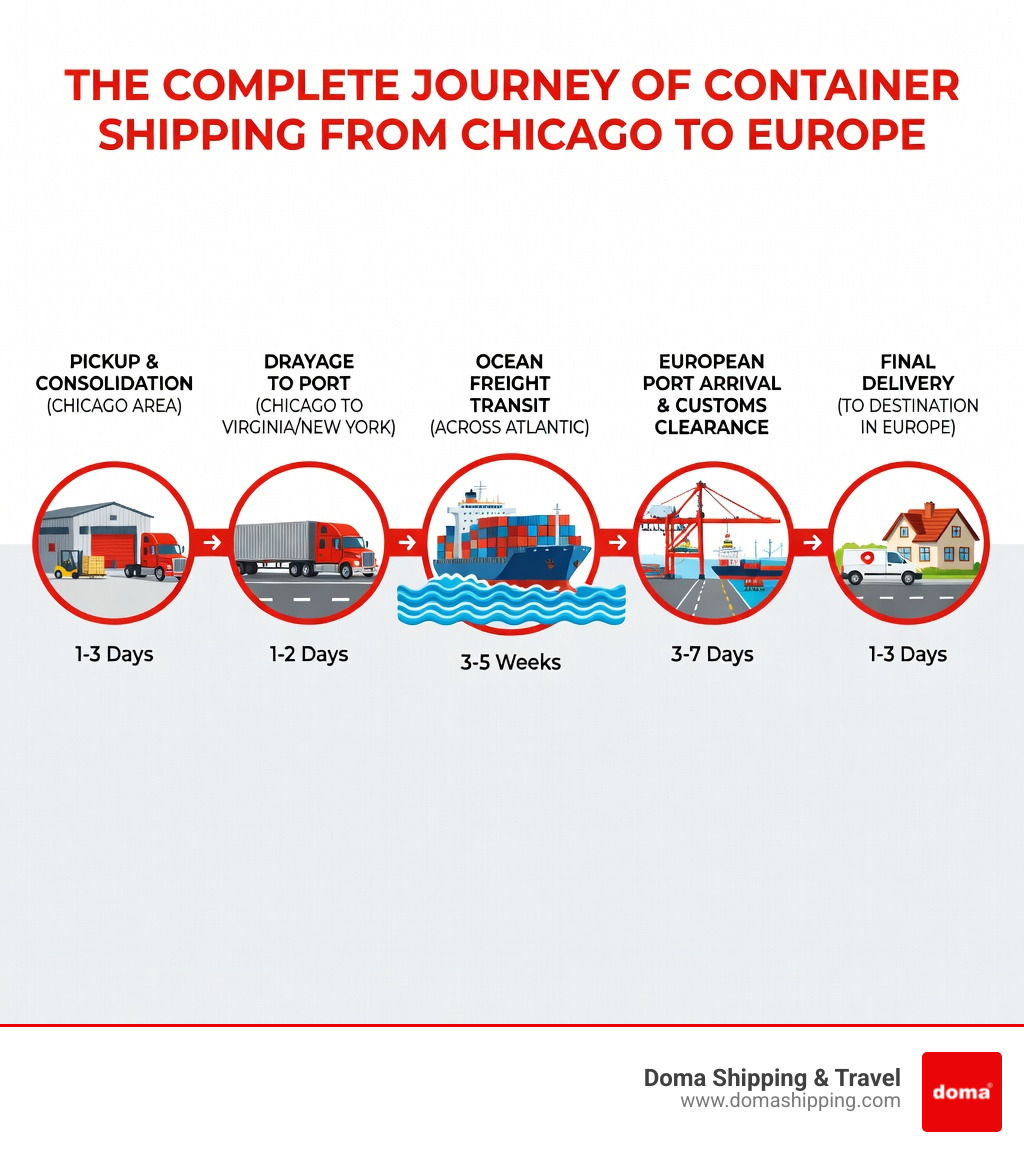
One of the most frequent questions we hear is “When will it get there?” It’s important to remember that sea freight is a marathon, not a sprint.
In total, you should plan for a timeline of 4 to 7 weeks from the moment your goods leave our Chicago-area facility until they are ready for final delivery in Europe. For a deeper dive into these logistics, you can read our guide on Shipping Smarter: Everything You Need to Know About International Container Transport.
When you receive a quote for container shipping from Chicago, the base logistics are only part of the story. The maritime industry uses several standardized surcharges to account for fluctuating variables.
Common surcharges you might encounter include:
We also monitor safety and sustainability through platforms like RightShip risk management platform, which provides expertise in global safety and environmental assessment. This ensures that the carriers we utilize meet high standards of social responsibility and efficiency.
The total door-to-door time is usually between 4 and 7 weeks. This includes the inland transport from Chicago to the coast, 3-5 weeks of ocean transit, and approximately 14 days for customs clearance in Europe.
FCL (Full Container Load) gives you the exclusive use of a container, which is faster and more secure for large shipments. LCL (Less than Container Load) allows you to pay only for the space you use by sharing a container with others, which is a highly efficient option for smaller shipments.
Yes! We provide real-time tracking for all shipments originating from our Chicago facilities. You will receive a tracking number that allows you to monitor the status of your cargo from our warehouse to the final destination in Europe.
Managing container shipping from Chicago doesn’t have to be a complex puzzle. By choosing between FCL and LCL based on your specific needs and ensuring your documentation is in order, you can ensure a smooth transition for your goods across the Atlantic.
At Doma Shipping, we bring over 30 years of experience to every shipment. Whether you are sending a single pallet or a Full Container Load Shipping to Poland or anywhere else in Europe, our team in Chicago, Melrose Park, and the surrounding suburbs is here to help. We provide the expertise needed to navigate customs, manage surcharges, and ensure your belongings arrive safely and efficiently. Ready to start your international journey? Let us handle the heavy lifting.