
Passenger ship from Canada to Europe travel is alive and well — and more accessible than many people realize.
Quick answer: The main options for sailing from Canada to Europe are:
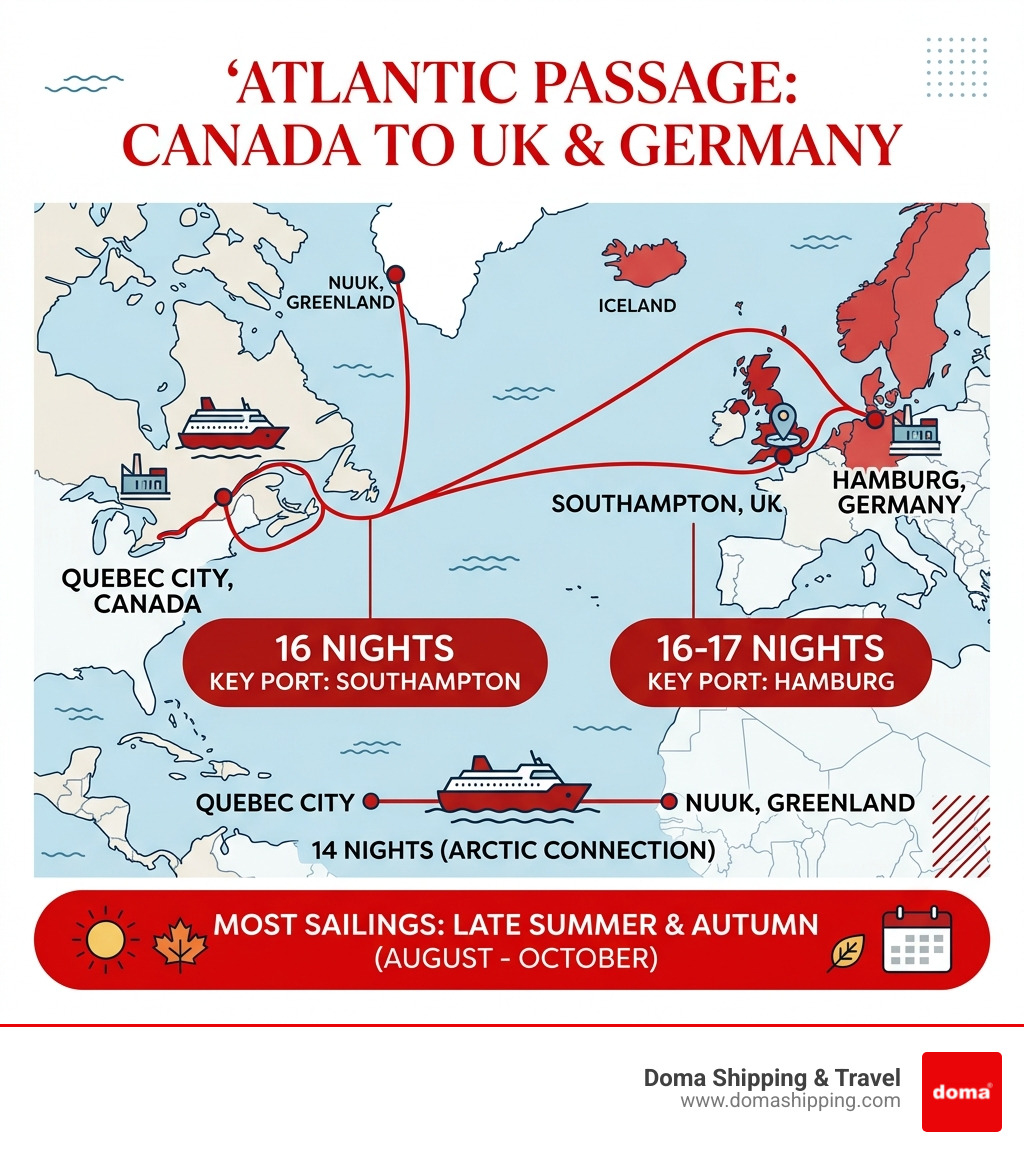
| Route | Cruise Line | Duration | Key Destination |
|---|---|---|---|
| Quebec City → Southampton | Norwegian Cruise Line | 16 nights | England |
| Quebec City → Hamburg | Cunard Queen Mary 2 | 16-17 nights | Germany |
| Quebec City → Hamburg | Cunard Queen Mary 2 | 15 nights (via New England) | Germany |
| Quebec → Nuuk (Arctic connection) | Ponant | 14 nights | Greenland/Europe |
Most sailings depart in late summer or autumn (August through October), with Quebec City being the primary Canadian departure port.
There is something deeply satisfying about crossing the Atlantic the slow way. No cramped seats. No jet lag. No rushing through airports. You simply board a ship in Canada, watch the St. Lawrence River give way to open ocean, and arrive in Europe a little over two weeks later — rested, unhurried, and ready to explore.
This style of travel has a long history. The legendary RMS Empress of Britain, launched in 1930, operated the Southampton–Quebec City route and was celebrated as the largest, fastest, and most luxurious ship between the United Kingdom and Canada. Today, Cunard’s Queen Mary 2 — the world’s only ocean liner purpose-built for transatlantic crossings — carries that tradition forward.
Whether you are drawn by maritime heritage, the romance of slow travel, or simply want an alternative to flying, this guide walks you through everything you need to know.
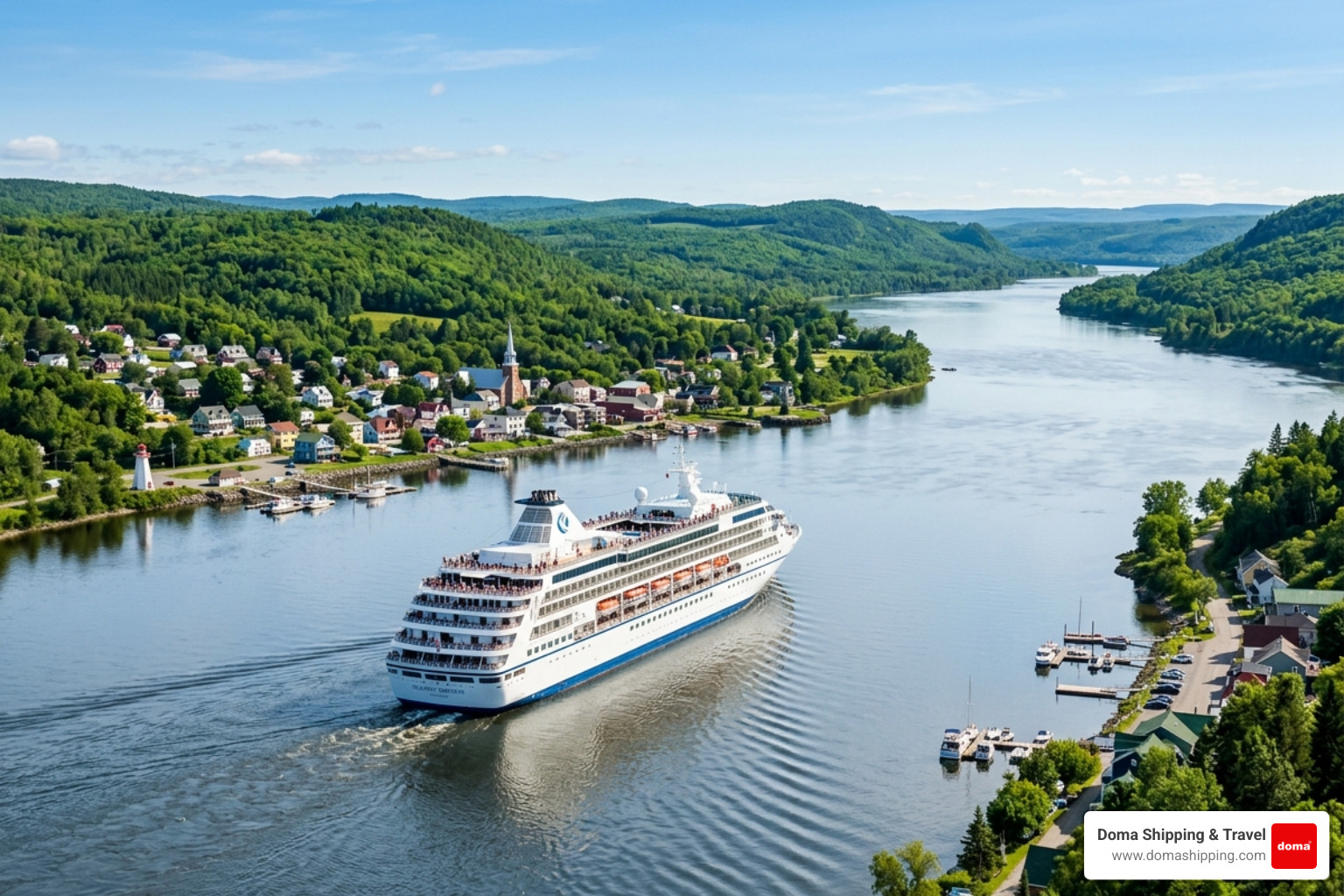
When we think about crossing the Atlantic, we often forget that for centuries, the only way to reach the “Old World” was by braving the North Atlantic waves. Today, departing on a passenger ship from Canada to Europe allows us to recapture that sense of adventure while enjoying modern comforts. Most of these voyages begin in Quebec City, a port steeped in maritime history that serves as the perfect gateway to the Atlantic.
The journey typically follows the majestic St. Lawrence River, offering a scenic departure that no airport runway can match. As the ship glides past the rugged coastlines of Quebec and the Maritimes, passengers are treated to a transition between the freshwater of the Great Lakes system and the salt spray of the open sea.
The routes available for a passenger ship from Canada to Europe are diverse, ranging from direct crossings to “stepping stone” itineraries that visit remote northern outposts.
Timing is everything when planning a voyage on a passenger ship from Canada to Europe. Unlike Caribbean cruises that run year-round, transatlantic crossings from Canada are highly seasonal. Most departures occur during the “repositioning” seasons—autumn when ships head to Europe for the winter, or spring when they return to North America.
These voyages are typically 7 to 17 nights in duration, with September and October being the most popular months for eastbound crossings. This timing allows passengers to witness the stunning fall foliage of the St. Lawrence River before heading into the crisp air of the North Atlantic.
Booking a transatlantic voyage requires more foresight than a standard vacation. Because these routes are limited, they often fill up more than a year in advance.
The type of vessel you choose for your passenger ship from Canada to Europe experience will fundamentally change your journey. There is a significant difference between a traditional ocean liner and a modern expedition ship.
The Queen Mary 2 is the only remaining true ocean liner. Unlike standard cruise ships, she is built with a thicker hull and a deeper draft specifically designed to handle the “mighty oceans” of the North Atlantic. On board Queen Mary 2, the atmosphere is one of refined elegance. You might find yourself attending a black-tie gala one evening and a planetarium show the next.
Other lines, such as Viking or Ponant, use smaller, more nimble ships. These voyages focus on “cultural immersion.” Instead of Broadway-style shows, you might find educational lectures from historians or naturalists. These ships can often navigate smaller ports that the larger liners cannot reach, such as Nuuk or smaller fjords in Norway.
Typical Onboard Activities Include:
Preparing for a journey on a passenger ship from Canada to Europe involves more than just packing a suitcase. You are crossing multiple time zones and entering different legal jurisdictions.
For most North American travelers, entering the Schengen Area (which includes much of Europe) requires a valid passport with at least six months of validity remaining. While many nationalities currently enjoy visa-free entry for short stays, it is vital to check the latest ETIAS requirements for 2025 and beyond.
The weather on the North Atlantic is famously unpredictable. Even in August or September, the winds can be chilly.
Why choose a passenger ship from Canada to Europe when you could fly in seven hours? For many, the journey is the vacation.
| Feature | Transatlantic Ship | Modern Airfare |
|---|---|---|
| Experience | Slow, immersive, and luxurious | Fast, functional, and often cramped |
| Comfort | Private cabins, fine dining, and spas | Limited legroom and tray-table meals |
| Time Investment | 15-17 days | 7-10 hours |
| Jet Lag | Minimal (the ship changes time slowly) | Significant |
| Environmental Impact | Higher per person, but lower stress | High carbon footprint per hour |
Sailing allows you to arrive in Europe feeling refreshed. Instead of the jarring experience of landing in a new time zone at 6:00 AM, the ship typically adjusts its clocks by one hour every few days. By the time you reach Southampton or Hamburg, your internal clock has already synchronized with Europe.
The “sweet spot” is late August through early October. During this window, the weather in Quebec is beautiful, the fall colors are beginning to show, and the North Atlantic is generally more settled than in the late winter months.
Yes. While transatlantic crossings are often seen as a “mature” travel choice, lines like Norwegian Cruise Line offer excellent children’s clubs and family-oriented activities. Even the Queen Mary 2 has dedicated zones for children, complete with supervised play areas and games.
While standard passenger ships are not designed for car transport, there are specialized “RoRo” (Roll-on/Roll-off) services for vehicles. For those moving to Europe permanently, we at Doma Shipping specialize in the international logistics of shipping containers and personal belongings from the USA to Europe. While you enjoy the luxury of a passenger ship from Canada to Europe, we can ensure your household goods or vehicle are waiting for you upon arrival.
Sailing from Canada to Europe is a rare opportunity to disconnect from the digital world and reconnect with the rhythm of the sea. Whether you choose the historical grandeur of an ocean liner or the intimate atmosphere of an expedition ship, the experience of watching the Canadian coastline fade away as you head toward the horizon is something you will never forget.
At Doma Shipping & Travel, we understand the complexities of international transitions. With over 30 years of experience in international logistics and freight forwarding, we help families and individuals in the Chicago area—from Mount Prospect, IL to Palos Hills, IL—bridge the gap between North America and Europe. While you take the “old fashioned way” across the ocean, we handle the modern complexities of shipping your packages, containers, and vehicles to Poland and beyond.
If you are planning a move or a long-term stay in Europe, we invite you to learn more about our comprehensive services, including More info about less than container load shipping. Let us take care of the heavy lifting so you can focus on the sunset over the North Atlantic.