
Door to door container shipping is a logistics service where a single provider manages your cargo’s entire journey — from pickup at your US address all the way to delivery at a European destination.
If you’re trying to understand how it works, here’s the short version:
What door to door container shipping includes:
This is different from port-to-port shipping, where you are responsible for getting goods to and from the ports. With door to door, one company handles everything in between.
International shipping from the USA to Europe involves a lot of moving parts — customs paperwork, carrier coordination, port handling, and last-mile delivery. For individuals and families sending personal belongings, vehicles, or commercial goods to Poland or other European countries, managing all of that independently is genuinely difficult.
That complexity is exactly why door to door container shipping has become the preferred approach for international moves and business shipments alike. As of April 2026, industry data shows that 90% of companies are actively working to improve supply chain visibility, and 77% consider end-to-end logistics visibility critical to managing disruptions effectively.
A fully managed door to door service removes the guesswork — and puts a single, accountable provider in charge of your shipment from start to finish.
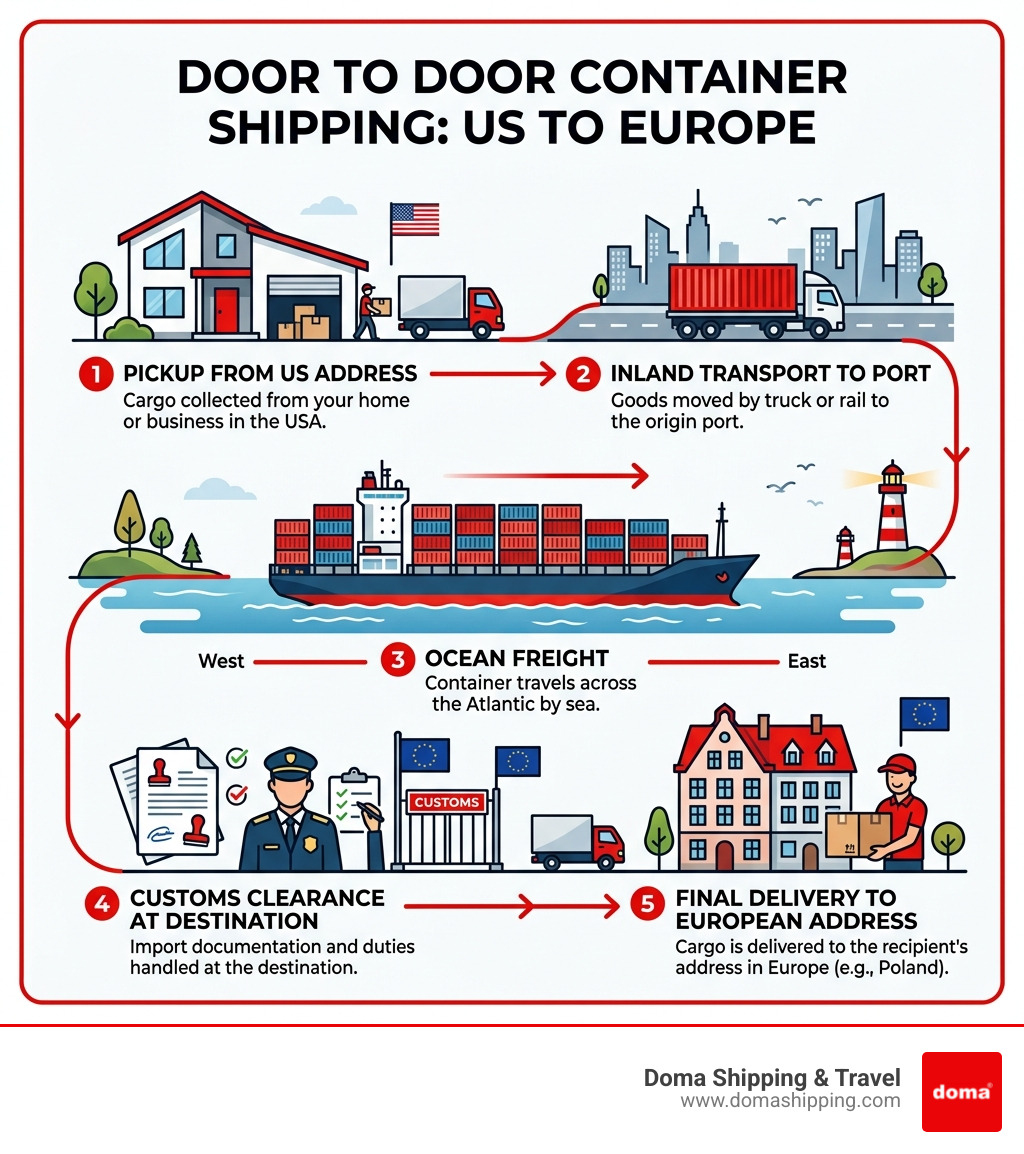
When we talk about door to door container shipping, we are describing the most comprehensive logistics solution available in the modern market. Think of it as a “concierge” service for your cargo. Instead of you acting as the project manager—hiring a trucker in Chicago, finding a customs broker, and then trying to locate a delivery driver in Poland—a single provider orchestrates every note of the symphony.
The process begins at the origin. Whether you are located in Melrose Park, Schiller Park, or the heart of Chicago, a truck arrives at your specified address to collect the goods. From that moment until the container is opened at its final destination in Europe, the responsibility remains with one entity. This “single point of contact” model is the secret weapon against logistics chaos, as it eliminates the “he-said, she-said” finger-pointing that often happens when multiple independent carriers are involved.
For those looking for more details on how these comprehensive solutions work, you can explore our Door to Door Shipping resources to see how we bridge the gap between the US Midwest and the European continent.
To appreciate the value of an end-to-end service, it helps to look at the alternatives. In a standard port-to-port arrangement, the shipping line’s responsibility begins at the origin port (like New York or Savannah) and ends at the destination port (like Gdynia or Hamburg).
This leaves the “first mile” and “last mile” entirely up to you. You would need to arrange:
While some experienced high-volume importers use Ocean freight to the United States | iContainers for specific port-side needs, most individuals and mid-sized businesses find that the logistical hurdles of port-to-port shipping are simply too high.
In door to door container shipping, the freight forwarder acts as your expert navigator. We don’t just “move boxes”; we manage the multimodal coordination required to switch your cargo from a truck to a train, then to a massive ocean vessel, and finally back to a truck in Europe.
Our role includes:
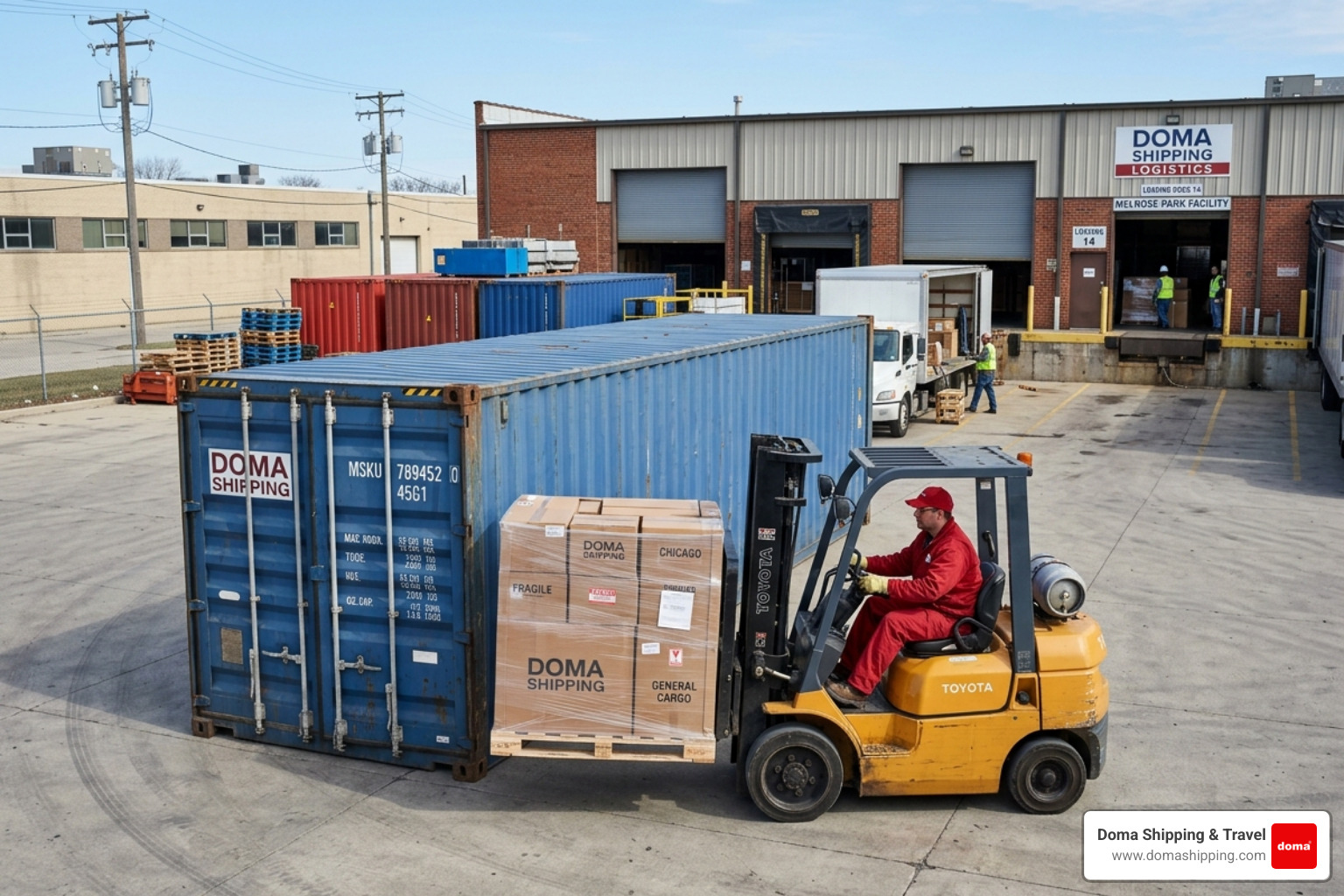
The journey of a container from the United States to Europe is a marvel of modern engineering and planning. Once your goods are packed—whether it’s a household move from Palos Hills or commercial machinery from a facility in Franklin Park—the container is loaded onto a chassis (a specialized trailer) and begins its trek toward the coast.
One of the first decisions you’ll make is choosing between Full Container Load (FCL) and Less than Container Load (LCL).
What exactly can you put in these containers? Almost anything that fits! We frequently handle a wide variety of goods for our clients in the Chicago suburbs:
If shipping is the “body” of international trade, documentation is the “soul.” Without the right paperwork, your cargo isn’t going anywhere. Navigating the bureaucratic waters of international shipping can feel like reading an ancient language, but it is the most critical step in ensuring a delay-free delivery.
Key documents you will encounter include:
For a deeper dive into these requirements, our guide on Shipping Smarter: Everything You Need to Know About International Container Transport provides a comprehensive checklist.
Incoterms (International Commercial Terms) are the “rules of the game.” They define exactly when the risk and responsibility transfer from the sender to the recipient. In door to door container shipping, two terms are most common:
Shipping to Poland or other EU nations requires specific knowledge of European customs. As of 2026, compliance with the Union Customs Code (UCC) is stricter than ever. This includes accurate HS Codes (Harmonized System codes) to classify your goods. If you misclassify a sofa as “industrial wood,” you could face significant delays. Our experience in the Polish market ensures that your cargo meets all local VAT and duty deferment requirements.
In April 2026, “where is my stuff?” should never be a mystery. Modern door to door container shipping relies heavily on technology to provide peace of mind.
With 77% of companies now viewing visibility as the foundation of their logistics strategy, we utilize GPS monitoring and real-time status updates. Whether your container is on a rail car in Ohio or a vessel in the middle of the Atlantic, you receive milestone alerts.
Enhanced visibility isn’t just about calming nerves; it’s about proactive management.
The industry has moved beyond paper ledgers. Today, we use WebCargo integrations and cloud-based logistics platforms to manage digital bookings and automated documentation. This tech-forward approach means that the information moves as fast as the cargo itself, reducing the risk of “lost” paperwork at international borders.
A comprehensive quote for door to door container shipping typically includes:
Transit times vary based on the specific route and current port conditions. Generally, a shipment from the US East Coast to Poland takes between 3 to 5 weeks. However, you should always account for “lead time”—the time it takes to position the empty container at your door and move it to the port. In 2026, schedule reliability has improved, but seasonal fluctuations (like the pre-holiday rush) can still add a week to the journey.
Navigating door to door container shipping doesn’t have to feel like a “Rubik’s cube blindfolded.” With over 30 years of experience, we at Doma Shipping & Travel have refined the art of moving cargo from the Chicago suburbs to the heart of Europe.
Whether you are shipping a single pallet of personal items or a fleet of containers for your business, our team handles the complexity so you don’t have to. From our locations in Algonquin, Roselle, and Mount Prospect to the ports of Europe, we ensure your shipment is safe, compliant, and on time.
Start your international shipment today and experience the simplicity of a truly end-to-end logistics partner.