
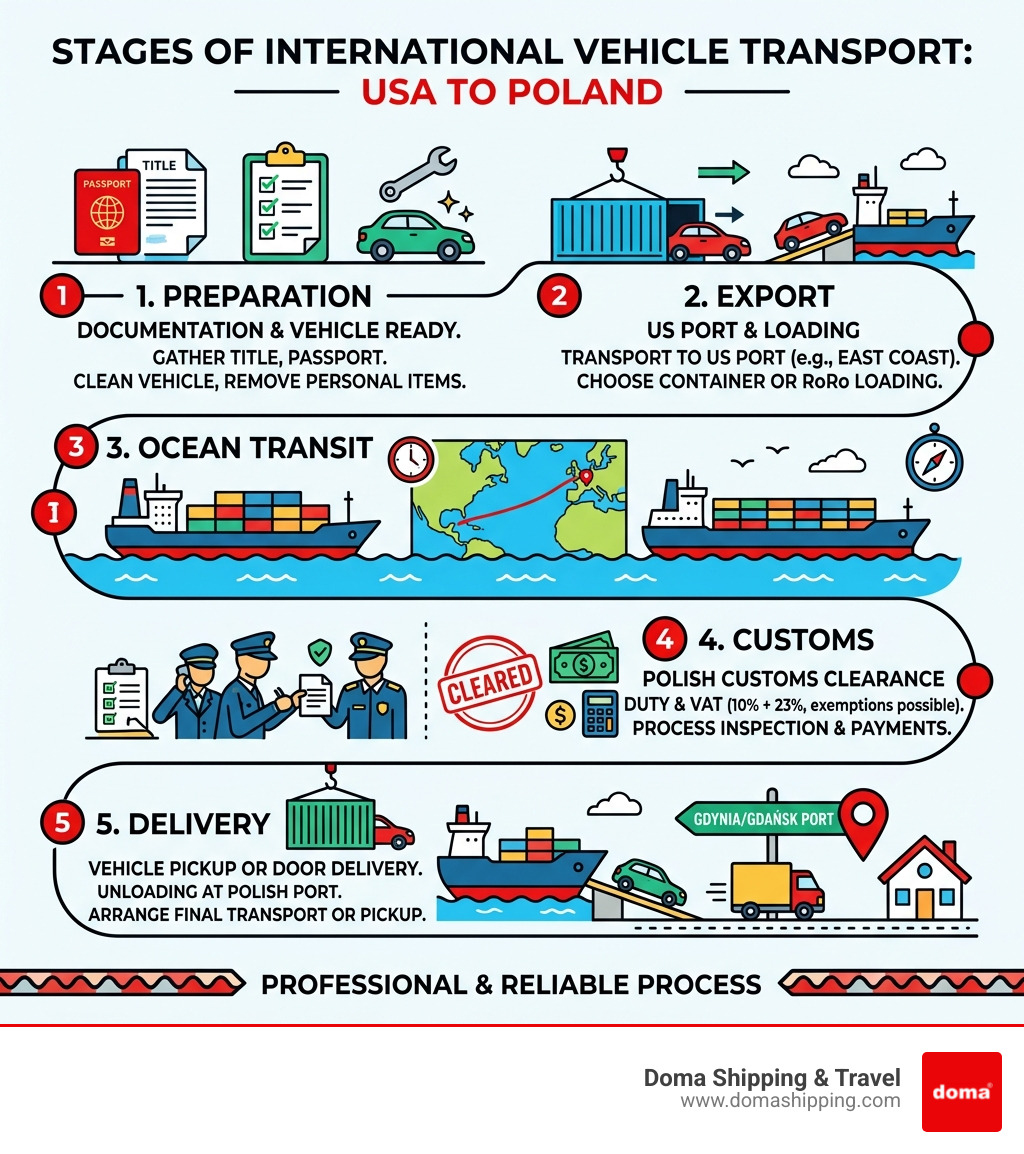
If you need to ship a car from USA to Poland, here is a quick overview of what the process involves:
How to ship a car from the USA to Poland — at a glance:
| Step | What’s involved |
|---|---|
| Choose a shipping method | Container shipping (shared or dedicated) or Roll-on/Roll-off (RoRo) |
| Prepare your documents | Original title, bill of sale, passport copy, power of attorney |
| Drop off or arrange pickup | Vehicle goes to a US port warehouse, typically on the East Coast |
| Ocean transit | 18–35 days depending on departure port |
| Polish customs clearance | 10% import duty + 23% VAT (exemptions may apply for relocations) |
| Vehicle pickup or delivery | From Gdynia or Gdańsk port to your destination in Poland |
Shipping a vehicle internationally is more involved than domestic transport. There are two countries’ customs rules to navigate, documentation requirements on both ends, and important decisions to make about how your vehicle travels across the Atlantic.
The good news is that this route — USA to Poland — is well-established. Thousands of vehicles make this journey every year, whether they belong to families relocating permanently, collectors importing a classic car, or individuals sending a vehicle to family overseas.
This guide walks you through every stage of the process clearly and completely.
Ship car from USA to Poland glossary:
When you decide to ship car from USA to Poland, the first major decision is the transport method. The choice usually comes down to how much protection you want for the vehicle and whether you intend to include personal belongings.
This is the most popular method for our clients in the Chicago area. Your vehicle is secured inside a steel shipping container, providing maximum protection from the elements and salt air during the Atlantic crossing.
For more details on handling larger equipment, you can explore our Vehicle & Machinery Shipping page.
RoRo involves driving the vehicle onto a specialized vessel that acts like a floating parking garage. While it is a standard method for many, it comes with strict limitations: the vehicle must be in good running condition, and you cannot leave any personal items inside. For many passenger cars destined for Poland, containerized shipping is often preferred due to the added security and the ability to include extra items.
The journey from the United States to the heart of Central Europe involves a well-coordinated logistics chain. For those shipping from our locations in Chicago, Des Plaines, or Schaumburg, the vehicle is typically transported to a major East Coast port, such as New York or New Jersey, before beginning its ocean voyage.
Poland’s coastline on the Baltic Sea offers two primary gateways for international vehicle arrivals:
The time your vehicle spends on the water depends heavily on the departure point:
Because we operate extensively out of the Midwest, we focus on streamlining the route to East Coast ports to ensure the most efficient transit times possible. Once the ship docks, customs clearance typically takes a few additional days before the vehicle is ready for pickup or inland delivery to cities like Warsaw, Kraków, or Poznań. Learn more about the specific arrival process at Samochody z USA do Polski.
To ship car from USA to Poland successfully, your paperwork must be flawless. U.S. Customs and Border Protection is very strict about vehicle exports to prevent the transport of stolen property or vehicles with outstanding liens.
Before the vehicle can even be loaded onto a ship, we must present several original documents to US authorities:
For a deep dive into the legalities of relocating with a vehicle, see our Wysyłka auta z USA do Polski – Mienie przesiedleńcze z Domashipping – Travel – Kompletny przewodnik prawno-proceduralny.
Importing a vehicle into Poland generally involves three main financial components: Import Duty, VAT (Value Added Tax), and Excise Tax (Akcyza). However, depending on your situation, you might not have to pay the full amount.
| Status | Import Duty | VAT | Excise Tax |
|---|---|---|---|
| Standard Import | 10% | 23% | Varies by engine size |
| Relocation (Mienie Przesiedleńcze) | Exempt* | Exempt* | Exempt* |
| Classic Cars (30+ years) | 0% | 7-8% | Exempt |
If you are moving back to Poland permanently after living in the USA for at least 12 months, you may qualify for a “resettlement property” exemption. To qualify, you must have owned and used the vehicle in the USA for at least six months prior to shipping. This can result in significant savings on import fees. You can find more information on this specific process at Mienie przesiedleńcze z USA do Polski.
Poland has a soft spot for automotive history. Vehicles that are over 30 years old, in original condition, and no longer in production can be imported as “collector’s items.” This status often grants a reduced VAT rate (typically 8%) and exempts the vehicle from standard import duties and excise taxes.
Electric vehicles (EVs) also have unique requirements. Due to the high-capacity lithium-ion batteries, they are classified as “dangerous goods” for ocean transit. This requires specific labeling, battery state-of-charge limits (usually around 30%), and additional safety documentation. For those interested in shipping two-wheeled vehicles, check out Motory z USA do Polski.
Before vehicle handover, confirm the agreed receiving location and preparation instructions for the booked transport. The loading point and schedule vary by service; do not assume a DOMA warehouse in Roselle or Schiller Park.
American cars are built to US standards (DOT), while Poland follows European standards (ECE). To register your car in Poland, you will likely need to make a few modifications:
Once modified, the vehicle must pass a technical inspection (SKP – Stacja Kontroli Pojazdów) before you can head to the local Wydział Komunikacji (Department of Communication) for registration. For those moving their entire lives, our Przeprowadzki do Polski section offers more guidance.
If you choose container shipping, the answer is generally yes. You can pack the trunk and the backseat (below the window line) with personal items. However, these must be clearly inventoried for customs. If you are shipping via RoRo, the car must be completely empty.
We offer various levels of protection. While the Carriage of Goods at Sea Act (COGSA) provides a basic level of carrier liability, it is often insufficient for the full value of a modern vehicle. We recommend “All-Risk” marine insurance, which covers the vehicle from the moment it is picked up until it is delivered in Poland.
After the car clears customs and passes its technical inspection, you will need to translate your US documents (Title and Bill of Sale) into Polish by a sworn translator (tłumacz przysięgły). With these in hand, along with proof of paid duties (or exemption), you can register the vehicle at your local municipal office.
Shipping a vehicle across the ocean is a significant undertaking, but it doesn’t have to be a stressful one. With over 30 years of experience, we at Doma Shipping & Travel pride ourselves on making the connection between the United States and Poland seamless. From our many locations around Chicago to the bustling ports of Gdynia and Gdańsk, we ensure your vehicle is handled with professional care every step of the way.
Whether you are returning home, sending a gift to family, or importing a dream car, we provide the comprehensive logistics and customs expertise needed to get your wheels on Polish roads. Ready to start your journey? Visit us at www.domashipping.com/service/samochody-z-usa-do-polski/ to learn more about how we can assist you.