
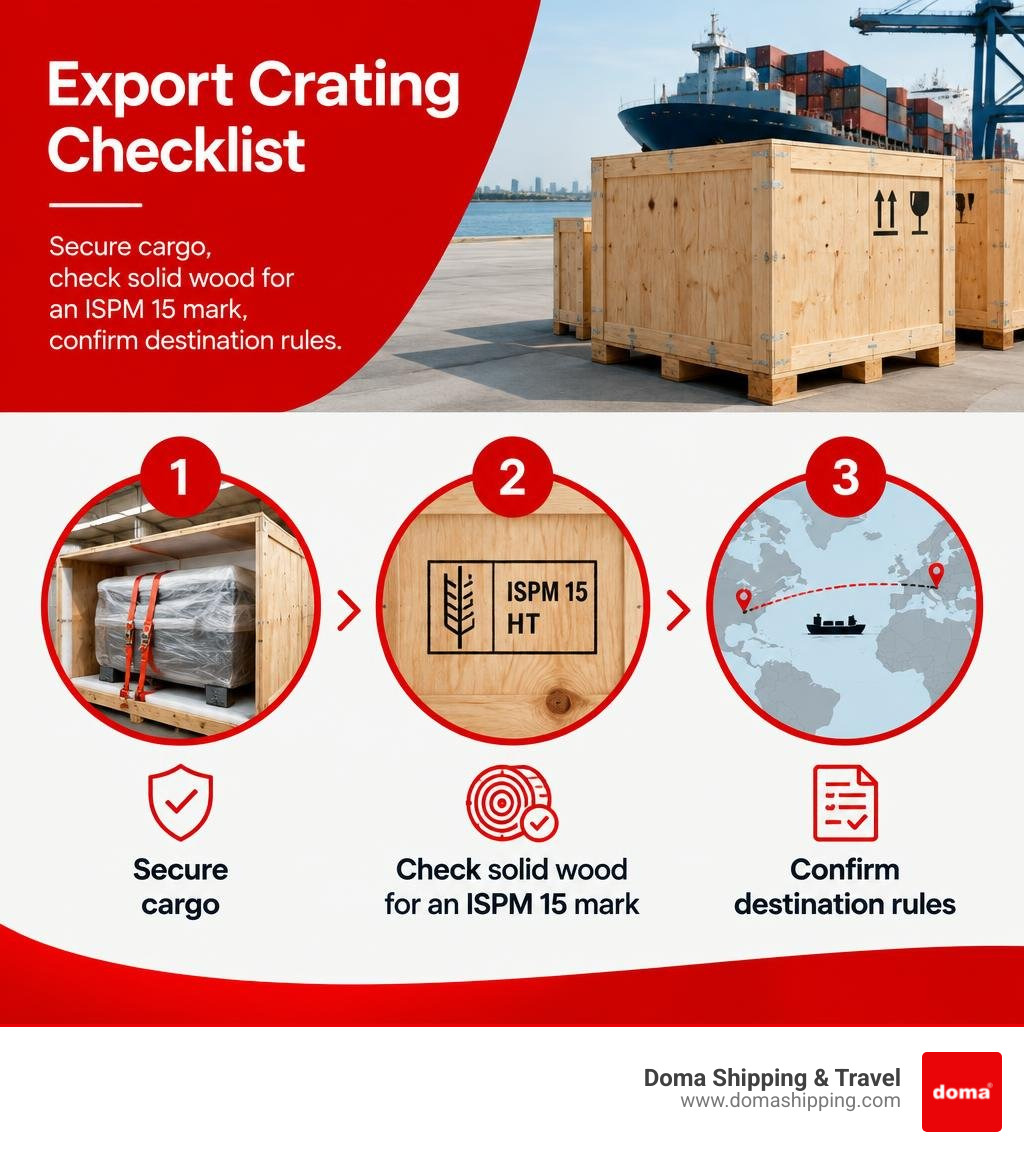
For crating for international shipping, choose a crate that fits the cargo and keeps it secure during handling. If the crate contains regulated solid wood, check for a legible ISPM 15 mark before it ships. The mark identifies the approved wood treatment; a missing or unreadable mark can lead to inspection or delays at the destination.
For a shipment from the Chicago area to Poland, share the cargo’s contents, dimensions, and weight when planning your shipment. Discuss route-specific freight and customs arrangements with Doma Shipping & Travel before sealing the crate. Confirm the current wood-packaging rules for your specific cargo and route before the crate is sealed.
Crating for international ship glossary:
When preparing cargo for ocean or air freight, understanding international phytosanitary and packaging standards is vital. Solid wood packaging material (WPM)—including timber crates, wooden boxes, load boards, and dunnage—presents an ecological risk if untreated, as it can harbor invasive pests and plant diseases. To mitigate these environmental risks, the International Plant Protection Convention (IPPC) established strict global guidelines governing wooden transport materials across international borders.
Poland and other European Union destinations apply phytosanitary controls to regulated wood packaging. Requirements and enforcement decisions can vary by cargo, route, and border authority. Maintaining commercial goods shipping compliance requires meeting all phytosanitary, export packaging, and customs documentation requirements prior to dispatch from facilities in Chicago, Mount Prospect, Algonquin, Park Ridge, or elsewhere across the greater metropolitan area.
The core standard governing international solid timber packaging is the International Standards for Phytosanitary Measures No. 15 (ISPM-15). Under ISPM-15, all non-manufactured, solid wood materials greater than 6 mm in thickness must undergo an approved phytosanitary treatment method before crossing international boundaries.
The primary approved treatment is conventional Heat Treatment (HT), which requires heating the solid timber core to a minimum of 56 degrees Celsius (132.8 degrees Fahrenheit) for at least 30 continuous minutes. Dielectric heating (DH) is another approved thermal method. Once treated, the wood must be visibly marked with the official IPPC certification stamp.
A certified ISPM-15 mark features specific components:
All solid wood components must also be debarked before treatment. Processed, engineered wood products—such as plywood, oriented strand board (OSB), particleboard, and hardboard—are manufactured using heat, pressure, and glues, making them naturally exempt from ISPM-15 treatment and stamping requirements when used exclusively.
Ensuring your export packaging is fully compliant before departure from the US prevents severe operational delays overseas. Phytosanitary inspection authorities at EU entry points will check the exterior of wooden shipping containers for clean, legible IPPC stamps on at least two opposite faces.
To safeguard your shipment, integrate a quality assurance step into your logistics workflow:
Failure to verify compliance before container loading can result in the European quarantine service denying entry, ordering the entire crate re-exported to the United States, or transferring cargo into compliant containers at the port terminal, adding significant storage and re-handling expenses.
Selecting between a collapsible (knockdown) wood shipping crate and a traditional, permanently assembled solid timber box depends on several factors: warehouse storage constraints, assembly capabilities, cargo payload, and whether the shipping loop is one-way or reusable.
Traditional wooden crates are constructed using solid timber dimensional lumber or heavy plywood sheathing secured with nails, wood screws, or heavy industrial staples. These crates offer rigid structural protection for oversized or heavy freight, but they arrive fully assembled, occupying substantial floor space before loading.
In contrast, collapsible wood shipping crates utilize engineered structural panels joined by interlocking steel clips, metal latches, or grooved corner profiles. They ship and store flat-pack style, allowing businesses to store larger quantities of crating materials without consuming excessive warehouse capacity.
| Packaging Feature | Traditional Fixed Wooden Crates | Collapsible / Knockdown Crates |
|---|---|---|
| Storage Footprint | Occupies space in its assembled form | Stores flat when designed for knockdown use |
| Inbound Freight Planning | Empty units take up more volume in transit | Flat components may use less volume in transit |
| Assembly | Pre-assembled or built manually from lumber | Interlocking components are assembled according to the manufacturer’s instructions |
| Stacking | Depends on framing and load rating | Depends on the manufacturer’s load rating and handling guidance |
| Fastener Mechanism | Nails, heavy wood screws, or pneumatic staples | Steel clips, corner extrusions, or integrated latches |
| ISPM-15 Compliance | Requires full HT timber inspection and stamps | Requires HT lumber or exempt engineered plywood |
| Best Transit Application | Heavy, oversized machinery or unique payloads | High-volume exports, standardized goods, LCL ocean freight |
Warehouse space in major transit hubs like the Chicago metropolitan area carries significant operational value. Storing rigid, assembled wooden boxes rapidly consumes square footage that could otherwise hold active freight.
Collapsible wooden crates offer notable structural and storage advantages:
Collapsible wood crates are designed for rapid deployment on busy packing lines, eliminating the need for pneumatic nail guns or custom carpentry.
Choosing between standard modular crate sizes and engineered custom crating depends on payload dimensions, fragile internal components, and the chosen method of international transport.
Standard export crate dimensions are optimized for standard 20-foot and 40-foot ocean containers, as well as European road trailers. Using standard modular sizes simplifies calculations for pallet shipping to Europe (route availability to be confirmed with Doma) and minimizes dead space within containerized loads.
However, non-standard items require custom crating solutions. Custom crating is recommended when:
For complex shipments from the Chicago area, discuss packaging, route, and handling arrangements with Doma Shipping & Travel based on the cargo and destination.
Industrial wooden crating is a foundational element across multiple commercial sectors shipping heavy, sensitive, or high-value commodities from the US to European markets.
Heavy equipment, CNC machinery, pumps, valves, and manufacturing spare parts require heavy-duty timber skids and bolted wooden framing. These crates support high concentrated floor loads and provide accessible anchor points for container lashing and overhead crane rigging.
Automotive components, engines, transmissions, and restoration assemblies moving overseas require rigid wooden packaging to prevent mechanical fluid leaks, surface scuffing, or structural frame shifting inside ocean containers.
Diagnostic machinery, optical devices, and cleanroom instruments require engineered crates with internal vibration dampeners, floating sub-bases, and airtight moisture barriers to protect sensitive calibration settings during sea or air transit.
Aircraft parts, structural composites, and engine assemblies demand certified export crating that complies with strict phytosanitary regulations while offering high strength-to-weight ratios to control international air freight expenses.
Valuable furnishings, gallery displays, and historic heirlooms require specialized wooden museum crates. When evaluating overseas furniture shipping factors, sturdy external crating paired with non-abrasive interior wraps protects fine finishes against transit shifts and handling strain.
If an export crate constructed from regulated solid wood arrives at an international border without an official, legible ISPM-15 stamp, customs and phytosanitary border authorities may detain the shipment. Depending on the destination port’s regulations and border authority decisions, the cargo may be placed into quarantine, subjected to mandatory off-site heat treatment or chemical fumigation at the shipper’s expense, or rejected and ordered re-exported to the United States. These actions routinely result in significant port storage fees, demurrage charges, and delivery delays.
Actual storage and freight effects depend on crate dimensions, freight classification, route logistics, and whether the shipping operation is one-way or reusable. Flat-pack crates can reduce the space needed to store or transport empty packaging, but the result depends on the crate design and the applicable carrier or warehouse arrangements.
A business should invest in custom crating when shipping cargo with non-standard dimensions, an uneven center of gravity, delicate surface finishes, or high sensitivity to shock and vibration. Custom crates feature internal timber blocking, tailored shock-absorbing foam, and vapor barrier bags, ensuring maximum protection while avoiding the excess dimensional freight charges that come with oversized standard boxes.
Proper crating for international ship operations helps protect cargo and support customs compliance. Verify ISPM-15 requirements for regulated solid wood packaging, choose a crate design suited to the cargo, and match internal bracing to the shipment’s handling needs.
Doma Shipping & Travel serves the greater Chicago area, including Melrose Park, Mount Prospect, Roselle, Palos Hills, Algonquin, Niles, and Park Ridge. Discuss the cargo, destination, and route-specific service arrangements with the local office before finalizing export packaging.
To ensure your overseas shipments are properly packaged and fully compliant with international shipping standards, reach out to our international shipping team to discuss your cargo specifications, request an accurate quote, and schedule your shipment.