
Domestic international shipping refers to the full process of preparing, handling, and dispatching a shipment within the USA before it crosses borders to reach another country — in this case, Poland or elsewhere in Europe.
Here’s the quick breakdown of how the two shipping types differ:
| Factor | Domestic Shipping (USA only) | International Shipping (USA → Europe) |
|---|---|---|
| Customs forms | Not required | Required for all shipments |
| Delivery time | 1–5 business days | Several days to multiple weeks |
| Documentation | Basic label | Commercial invoice, customs declaration, HS codes |
| Duties & taxes | None | May apply based on value and destination |
| Regulations | Minimal | Country-specific import laws apply |
| Prohibited items | Few restrictions | Stricter rules vary by destination country |
It’s a big distinction. Sending a box from Chicago to Warsaw is fundamentally different from sending it to another US city — even if the first leg of the journey looks the same.
The complexity isn’t just about distance. It’s about documentation, customs compliance, restricted items, and understanding exactly what happens to your shipment once it leaves US soil.
If you’re shipping personal belongings, packages, or goods from the USA to Poland or Europe, understanding this difference is the first step to avoiding costly delays, seizures, or surprises at the border.
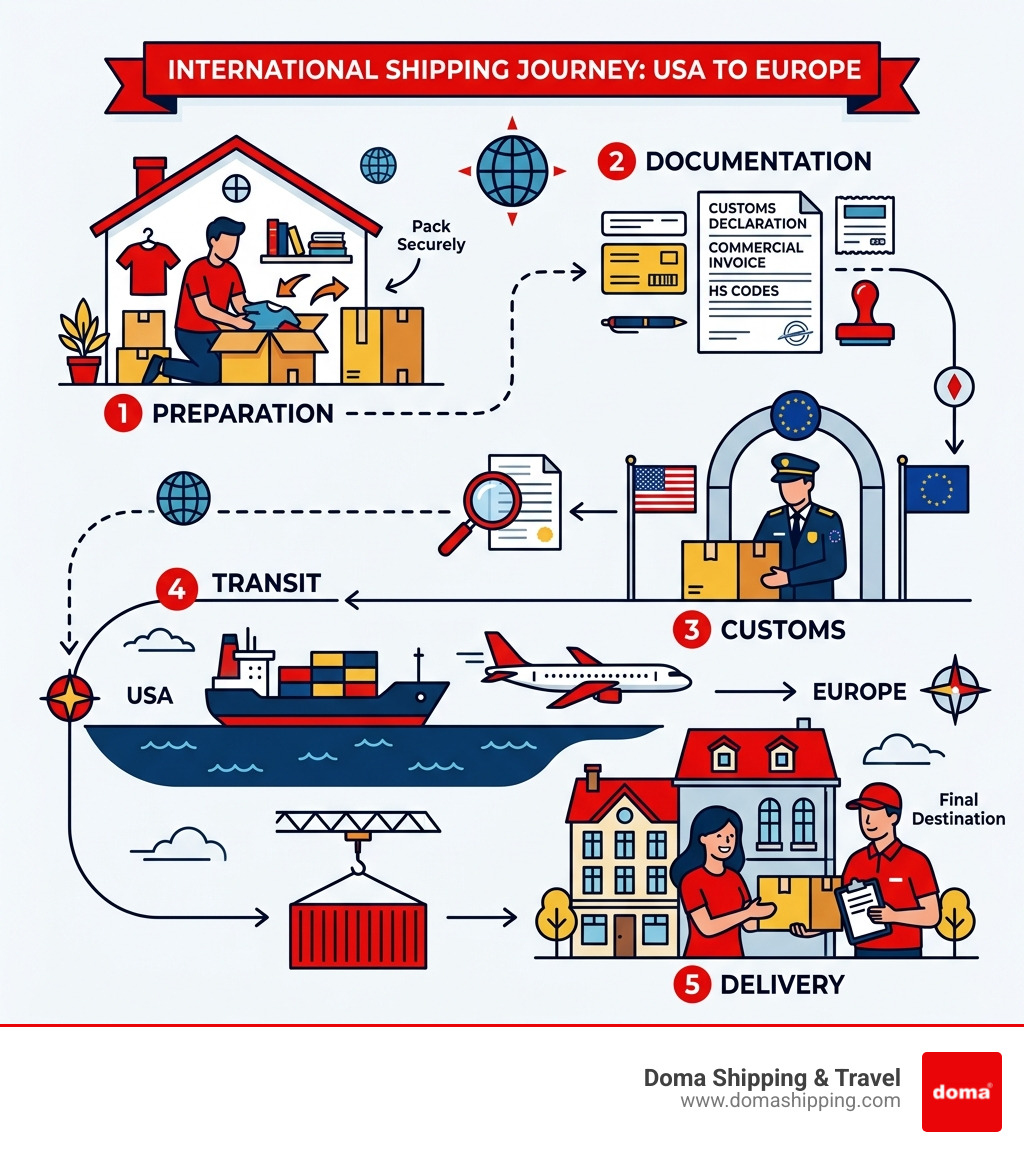
When we talk about domestic international shipping, we are looking at a sophisticated logistics chain that begins at your doorstep in places like Chicago, Niles, or Schaumburg and ends at a destination thousands of miles away. Unlike moving goods between states, international transport involves navigating a maze of border regulations and ensuring strict regulatory compliance.
At Doma Shipping, we specialize in bridging this gap. Whether you are utilizing our International Parcel Shipping for smaller items or require Door-to-Door Shipping for a more hands-off experience, the preparation phase is critical. Every package that crosses an international border requires a formal declaration of its contents, value, and intended use. This isn’t just a formality; it is a legal requirement that determines how your shipment is treated by customs officials in Europe.
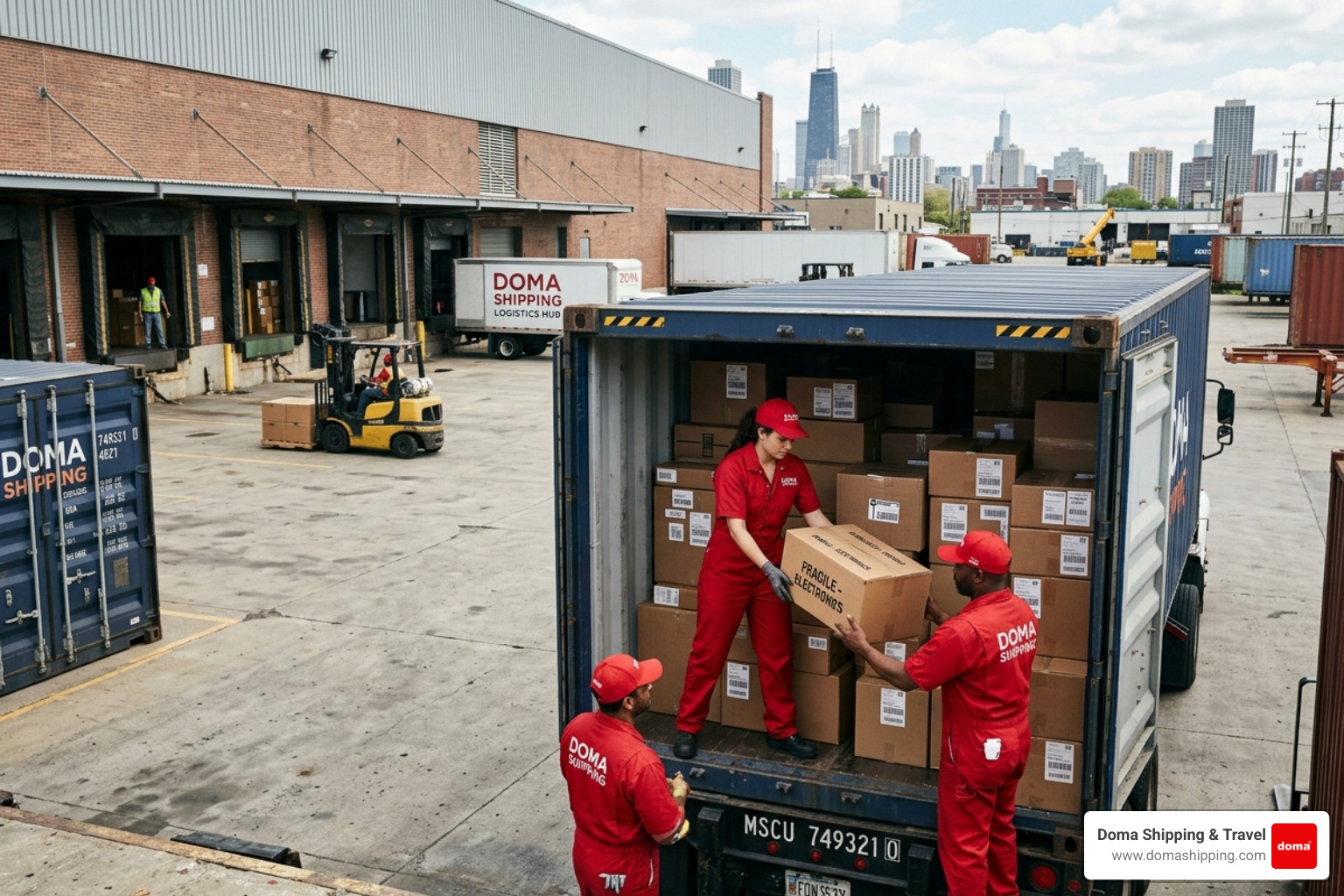
One of the most common questions we encounter is: “How long will it take?” While domestic transit within the US is often predictable, international timelines are influenced by several variables. Transit days are just one part of the equation; the time spent in customs clearance can vary significantly based on the accuracy of your paperwork and the current volume at the port of entry. Proper logistics planning—choosing the right departure dates and ensuring all digital data is transmitted to customs authorities ahead of time—can help mitigate these variables.
To accommodate different needs, we offer various service tiers. Standard delivery via ocean freight is the most common choice for those prioritizing volume and reliability. For more time-sensitive items, premium transit via air freight is available. We also provide deferred options for those who have more flexible schedules and are shipping larger quantities of household goods or personal effects.
The “mind-losing” part of shipping often stems from paperwork. However, when handled correctly, documentation is simply a roadmap for your cargo. For every international shipment, a commercial invoice (or a detailed packing list for personal items) is the most important document. It must include Harmonized System (HS) codes—internationally recognized numerical signatures that tell customs exactly what is inside the box.
If you are relocating, you may be eligible for specific exemptions. Our expertise in Settler’s Effects from USA to Poland helps individuals moving their lives back to Europe navigate the complexities of duty-free entry for used personal property.
Customs authorities in Europe apply import duties and tax obligations based on the value of the goods and the “de minimis” thresholds of the destination country. While some low-value items may pass through without additional fees, most Commercial Goods Shipping requires a formal entry process. Understanding these rules before the box leaves Illinois is essential to ensure a smooth transition through European ports.
For personal shipments, an itemized list is mandatory. You cannot simply write “clothes” or “gift.” Customs officials require specificity—for example, “5 cotton t-shirts” or “1 plastic kitchen mixer.” This level of detail, combined with an accurate value assessment and origin verification, ensures that the authorities have no reason to flag your shipment for an intensive (and time-consuming) physical inspection.
International shipments endure much more handling than domestic ones. A package traveling from Des Plaines to Krakow will be moved by forklifts, stacked in containers, and potentially subjected to varying climates and humidity levels. Because of this, we recommend reinforced materials and extra cushioning.
If you are shipping Household & Personal Belongings Shipping, the “H-tape” method is your best friend—sealing all seams of the box with heavy-duty shipping tape to prevent the box from bursting under pressure.
Weight and size limits are stricter for international parcels compared to domestic ones. Most standard international parcel services have a maximum weight limit (often around 70 lbs for priority services or as low as 4 lbs for economy small-packet services). Beyond these limits, we move into the realm of freight.
For those with significant volume, Full Container Load Shipping offers the most security, as you have the entire 20-foot or 40-foot space to yourself.
Before you pack, you must check the prohibited list. Common items that are perfectly fine to drive across the US are often banned in international cargo. This includes:
Choosing between air and sea is the biggest decision you’ll make in the domestic international shipping process. Air freight is the fastest way to reach Europe, typically taking just a few days once the plane leaves the runway. However, for the vast majority of our clients in the Chicago suburbs, ocean freight provides the best balance of capacity and reliability, especially for those utilizing Sea & Air Parcels to Poland.
Ocean freight is the backbone of global trade. Through containerization, we can safely transport massive amounts of goods. If you don’t have enough to fill a whole container, we offer Less Than Container Load Shipping, where your goods are securely consolidated with others. This allows you to benefit from the infrastructure of ocean transport without needing a warehouse-sized shipment.
Shipping a car or heavy equipment requires more than just a sturdy box. Our Vehicle & Machinery Shipping service involves specialized loading techniques, such as blocking and bracing, to ensure your vehicle doesn’t move an inch during the Atlantic crossing. We handle the US Customs export title clearance, which is a mandatory step before any vehicle can legally leave a US port.
Addressing for Europe is slightly different than the US. You must include the recipient’s full name, the street address, the postal code (which often comes before the city in Europe), and the country. Most importantly, always include a local phone number for the recipient. Customs and local couriers in Europe will use this to contact them regarding delivery or any necessary tax payments.
We highly recommend international insurance for all shipments to protect against the unforeseen. Unlike domestic shipping, where basic coverage might be included, international transit involves more risk factors. We also provide real-time tracking so you can monitor your shipment’s journey from our warehouse in Illinois all the way to its final destination in Poland or Europe.
The number one cause of delays is incomplete or inaccurate documentation. Ensure your item descriptions are specific, your values are realistic, and your contact information is correct. Also, be aware of European holidays and peak shipping seasons (like the lead-up to Christmas), which can slow down port operations.
Navigating domestic international shipping doesn’t have to be a headache. By understanding the fundamental differences in documentation, packaging, and regulations, you can ensure your goods reach their destination safely.
At Doma Shipping & Travel, we bring over 30 years of experience to every shipment. From our roots in the Chicago area—serving communities in Mount Prospect, Palos Hills, Algonquin, and beyond—we have built a reputation for comprehensive logistics expertise. Whether you are sending a small parcel to a loved one or moving an entire household and vehicle to Poland, we provide the experienced touch needed for international success.
Beyond shipping, we support our community with online shopping assistance, money transfers, and travel booking, making us a true one-stop shop for your international needs. Ready to start your journey? Visit us at www.domashipping.com/ to learn more about how we can help you cross borders with confidence.