
edible arrangements international delivery is absolutely possible — but it works very differently depending on where you’re sending and what’s inside the package.
Here’s a quick overview of your main options:
| Option | Coverage | Best For |
|---|---|---|
| Local edible arrangement franchise networks | 31 countries, 1,500+ locations | Local fulfillment near the recipient |
| Specialist gift basket services | 200+ countries | Pre-packaged, non-fresh fruit gifts |
| International shipping carriers | 170+ countries | Shelf-stable or chocolate items |
A few things to know upfront:
The challenge is real. Fresh fruit is perishable, regulations vary by country, and not every carrier is equipped to handle temperature-sensitive gifts. Whether you’re sending a birthday treat to family in Poland or a corporate gift to a client in Germany, the logistics require careful planning.
This guide walks you through everything — from customs rules and packaging to the best alternatives for getting sweet gifts safely across borders.
Know your edible arrangements international delivery terms:
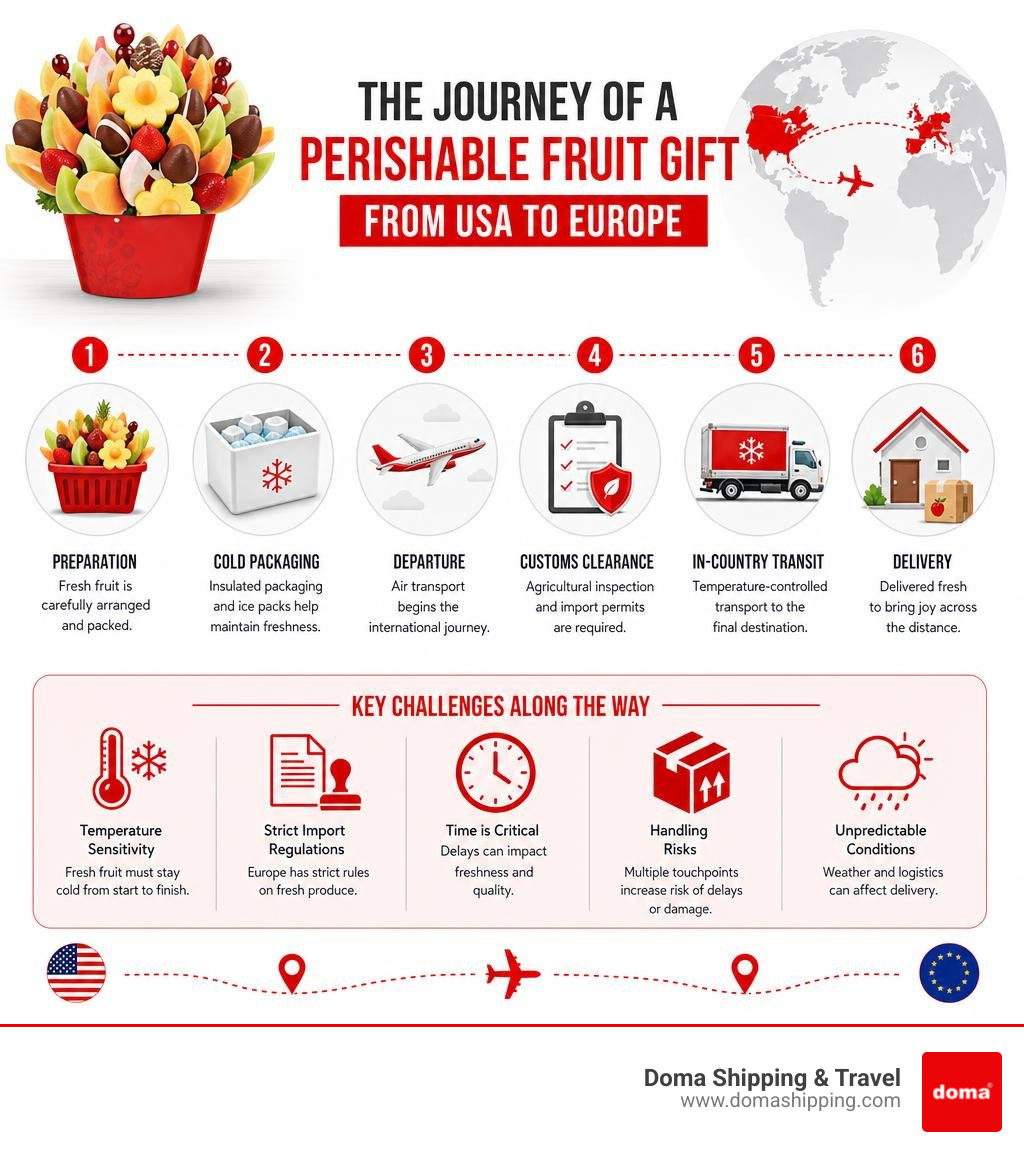
When you want to send a stunning, mouth-watering fruit arrangement to someone overseas, the first thing to understand is how the global logistics network operates. You cannot simply walk into a local store in Chicago, buy a fresh melon-and-strawberry bouquet, and hand it to an international courier to fly across the Atlantic. By the time it clears customs in Europe, you would have a box of spoiled, fermented fruit.
To make edible arrangements international delivery work, the industry relies heavily on localized fulfillment networks. Many specialty gift networks operate as global franchises. Today, these networks have over 1,500 franchise locations worldwide across 31 countries, and there are active plans to open more than 300 new stores internationally.
When you place an order for international delivery through a major edible arrangements website, the system does not ship the physical product from your local Illinois neighborhood. Instead, it routes the order details to a franchise location nearest to your recipient’s physical address.
For instance, if you are ordering from our service area in the Chicago suburbs — such as Roselle, Schaumburg, or Mount Prospect — and your recipient is located in London, the order is fulfilled by a local UK kitchen. They handcraft the arrangement using local produce and deliver it using local, temperature-controlled delivery vehicles.
You can explore global presence through an edible arrangements global locations directory. If your recipient is in an area served by these international stores, you can easily organize delivery for items like chocolate-dipped strawberries, fresh fruit bouquets, or even specialized floral additions like edible flowers.
However, if your recipient lives in a country or region without a local franchise — such as many parts of Eastern Europe, including Poland — direct local fulfillment of fresh fruit arrangements is not an option. In these situations, you have to look at alternative gift-shipping methods, utilizing professional freight forwarding and international logistics services to transport shelf-stable sweet treats, high-quality chocolates, or beautifully preserved gourmet baskets.

Shipping fresh, perishable items across international borders introduces a unique set of logistical hurdles. Unlike shipping a book or a piece of clothing, perishable items have a highly sensitive shelf life that is measured in hours, not weeks.
The primary challenges include:
Because of these extreme sensitivities, sending fresh-cut arrangements directly from the US to Europe is practically impossible. Instead, smart senders rely on sending beautifully packaged, shelf-stable alternatives. When choosing a gift to send across the ocean, it is vital to select items that can withstand the journey. For a deeper look at what makes a great long-distance gift, check out our guide on the best gifts to send abroad to friends and family.
Even if you solve the temperature and transit challenges, you still have to face the strict barrier of international customs. Every country has rigorous agricultural and biosecurity laws designed to protect local ecosystems from foreign pests, diseases, and invasive species.
Fresh fruits and vegetables are among the most heavily restricted items in global shipping. When a package containing fresh fruit arrives at an international border, it is subject to immediate agricultural inspection. In almost all cases, customs officials in Europe will confiscate and destroy fresh, unprocessed agricultural products sent by individuals, as they lack the mandatory phytosanitary certificates required for commercial agricultural imports.
Key customs considerations include:
Navigating these rules can be incredibly stressful, but with the right preparation and knowledge, you can avoid having your thoughtful gift stuck in a customs warehouse. To learn more about how to prepare your shipments for smooth border crossings, read our practical advice on how to send love across borders without the customs headache.
Since fresh-cut fruit arrangements cannot be safely shipped directly from the USA to Europe, many senders choose to ship high-quality chocolates, gourmet baked goods, or specialized dried fruit gift baskets. These items offer a similar sense of luxury and indulgence but are far more resilient during transit.
However, shipping chocolate and processed sweets internationally still requires a high level of care, particularly when it comes to temperature control. Chocolate is notoriously sensitive to environmental changes.
When shipping chocolate overseas, you must account for the five critical factors of chocolate transit: temperature, fragility, moisture, time, and customs. The melting point of standard milk chocolate is between 86°F and 90°F (30°C to 32°C), which is easily reached inside cargo planes, customs warehouses, and delivery trucks during the warmer months of the year.
To protect these delicate items, professional logistics and shipping services utilize specialized cold-chain packaging techniques. By utilizing expedited transport methods and insulating the cargo, we can help ensure that your gourmet sweet treats arrive at their European destination in pristine, solid condition.
To successfully ship chocolates, gourmet cookies, or dipped treats without them turning into a melted, sticky mess, you must create a micro-climate inside the shipping box. This involves using specialized materials designed to block external heat and manage internal moisture.
Here is how to manage these factors effectively:
If you are planning to send sweet gifts for specific seasonal events, such as springtime holidays, you can find tailored advice in our guide on international Easter delivery: sending sweet surprises overseas.
If you want to completely eliminate the risk of melting or spoilage, the best strategy is to select sturdy, shelf-stable gourmet alternatives that capture the elegance of a fresh fruit bouquet but are built to survive international travel.
Excellent alternatives include:
For those looking to ship during the winter holidays, choosing the right combination of sturdy items is key to a successful delivery. Discover our top recommendations in our article on holiday gift shipping: best boxes and baskets.
If you decide to assemble and ship your own custom gourmet gift basket from the Chicago area to Europe, proper packaging is the single most important factor determining whether your gift arrives looking like a professional masterpiece or a chaotic jumble of loose items.
During international transit, your package will experience vibrations, sudden movements, and changes in atmospheric pressure. Items must be packed so tightly and securely that there is absolutely zero movement inside the box when it is gently shaken.
To help you decide which types of sweet treats to include in your international shipment, here is a comparison of how different food types behave during transit:
| Gift Type | Transit Stability | Packaging Requirements | Customs Risk Level |
|---|---|---|---|
| Fresh Cut Fruit | Extremely Low | Refrigerated / Not recommended for direct export | High (Often confiscated) |
| Dried Fruit Trays | High | Airtight wrapping, sturdy outer box | Low (Generally accepted) |
| Chocolates & Truffles | Medium | Thermal liners, gel cool packs, moisture barriers | Low to Medium (Check dairy rules) |
| Gourmet Cookies | High | Individual wrapping, rigid tins, double-boxing | Low (Highly stable) |
To ensure your gourmet gift basket survives the long journey from Illinois to Europe, follow this professional packaging method:
For a detailed comparison of how professional shipping services handle these fragile gift shipments, take a look at our breakdown of the 5 best international gift delivery services compared.
An perfectly packed gift can still fail to reach its destination if the paperwork is incorrect. International shipping requires precise documentation to pass through customs smoothly and find its way to the recipient’s door.
When preparing your shipment, make sure to:
It is also wise to keep in mind what happens on the receiving end. While rare, delivery mistakes can happen with any carrier. To understand the legal and practical realities of incorrect deliveries, you can read about the interesting scenarios discussed in this article on what happens if you receive an edible arrangement by mistake.
No, you cannot safely or legally ship fresh-cut fruit arrangements directly from the USA to Europe. Fresh-cut fruit is highly perishable and will spoil within days, far faster than standard international shipping times. Additionally, European customs authorities enforce strict agricultural bans on unprocessed fresh produce to prevent the introduction of foreign pests and plant diseases.
If you wish to send fresh fruit arrangements, you must use a service that offers local fulfillment within the recipient’s country, such as global franchise networks for edible arrangements. If you are shipping from our service areas in Illinois to countries like Poland where local franchises are not available, we highly recommend sending beautifully arranged dried fruit baskets or premium chocolate gifts instead. Learn more about sending beautiful gifts to Poland in our guide: Surprise Them in Poland: A Guide to Sending Thoughtful Gifts.
Customs offices treat chocolate-dipped fresh fruits with the same strictness as regular fresh fruit. Because the fruit inside is fresh and unprocessed, it is subject to immediate agricultural inspection and is highly likely to be confiscated and destroyed at the border.
However, commercially packaged chocolates, chocolate truffles, and chocolate-covered dried fruits are generally permitted. These items have undergone extensive processing, which eliminates agricultural biosecurity risks. As long as the ingredients are clearly declared on the packaging and the customs form, chocolate-covered processed treats will pass through customs without issue.
The most reliable way to ensure sweet gifts arrive in perfect condition is to use expedited shipping services combined with professional thermal packaging. By packing your items using the double-boxing technique, lining the shipping container with thermal barriers, and using frozen gel cool packs, you can protect temperature-sensitive items like gourmet chocolates or specialty baked goods from the elements.
Additionally, choosing to ship during the cooler autumn and winter months naturally reduces the risk of heat damage. For those looking to send floral-themed gifts or other delicate items, you can explore creative options in our article Say It with Petals Across the Ocean.
Sending a thoughtful, delicious gift across the ocean is a wonderful way to celebrate milestones, share holiday joy, or simply let someone know you are thinking of them. While edible arrangements international delivery for fresh-cut fruit has its limitations due to the laws of nature and strict customs regulations, you can easily send stunning, high-quality alternatives that carry the exact same warmth and sophistication.
At Doma Shipping & Travel, we bring over 30 years of international logistics and freight forwarding experience to help you stay connected with your loved ones in Poland and across Europe. Operating from our convenient locations across the Chicago area — including Niles, Des Plaines, Schaumburg, Park Ridge, and Franklin Park — we specialize in safe, efficient international parcel delivery.
Whether you are shipping a custom-packed basket of premium chocolates, holiday sweet treats, or personal belongings, our experienced team ensures your packages are prepared, documented, and transported with the utmost care. Let us take the hassle out of your international shipping needs so you can focus on sharing life’s sweetest moments.
Explore our specialized shipping options for your upcoming gifts: