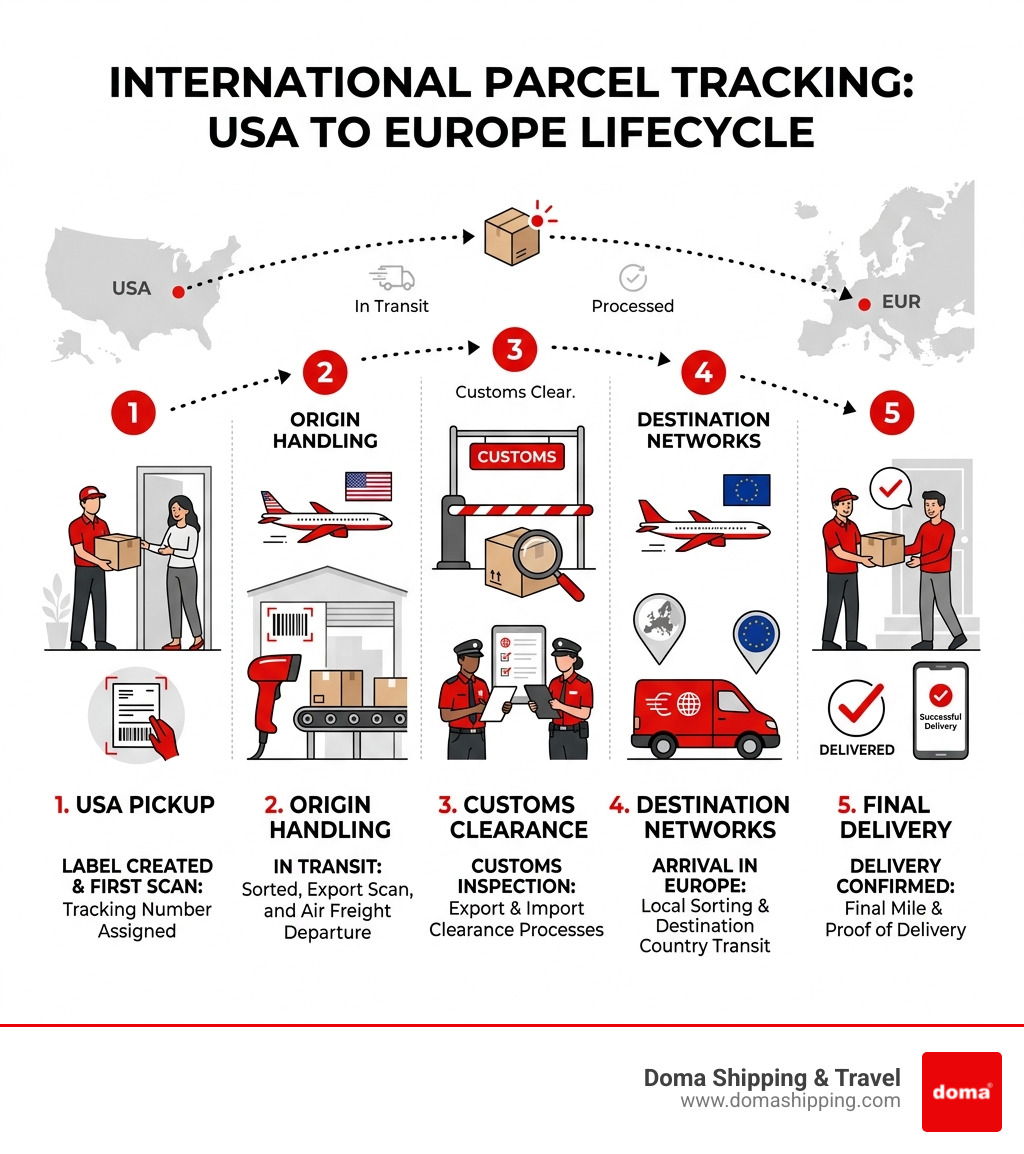
International parcel tracking is the process of monitoring a package’s journey from the moment it’s shipped until it arrives at its destination — across borders, customs checkpoints, and multiple carriers.
Here’s a quick overview of how it works:
| Step | What Happens |
|---|---|
| 1. Label created | A tracking number is assigned to your parcel |
| 2. First scan | Tracking goes live once the package is physically picked up or dropped off |
| 3. In transit | Each scan at sorting facilities, customs offices, and airports adds a new status update |
| 4. Customs clearance | The parcel passes through export and import customs in both countries |
| 5. Final delivery | The destination country’s postal or courier service delivers the parcel |
To track an international parcel, you need your tracking number — a unique alphanumeric code assigned to your shipment. Enter it on the carrier’s website or a universal tracking tool to see real-time status updates.
Sending a package from the USA to Poland or anywhere in Europe sounds straightforward. But once that parcel leaves your hands, it passes through a surprisingly complex chain of carriers, customs offices, airline handoffs, and local postal networks.
Most people don’t think about any of this — until something goes wrong.
A status that hasn’t changed in two weeks. A message that says “Electronic data received” with nothing after it. A parcel that apparently arrived in the destination country but still hasn’t been delivered.
These situations are frustrating. But they’re also very common — and usually explainable.
This guide breaks down everything you need to know about international parcel tracking: what the status messages mean, which tools to use, how to handle delays, and what to do if your package seems lost.
International parcel tracking glossary:
When we ship a package from our locations in Chicago or the surrounding suburbs like Niles or Park Ridge to a destination in Europe, the journey begins with a simple barcode. This barcode is the heartbeat of the entire international parcel tracking system.

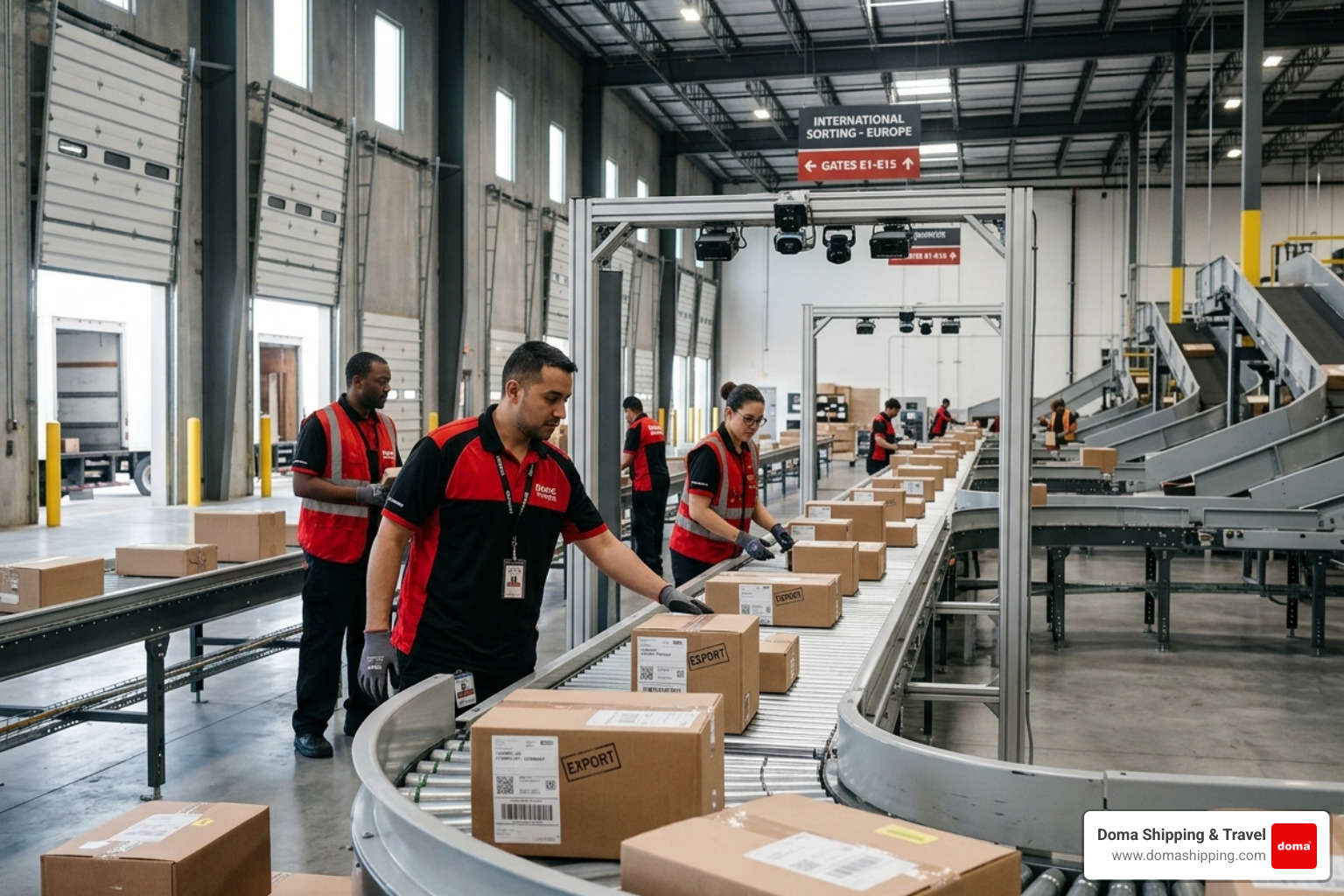
As of April 2026, the technology behind these scans has become incredibly sophisticated. Each time your parcel moves—from our warehouse to the airport, through export customs, and into the hands of a European postal member—a digital “milestone” is recorded. These milestones are generated by scanning technology at sorting facilities and logistics hubs.
For most global shipments, the Universal Parcel Tracking – Global Package Tracking system relies on these physical scans to update the database. If a package sits in a container waiting for a ship or a plane, there are no scans, which is why tracking sometimes seems to “freeze” for several days.
The tracking number is a unique identifier that acts as a passport for your goods. While formats vary, many follow the Universal Postal Union (UPU) standard—typically two letters, nine digits, and a two-letter country code (like “US” for the United States).
However, modern courier and freight forwarding services often use a 16-digit reference or other alphanumeric codes. For example, tracking formats can include 18-character strings starting with specific prefixes or 10 to 12-digit numeric sequences depending on the logistics provider and the type of service selected.
One of the most helpful features of modern tracking is carrier auto-detection. When you use a Universal Parcel Tracking – Global Package Tracking tool, the system recognizes the format of the number and automatically identifies which carrier is handling the shipment. This is vital because, in international shipping, a parcel often changes hands. A package we send might start with a private courier in Illinois and end up being delivered by the national post office in Poland.
To ensure you always know where your items are, we recommend a few “pro” strategies:
For our Polish-speaking customers, we provide dedicated resources for Śledzenie paczki to make the process as clear as possible.
Tracking updates can be cryptic. Understanding what “Departure from outward office of exchange” actually means can save you a lot of unnecessary worry.
When a package moves from the USA to Europe, it hits several standardized milestones. Here is a breakdown of what those common Universal Parcel Tracking – Global Package Tracking updates really signify:
| Tracking Status | What it Actually Means | Typical Duration |
|---|---|---|
| Electronic data received | The label is printed, but the carrier hasn’t physically scanned the box yet. | 1–5 days |
| Departure from outward office | The parcel has cleared US export customs and is waiting to be loaded onto a plane or ship. | 2–10 days |
| Sent to airline | The parcel has been handed over to the air carrier. It may still be waiting for a flight. | 2–4 weeks |
| Arrival at inward office | The package has landed in the destination country (e.g., Poland) and is at the import customs office. | 1–3 days |
| Import customs scan | Customs officials are reviewing the paperwork and contents. | 2–7 days |
| Arrival at distribution warehouse | The parcel has cleared customs and is moving to a local delivery hub. | 1–2 days |
The status “Sent to airline” is often where customers get most anxious. It does not always mean the plane is in the air. It means the postal service has delivered the mail bags to the airline’s ground handling agent. In busy seasons (like November or December), a package might sit in this status for 4 to 6 weeks while waiting for available cargo space.
If your package is stuck at “Departure from outward office of exchange” for more than 3 weeks, it could indicate a security check failure, and it may be being returned to the sender. This is why monitoring these milestones is so important for Express Parcel Delivery in Chicago and beyond.
Even with the best planning, international shipping can face hurdles. Understanding why a delay happens is the first step to resolving it.
There are several common reasons for a lack of updates:
If you see “Electronic data received” or “Shipping notice received” for more than 7–10 days, it often means the seller has generated a label but hasn’t actually handed the box to the carrier. In e-commerce, some sellers do this to meet platform deadlines even if they don’t have the stock ready. If this persists, it is time to contact the shipper.
If the tracking shows “Delivered” but the recipient doesn’t have the box:
For more details on how we handle these logistics, visit our page on International Parcel Shipping.
Tracking a small box is different from tracking a 40-foot shipping container or a pallet of vehicle parts. For larger Parcel Package Shipping, we use different systems.
For air cargo, we use an Air Waybill (AWB). This is a 11-digit number used by airlines to track the movement of freight. Unlike standard parcel tracking, AWB tracking provides details on the specific flight number and flight schedule. You can often track these directly through the airline’s cargo portal or via Universal Parcel Tracking – Global Package Tracking.
Sea freight moves slower but is a highly efficient option for large moves. When we ship containers from the USA to Poland:
Whether you are sending a single gift or an entire household of belongings, our overseas logistics expertise ensures that the right tracking tools are applied to your specific shipment type.
Don’t panic! This is the most common “holding” status in international shipping. It means the parcel is in the hands of the airline’s logistics chain. During peak seasons, it can take 4 weeks for a parcel to be scanned at the destination airport. If it has been more than 45 days without an update, contact us or the carrier to initiate a search.
Yes, it is perfectly safe. Public health experts, including the WHO and CDC, have confirmed that viruses do not survive long on surfaces like cardboard or plastic shipping bags. The journey across the ocean involves temperature changes and timeframes that make the survival of such risks practically impossible.
This usually means the shipping label has been created, but the physical package hasn’t been scanned into the carrier’s sorting system yet. If you are the recipient, this is a sign that the sender may still be preparing the items for shipment. If it lasts more than a week, reach out to the sender to confirm the package was actually picked up.
Navigating international parcel tracking doesn’t have to be a mystery. By understanding the lifecycle of a tracking number—from that first scan in a Chicago suburb like Roselle or Algonquin to the final customs clearance in Europe—you can manage your expectations and stay informed.
At Doma Shipping & Travel, we bring over 30 years of experience to the table. We don’t just move boxes; we manage the complex logistics of USA-to-Poland shipping, including customs handling and freight forwarding. Whether you need to track a small gift or a full container, our systems are designed to give you peace of mind.
Ready to check on your shipment? Use our dedicated tool for Śledzenie paczki and see exactly where your items are in the global network today.