
Freight from the US to Europe moves primarily by two methods: ocean freight and air freight. While many inquiries involve freight from europe to us, our specialized services focus on the export route from the United States to European destinations. Here’s a quick overview of the logistics involved:
| Factor | Ocean Freight | Air Freight |
|---|---|---|
| Transit time | 13-35 days | 3-7 days |
| Best for | Large, heavy cargo | Small, high-value, time-sensitive goods |
| Shipment type | FCL (full container) or LCL (shared container) | Pallets or loose cargo |
| Key documents | Bill of lading, commercial invoice, packing list, EEI/AES | Airway bill, commercial invoice, packing list |
| EU duty threshold | Varies by country (VAT applies) | Same |
Shipping goods across the Atlantic is a serious logistical undertaking. Whether you’re moving personal belongings, commercial goods, or business inventory from the United States to Europe, the process involves international carriers, customs authorities on both sides, and a range of regulations that require professional handling.
The transatlantic trade lane is one of the busiest in the world. Major US hubs like the Port of New York/New Jersey, Savannah, and Houston connect to major European receiving ports including Rotterdam, Antwerp, and Gdynia. That scale means established routes and reliable schedules — but also complexity around documentation and carrier selection.
In April 2026, transatlantic shipping remains a well-traveled route, but one that requires careful planning. Getting it wrong — from a misfiled export declaration to a missed documentation deadline — can mean delays or seized cargo.
This guide walks you through everything: shipping methods, US export requirements, European customs rules, and how to manage your total landed logistics.
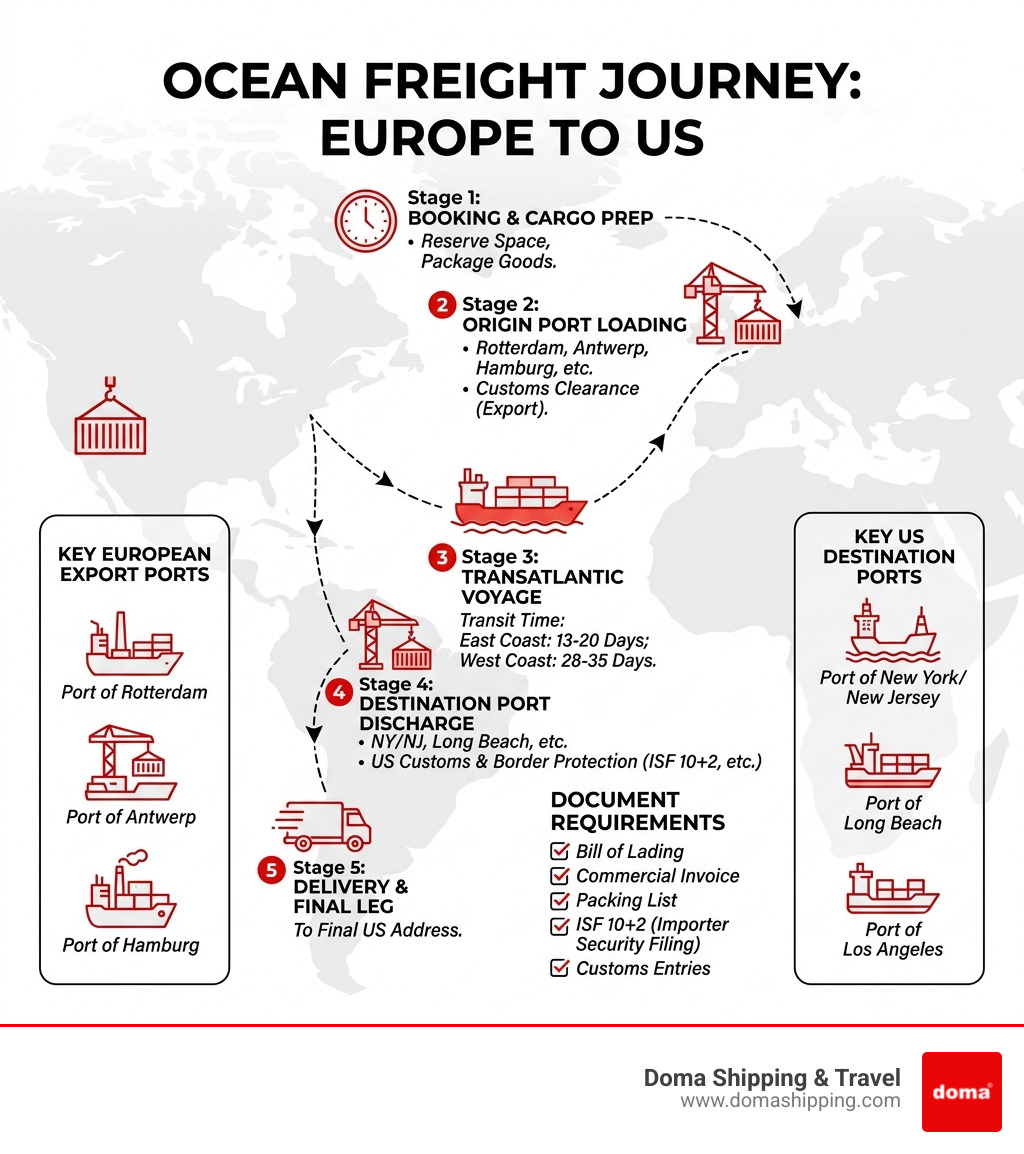
Navigating the logistics of freight from europe to us trade lanes requires choosing the right mode of transport based on the nature of your cargo. While air freight offers rapid delivery for urgent items, ocean freight remains the backbone of trade from the USA to Europe due to its ability to handle massive volumes.
For those moving significant quantities, Full Container Load Shipping provides a dedicated space where your goods occupy an entire 20ft or 40ft container. This method is often preferred for its security, as the container is sealed at the US origin and stays closed until it reaches its European destination.
Conversely, Less Than Container Load Shipping is an excellent solution for smaller consignments. We consolidate your cargo with other shipments into a single container. While this involves more handling at Container Freight Stations (CFS) for stuffing and unstuffing, it allows for efficient transport of smaller volumes that don’t require a full box.
The choice between FCL and LCL often hinges on volume and urgency. Generally, if your shipment exceeds 15 cubic meters (CBM), FCL becomes the more logical choice. Transit times vary significantly depending on the port pair; for instance, a vessel from the US East Coast might reach the Port of Rotterdam in 14 days, while a journey from the West Coast can take significantly longer.
The Port of Antwerp and the Port of Hamburg also serve as vital gateways, offering frequent arrivals from North American hubs. When planning Shipping to Chicago, United States of America From Rome …, logistics providers manage complex intermodal connections, though our primary focus remains the efficient export of goods from the USA to the European heartland.
On the receiving side, Europe boasts world-class infrastructure. The Port of Rotterdam is a primary entry point, handling millions of TEUs annually. In Poland, the Port of Gdynia serves as a critical hub for Baltic trade. Efficient vessel scheduling and intermodal transport are key. Once a ship docks, the cargo is often transferred to chassis for road transport or loaded onto trains for final delivery.
Exporting from the United States involves strict adherence to federal laws. One of the first requirements for many businesses is filing the Electronic Export Information (EEI) through the Automated Export System (AES), which is mandatory for most shipments valued over $2,500 per Schedule B number or those requiring an export license.
Furthermore, while exports from the US are generally not subject to US sales tax, proper documentation must be maintained to prove the goods have left the country. This is typically handled through the Bill of Lading and export declarations. For detailed insights into these requirements, you can refer to the Freight Forwarders Europe to USA: A Complete 2026 Guide | EuroSaleOnline.com. It is also vital to check for export controls on sensitive items, such as dual-use goods or specific technologies, which may require special licenses from the Department of Commerce.
Before booking your shipment, it is essential to verify that your items are not on a restricted list. Common restrictions include:
European Customs authorities oversee all entries into the EU. Compliance starts long before the ship arrives. For imports into Europe, an EORI number (Economic Operators Registration and Identification) is required for the receiving party. Accuracy in your Customs Support & Clearance paperwork is non-negotiable. The core documents required include:
International shipping carries inherent risks, from maritime accidents to port congestion. We always recommend comprehensive cargo insurance, as carrier liability is often limited by international conventions. Understanding the difference between demurrage (fees for staying too long at the pier) and detention (fees for holding the container outside the port) is also vital for managing potential delays.
When handling International Parcel Shipping, red flags to avoid include vague descriptions like “gift” or “merchandise” on customs forms. Such labels almost guarantee inspections and delays.
Unlike the US de minimis threshold, European countries often have lower thresholds for VAT and duty application. Most International Parcel Shipping entering the EU will be subject to VAT. Certain goods, especially food, beverages, and medical devices, fall under specific European health and safety regulations, requiring additional filings before they can be cleared for entry.
The logistics for freight from europe to us trade lanes are influenced by several variables. For LCL shipments, the primary factor is the chargeable volume, measured in cubic meters (CBM). We calculate this by multiplying the length, width, and height of your pallets.
| Logistics Component | Description |
|---|---|
| BAF (Bunker Adjustment Factor) | Surcharge to account for fluctuations in fuel. |
| CAF (Currency Adjustment Factor) | Adjusts for exchange rate volatility between the US Dollar and Euro. |
| THC (Terminal Handling Charges) | Fees paid to the port for loading and unloading the vessel. |
When shipping Commercial Goods Shipping, it is important to remember that ocean freight often has a minimum billable volume of 1 CBM. Even if your box is smaller, the logistics are calculated based on the full cubic meter.
To understand the true requirements of your shipment, you must look at the “total landed logistics.” This includes the ocean freight, inland transport at both ends, customs brokerage, and any applicable duties or VAT at the European destination.
Optimizing your packaging to reduce empty space can lead to significant efficiency. Furthermore, choosing the correct Incoterm 2020 (such as EXW, FOB, or DDP) defines exactly where your responsibility ends and the carrier’s or buyer’s begins. For those moving specialized cargo, Vehicle & Machinery Shipping requires even more detailed planning regarding roll-on/roll-off (RoRo) services or specialized flat-rack containers.
Generally, ocean freight takes between 13 and 35 days. A direct route from the US East Coast to Northern Europe is the fastest, while shipments originating from the West Coast take longer due to the additional distance and canal transits.
In sea freight, the chargeable weight is usually based on volume (1 CBM = 1,000 kg). In air freight, the ratio is much tighter (typically 1 CBM = 167 kg), meaning bulky but light items require more space and resources to send by air.
At a minimum, you will need a Commercial Invoice, a detailed Packing List, and the Bill of Lading. For exports from the US, the EEI/AES filing is also a mandatory requirement for most commercial shipments.
Managing the logistics of shipping from the USA to Europe is a complex process that rewards those who plan ahead. With over 30 years of experience in the industry, our team at Doma Shipping understands the nuances of transatlantic logistics, from the busy docks of the US East Coast to the final delivery in Poland and across Europe.
Whether you are sending small parcels, full containers of Commercial Goods Shipping, or personal belongings, we provide the expertise needed to navigate customs, regulations, and international transport safely. While many focus on freight from europe to us, we ensure your cargo crosses the Atlantic from the United States with the care and professionalism it deserves. For more information or to begin your shipment, visit our Commercial Goods Services page today.
