
If you are researching Florida to Illinois vehicle shipping, first confirm where the vehicle ultimately needs to go. Doma Shipping & Travel specializes in international vehicle shipping from the USA to Poland and other European countries, rather than domestic transport between Florida and Illinois. While many clients initially search for domestic carrier routes connecting southern states with midwestern hubs such as Chicago, our dedicated operations center on global logistics, ocean freight forwarding, and international auto export.
For vehicle owners preparing an overseas relocation or commercial automobile export, the practical initial steps include:
International automotive logistics depend on precise parameters such as vehicle dimensions, curb weight, inland accessibility, port handling schedules, ocean-freight container capacity, seasonal vessel timetables, and final delivery logistics in Europe. Thorough preparation avoids administrative delays and ensures an orderly handoff between regional haulers, export terminal staff, and maritime customs authorities.
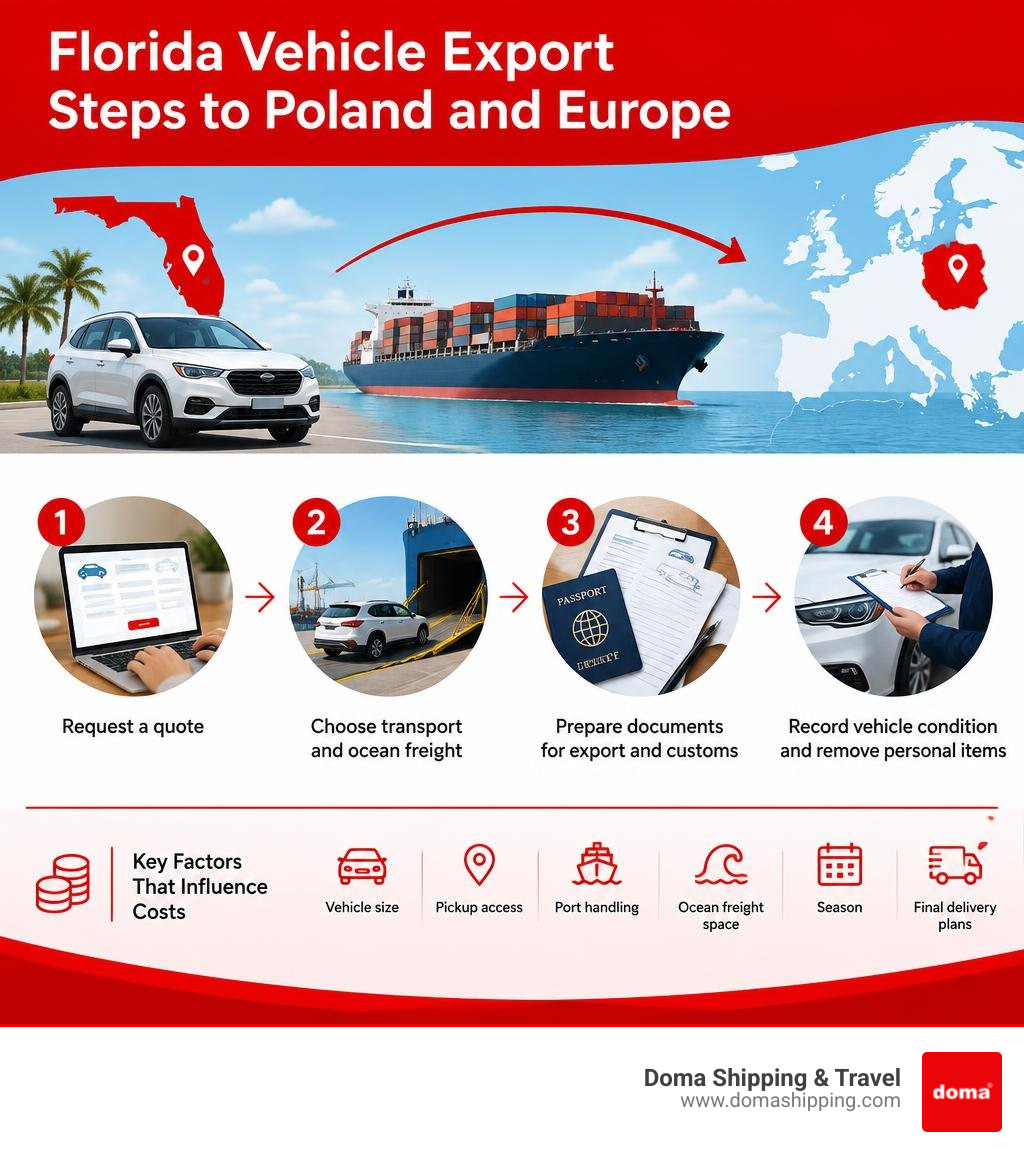
For more details on preparing a vehicle for overseas transport, explore our guide to international vehicle shipping services.

Transporting a motor vehicle from the United States across the Atlantic requires organized logistics coordination. When planning an overseas export, several variables influence the handling process, transit timelines, and container arrangements.
Whether your automobile originates in the southern coastal regions of Florida or coordinates through logistics staging networks in Illinois hubs such as Chicago, Melrose Park, Roselle, or Franklin Park, every phase must align with international maritime standards. To understand the broader scope of our freight capabilities, explore our specialized international vehicle shipping services.
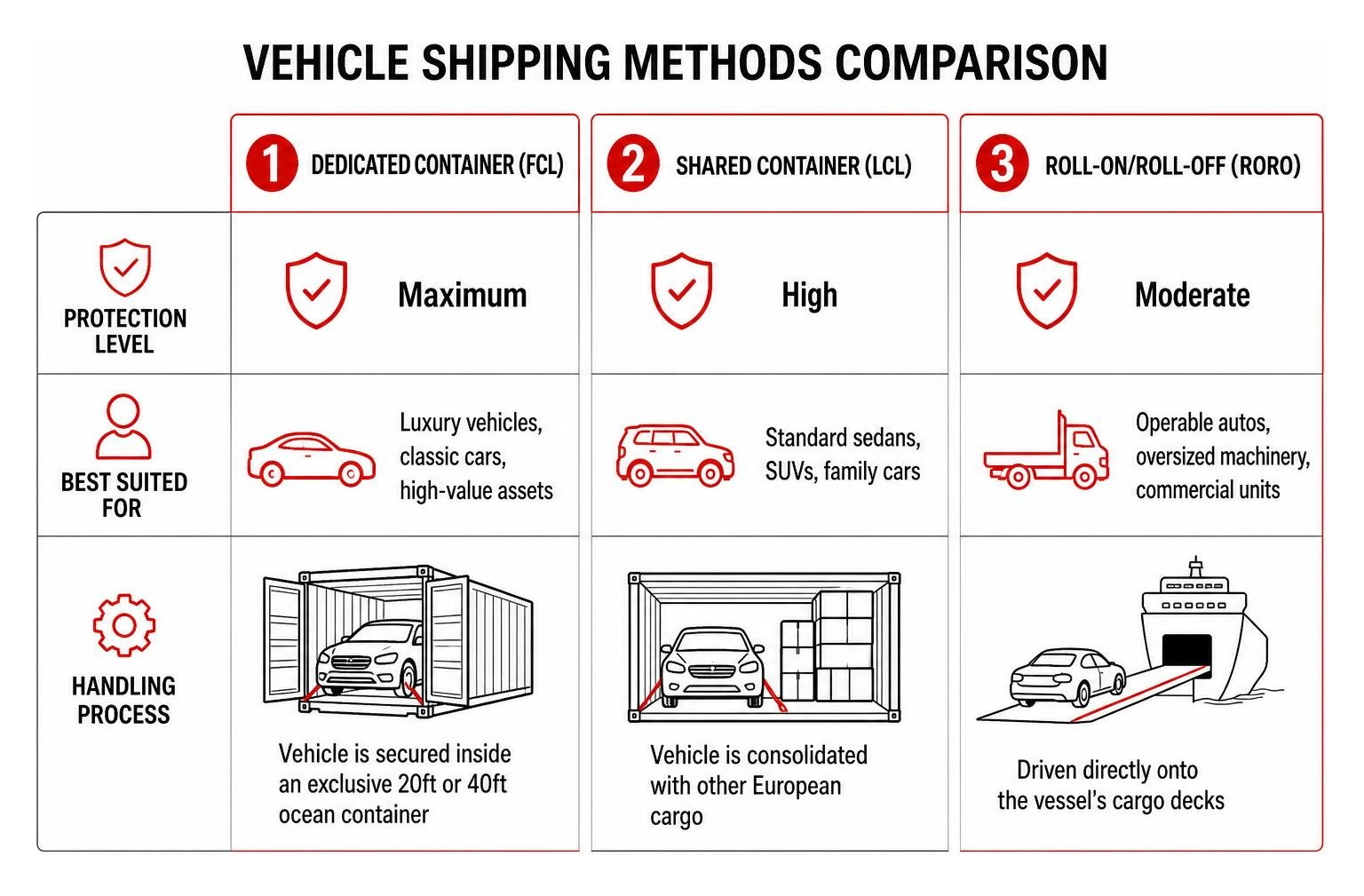
| Shipping Method | Protection Level | Best Suited For | Handling Process |
|---|---|---|---|
| Dedicated Container (FCL) | Maximum | Luxury vehicles, classic cars, high-value assets | Vehicle is secured inside an exclusive 20ft or 40ft ocean container |
| Shared Container (LCL) | High | Standard sedans, SUVs, family cars | Vehicle is consolidated with other European cargo |
| Roll-On/Roll-Off (RORO) | Moderate | Operable autos, oversized machinery, commercial units | Driven directly onto the vessel’s cargo decks |
International shipping calculations involve several specific logistics factors:
Selecting the proper transport configuration ensures your vehicle arrives overseas in pristine condition:
Preparing an automobile for international freight forwarding avoids administrative delays and ensures strict adherence to maritime safety standards. Vehicles traveling overseas undergo physical inspections and thorough verification prior to vessel loading.
Before handover to inland carriers or port terminals, make sure to:
Thorough documentation is essential for international vehicle logistics. Agencies including U.S. Customs and Border Protection require strict validation of vehicle provenance, ownership records, and vehicle identification numbers (VIN) before granting official export clearance.
Strict maritime safety rules govern the mechanical condition of vehicles loaded onto ocean vessels and container ships:

Transitioning an automobile from domestic roadways to international ocean vessels requires specialized freight forwarding expertise. Our facilities across the greater Chicago area—including strategic hubs in Des Plaines, Bensenville, Schaumburg, Melrose Park, Roselle, Palos Hills, Mount Prospect, Niles, Algonquin, Park Ridge, Glenview, and Schiller Park—regularly coordinate complex cargo movements between domestic staging areas and ocean departure ports.
Proper staging, export customs clearance, and container consolidation ensure that automotive cargo safely transitions across borders. For detailed steps on maritime port procedures, review our guide on shipping your car from the USA to international ports.

Relocating across continents requires comprehensive cargo management from initial pickup to final European handover:
Total transit time typically ranges from 4 to 7 weeks. This duration accounts for inland carrier coordination to the export terminal (3–7 days), customs document validation and port processing (3–5 days), transatlantic ocean transit (15–25 days depending on the specific vessel rotation), and final customs clearance upon arrival in Europe. Severe weather conditions, transatlantic storms, or terminal congestion can occasionally influence vessel sailing schedules.
International shipping requirements and logistics plans in 2026 depend on specific cargo parameters: vehicle curb weight, total cubic dimensions, container service selection (dedicated FCL vs. consolidated LCL), export terminal handling fees, and destination port clearance procedures. For an accurate logistics plan tailored to your vehicle’s make, model, and final European destination, contact our logistics specialists directly.
As a general rule, personal items should not be left inside vehicles during international transport. International maritime safety regulations and customs authorities strictly prohibit unauthorized loose items inside vehicles shipped via standard RoRo or consolidated containers. When shipping via a dedicated Full Container Load (FCL), personal effects may be packed and manifested alongside the vehicle, provided every single item is fully declared on the official export packing list.
Exporting a vehicle across the Atlantic requires deep logistics knowledge, rigorous attention to customs compliance, and reliable freight handling. With over 30 years of dedicated experience serving the Polish-American community and global clients across Chicago, Niles, Palos Hills, Mount Prospect, and beyond, Doma Shipping & Travel provides dependable, end-to-end overseas logistics.
From export documentation and terminal staging to ocean container freight and European customs clearance, we ensure your vehicle reaches its destination smoothly. Contact us today to arrange your professional vehicle and machinery shipping solutions.