
If you’re planning an overseas move, working with an allied international moving company means tapping into a global network of coordinated agents, logistics partners, and shipping professionals — all working together to move your belongings from the USA to your destination country. In this context, “allied” refers to a strategic alliance of international movers and freight forwarders collaborating to provide seamless door-to-door service.
Here’s a quick overview of what to look for:
| Factor | What to Check |
|---|---|
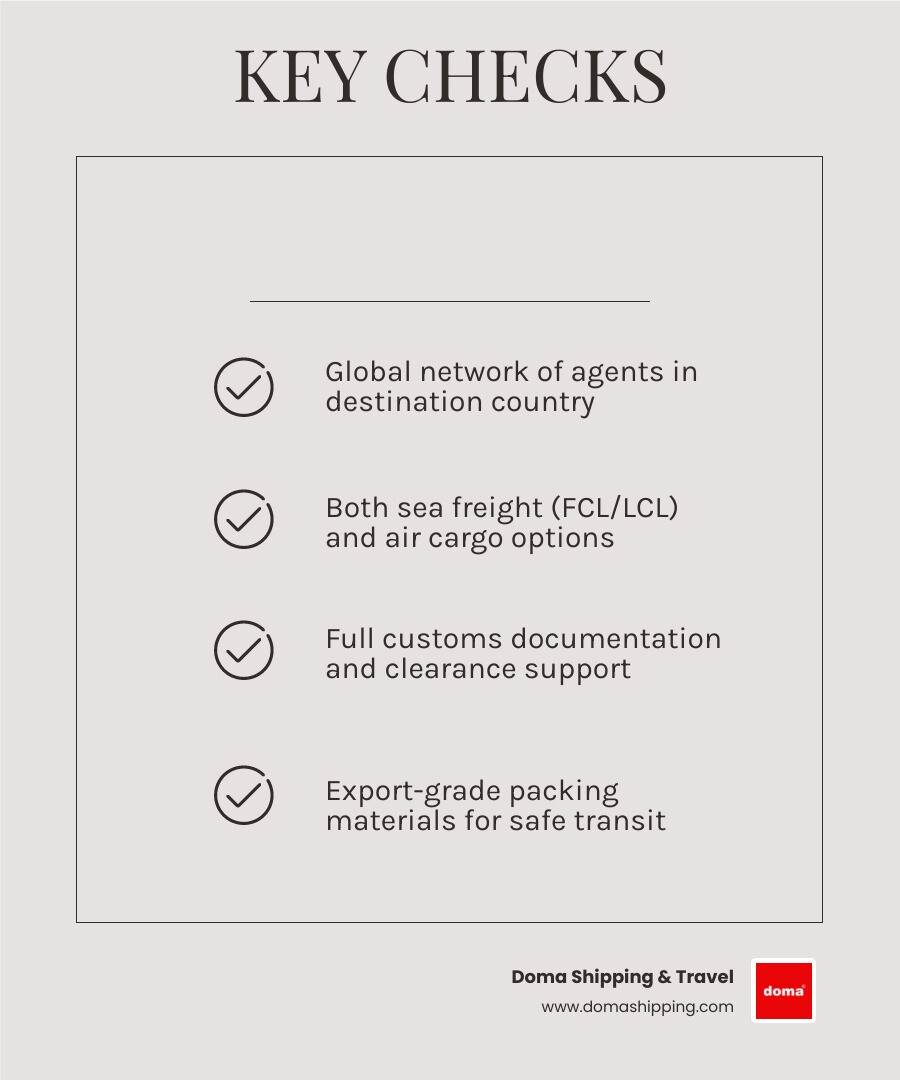
| Global network | Does the company have agents in your destination country (e.g., Poland, Germany, UK)? |
| Shipping methods | Do they offer both sea freight (FCL/LCL) and air cargo options? |
| Customs support | Will they handle documentation and clearance at the destination port? |
| Packing standards | Do they use export-grade materials for international transit? |
| Shipment tracking | Can you monitor your shipment in real time? |
| Single point of contact | Is one coordinator responsible for your entire move? |
Moving overseas is exhilarating — but without the right logistics partner, it can quickly become overwhelming. International relocation isn’t just about putting boxes on a ship. It involves export packing, ocean or air freight coordination, customs declarations, port handling, and final delivery to your new home abroad.
The scale of international moving is significant. Established networks of allied moving companies coordinate thousands of global shipments annually under strict quality standards monitored by organizations like the International Association of Movers. This kind of infrastructure matters when your furniture, family heirlooms, and personal belongings are crossing an ocean.
For individuals and families shipping from the USA to Poland or other European countries, understanding how these international moving networks operate — and how to choose the right partner within them — can mean the difference between a smooth transition and a logistical nightmare.
This guide breaks it all down.
When planning a relocation across the Atlantic, you are not simply hiring a local truck and two movers. An international relocation requires an integrated network of logistics providers. An allied international moving company operates as a unified system of freight forwarders, local agents, port authorities, and customs brokers.
In the logistics industry, “allied” refers to a cooperative framework where independent, highly qualified moving representatives and corporate-owned branches work under a single service standard. This means whether your cargo is packed in Chicago, loaded onto a container vessel in New York, or cleared through the port of Gdynia in Poland, every hand touching your shipment adheres to the same strict operational protocols.
For residents in the Chicago area—including suburbs like Mount Prospect, Park Ridge, Algonquin, and Glenview—this network structure is highly beneficial. You receive local, personalized service from a neighborhood office, backed by the massive infrastructure of a global freight forwarding network. This approach guarantees that your goods are tracked continuously from your US doorstep to your European destination.
To ensure your items are handled correctly during this process, you can explore specialized International Shipping Services and custom Household & Personal Belongings Shipping solutions that fit your specific relocation needs.
The strength of an international network is measured by its physical presence. A true global network operates in over 37 countries with more than 1,000 locations worldwide. In North America alone, the network boasts over 500 agent locations, supported by corporate-owned and franchised offices in over 40 countries, and trusted representatives in 135 additional nations.
This footprint is critical for transatlantic shipping. When your household goods leave the United States, they enter a complex supply chain. Having established agent locations in European transit hubs ensures that your container is received by professionals who understand local port operations, regional road transport laws, and European Union customs procedures.
By working with an established network, you tap into a system where trucks cover enough miles annually to circle the globe 13 times. This scale translates into reliable vessel scheduling, consistent container availability, and structured transport routes to destinations throughout Poland and wider Europe. To learn more about how these networks operate, you can read about International Shipping and Logistics to understand the backend of global cargo movement.
Not all moving agents are created equal when it comes to European relocations. While many companies can transport a truckload of furniture across state lines, shipping overseas requires highly specialized knowledge. When selecting an agent in your local area—whether in Melrose Park, Niles, Palos Hills, or Schaumburg—you must verify their specific expertise in European destinations.
An experienced agent understands that European delivery involves navigating narrow streets, historic city centers, and strict local parking regulations. They must have direct, reliable communication with destination agents who speak the local language and can manage the final stage of delivery. For example, if you are relocating from Illinois to Poland, your agent must be deeply familiar with Polish customs ports, such as Gdańsk or Gdynia, and regional distribution networks.
To make an informed decision, it is highly recommended to review detailed resources such as How to Handle International Removals from the USA to Poland. This will help you understand the localized expertise required to manage a seamless transition from the midwestern United States to Central Europe.
The journey of your personal belongings across the ocean is a true test of logistics. Unlike domestic moves, where items are loaded onto a trailer and driven down a highway, international shipping subjects your goods to unique environmental forces. Ocean transit involves container vibrations, humidity changes, and shifting forces on the high seas. Therefore, professional packing, secure ocean freight coordination, and precise customs clearance are the three pillars of a successful international move.

Standard moving boxes and packing tape are insufficient for ocean voyages. To protect your belongings during weeks at sea, international logistics providers utilize export-grade packing materials and specialized techniques:
Every item must be meticulously wrapped, packed, and secured inside the container to prevent shifting during maritime transport.
The most complex aspect of moving overseas is not the physical transport, but passing through customs. Every country has strict laws regarding what can be imported, who is eligible for duty-free import of personal effects, and what documentation must accompany the shipment.
Failing to provide the correct paperwork can result in lengthy port delays, expensive storage fees, or even the seizure of your belongings. A professional international moving coordinator will guide you through this process, helping you prepare the essential documents:
For a detailed walkthrough of this complex administrative process, consult the Step-by-Step Guide to Relocation Transport USA Poland as well as Your Stuff, Their Country: How to Ship Personal Belongings Without a Hitch.
When shipping household goods from the USA to Europe, you must choose the most appropriate shipping method based on the volume of your belongings and your timeline. The two primary ocean freight methods are Full Container Load (FCL) and Less than Container Load (LCL), also known as shared container shipping.
To help you understand the differences between these two methods, review the comparison table below:
| Feature | Full Container Load (FCL) | Shared Container (LCL) |
|---|---|---|
| Container Use | Dedicated solely to your belongings. | Shared with other shippers’ cargo. |
| Volume | Best for large homes (3+ bedrooms) or vehicles. | Best for smaller shipments (1-2 rooms) or parcels. |
| Transit Time | Faster; container goes directly to port after loading. | Slightly longer; requires consolidation at a warehouse. |
| Handling | Sealed at your home and opened only at destination. | Handled at consolidation and deconsolidation warehouses. |
| Ideal For | Complete household relocations. | Partial moves, boxes, and small furniture shipments. |
Choosing the right method depends on the scale of your move. If you are relocating an entire household from Chicago suburbs like Des Plaines, Franklin Park, or Schiller Park to Europe, FCL provides a dedicated space that is sealed at your residence. For smaller shipments, LCL allows you to pay only for the volume your goods occupy within a shared container, making it a highly efficient option.
Ocean freight coordination begins with an in-home or virtual survey to calculate the total volume of your shipment. Once the volume is determined, a shipping container (typically 20-foot or 40-foot) is booked on an ocean vessel.
For FCL shipments, the container is brought to your home or a local warehouse, loaded, sealed, and transported by truck or rail to the departure port. For LCL shipments, your packed goods are transported to a local consolidation warehouse, where they are carefully loaded into a container alongside other European-bound cargo. The container is then delivered to the port, loaded onto the vessel, and tracked across the ocean to the destination port in Europe.
While requirements vary slightly by country, the standard documentation required for clearing personal household goods through European customs includes:
Your dedicated move coordinator will assist you in compiling and verifying these documents before the vessel arrives at the destination port.
Fragile and oversized items require specialized packing strategies. Pianos, delicate sculptures, large glass items, and motorcycles are secured using custom-built wooden crates lined with shock-absorbent materials like high-density foam and heavy-duty bubble wrap.
Inside the ocean container, heavy items are loaded at the bottom, and all cargo is tightly secured using industrial-grade cargo straps, wooden bracing, and dunnage bags (inflatable bags placed in empty spaces to prevent shifting). This ensures that even during rough sea conditions, your most valuable possessions remain completely stationary and protected.
Choosing the right allied international moving company is the most critical decision you will make during your overseas relocation. By partnering with an experienced provider that utilizes a robust global network, adheres to strict export packing standards, and understands the complexities of European customs clearance, you can focus on the exciting journey ahead rather than the stress of logistics.
With over 30 years of experience in international logistics and freight forwarding, Doma Shipping & Travel specializes in shipping personal belongings, packages, containers, and vehicles from the USA to Poland and throughout Europe. Operating from key Illinois locations including Chicago, Melrose Park, Mount Prospect, Roselle, Palos Hills, Algonquin, Niles, Park Ridge, Des Plaines, Glenview, Franklin Park, Schiller Park, Bensenville, and Schaumburg, we provide a seamless, reliable door-to-destination service.
Whether you are shipping a few boxes of personal keepsakes or coordinating a full household container relocation, our experienced team ensures your belongings are packed, secured, and cleared through customs with the utmost care.
Secure your international shipment today with Doma Shipping & Travel and experience a smooth, professional transition to Europe.
