
If you need to wire money to Poland, here is what you need to know upfront:
The fastest ways to send money to Poland from the USA:
What you’ll need to send a bank transfer to Poland:
Sending money overseas to family or loved ones in Poland is something millions of Americans do every year. The Polish-American community has deep roots, and maintaining these financial ties is a vital part of supporting relatives, managing inherited property, or contributing to local projects in the homeland. Whether it’s supporting family, covering an emergency, or managing a property abroad, the process involves more steps than a simple domestic transfer.
Get it wrong — a mismatched name, a missing IBAN digit — and your transfer can be delayed or returned.
This guide walks you through the entire process clearly, so your money arrives safely and on time. Understanding the regulatory landscape and the technical requirements ensures that your hard-earned funds reach their destination without unnecessary administrative hurdles.
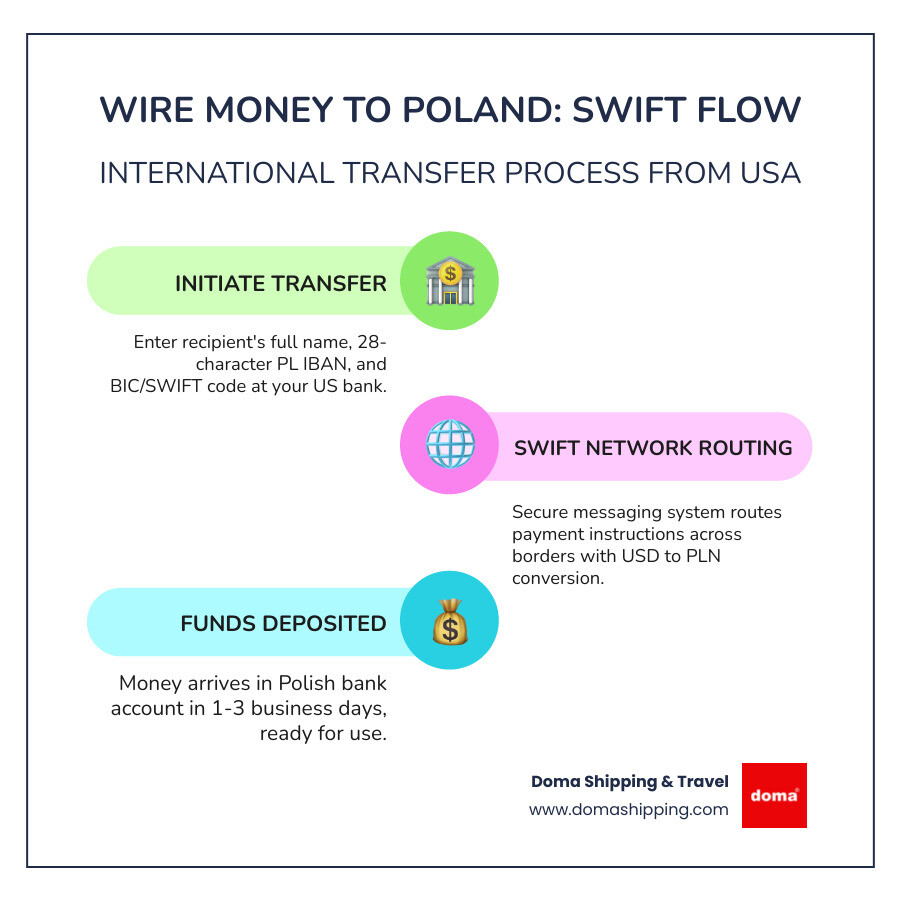
Navigating international finance can feel a bit like learning a new language. When we talk about how to wire money to Poland, we are essentially discussing the movement of funds across borders, usually through the Society for Worldwide Interbank Financial Telecommunication (SWIFT) network. This network acts as a secure messaging system that banks use to send payment instructions to one another, ensuring that each transaction is tracked and verified at every stage of the journey.
Poland’s banking system is modern and highly integrated with the European Union’s financial infrastructure. Most residents use major national institutions that offer robust digital services. When you initiate a transfer, your U.S. Dollars (USD) must be converted into Polish Zloty (PLN). This conversion happens at an exchange rate that fluctuates daily based on global market conditions and the economic policies set by the National Bank of Poland (NBP).
Security is the cornerstone of these transactions. Reputable services are often FCA authorised, ensuring they adhere to strict capital requirements and consumer protection standards. For us in the Chicago area—from Niles and Algonquin to Palos Hills and Schaumburg—ensuring that our money is handled by regulated entities is the first step toward a successful transfer. These regulations are in place to prevent fraud and ensure that international transfers remain a reliable way to support family abroad.
Before you sit down at your computer or visit an agent location in Melrose Park or Des Plaines, you need to have your paperwork in order. International regulations, including “Know Your Customer” (KYC) and Anti-Money Laundering (AML) laws, require providers to verify the identity of the sender. These laws are strictly enforced to maintain the integrity of the global financial system.
Typically, you will need:
These requirements aren’t just red tape; they are designed to protect you and the financial system from fraud and unauthorized access.
The most common reason for a failed or delayed wire is incorrect recipient information. To ensure a smooth delivery to a Polish bank account, you must provide:
When you wire money to Poland, your data should be protected by bank-level encryption. Most modern platforms use 2-factor authentication (2FA), requiring you to verify your identity via a code sent to your smartphone before a transfer can be finalized. This adds an essential layer of security against unauthorized transactions.
Furthermore, many providers participate in programs where funds are held in specialized accounts. For example, some U.S.-based institutions may have arrangements where eligible customer balances are held at a Program Bank to ensure safety and compliance with federal standards.
Depending on how your recipient needs the money, there are several ways to finalize the transfer. Poland has a highly developed financial infrastructure, offering both digital and physical payout options.
| Method | Best For | Typical Timeline |
|---|---|---|
| Bank Deposit | Safety and convenience; large amounts | 1–3 Business Days |
| Cash Pickup | Recipients without bank accounts; emergencies | Minutes |
| Mobile Wallet | Tech-savvy users; small amounts | Instant |
| Debit Card Deposit | Speed without visiting a bank | Minutes to Hours |
In Poland, the network for cash pickup is extensive. Recipients can often collect funds at local postal branches or dedicated agent locations found in most towns and cities. However, direct bank deposits remain the standard for most significant financial transactions, such as property payments or regular family support, due to the security and record-keeping they provide.
If you prefer to handle things from the comfort of your home in Glenview or Park Ridge, online transfers are the way to go. Here is the general flow to ensure everything is handled correctly:
The IBAN (International Bank Account Number) is a standardized numbering system developed to identify bank accounts across national borders. In Poland, it is essential because it reduces the risk of transcription errors and ensures the automated processing of your wire transfer. Without a valid “PL” IBAN, most European banks will reject the incoming wire, leading to delays and potential return processing.
The timeline depends on the method. Digital-first providers often complete transfers in under 24 hours—sometimes even in seconds. Traditional bank-to-bank SWIFT wires usually take 1 to 3 business days. Factors like bank holidays in either the U.S. or Poland, time zone differences, and the specific processing times of intermediary banks can also impact the arrival time.
For bank deposits, you will receive a transaction reference number. For cash pickups, a specific control number is the vital piece of information. You can use these numbers on the provider’s website or mobile app to see exactly where your money is in the process, from the initial funding to the final payout.
If an incorrect IBAN is provided, the transfer will likely be rejected by the receiving bank in Poland. The funds will then be returned to the sender’s account. However, this process can take several business days, and the returned amount may be subject to exchange rate fluctuations that occurred during the interim.
Sending a wire transfer to Poland doesn’t have to be a stressful experience. By gathering the correct IBAN, verifying your recipient’s name, and using a secure, regulated platform, you can ensure your support reaches your loved ones without a hitch. Accuracy at the start of the process is the best way to avoid complications later on.
At Doma Shipping, we understand the importance of connecting families across the Atlantic. With over 30 years of experience in international logistics—from shipping parcels to handling vehicles and containers—we pride ourselves on being a trusted bridge between the United States and Europe. Our deep understanding of the Polish market and regulatory requirements allows us to provide reliable guidance to our community. Whether you are sending a package from our locations in Chicago, Schiller Park, or Bensenville, or looking for information on Przekazy pieniężne do Polski, we are here to help you navigate the complexities of international service with ease and reliability. Our commitment to the Polish-American community remains as strong today as it was three decades ago.
