
Container Shipping to Poland connects American shippers with one of Central Europe’s fastest-growing logistics hubs. Whether you’re relocating overseas, exporting commercial goods, or managing international supply chains, understanding the container shipping process helps you navigate customs, transit times, and documentation requirements with confidence.
Quick Answer: Container Shipping to Poland Essentials
| Aspect | Key Information |
|---|---|
| Main Ports | Gdynia, Gdańsk, Szczecin, Świnoujście |
| Transit Time from USA | 18-40 days (East Coast faster than West Coast) |
| Container Options | FCL (Full Container Load) or LCL (Less Than Container Load) |
| Import Duties | 1.84%-11% + 23% VAT on CIF value |
| Required Documents | Bill of Lading, Commercial Invoice, Packing List, Customs Declaration |
Poland’s strategic location in Central Europe and its membership in the European Union make it a critical gateway for international freight. The country’s Baltic Sea ports handle millions of containers annually, offering both direct trans-Atlantic services and feeder connections from major European hubs like Hamburg and Rotterdam.
The research shows that shipping routes, container types, and proper documentation significantly impact both timing and total logistics expenses. Understanding the difference between Full Container Load (FCL) and Less Than Container Load (LCL) options allows you to match your cargo volume with the most practical shipping method. Poland’s modern intermodal infrastructure—combining rail, truck, and inland waterways—ensures efficient distribution once your container clears customs at the port.
For Americans shipping to Poland, the process involves coordinating with freight forwarders, preparing customs paperwork, and selecting the right port based on your final destination within Poland or broader Europe. Transit times vary from approximately three weeks from East Coast ports to six weeks or more from the West Coast, depending on vessel schedules and whether your shipment requires transfer to a feeder vessel.
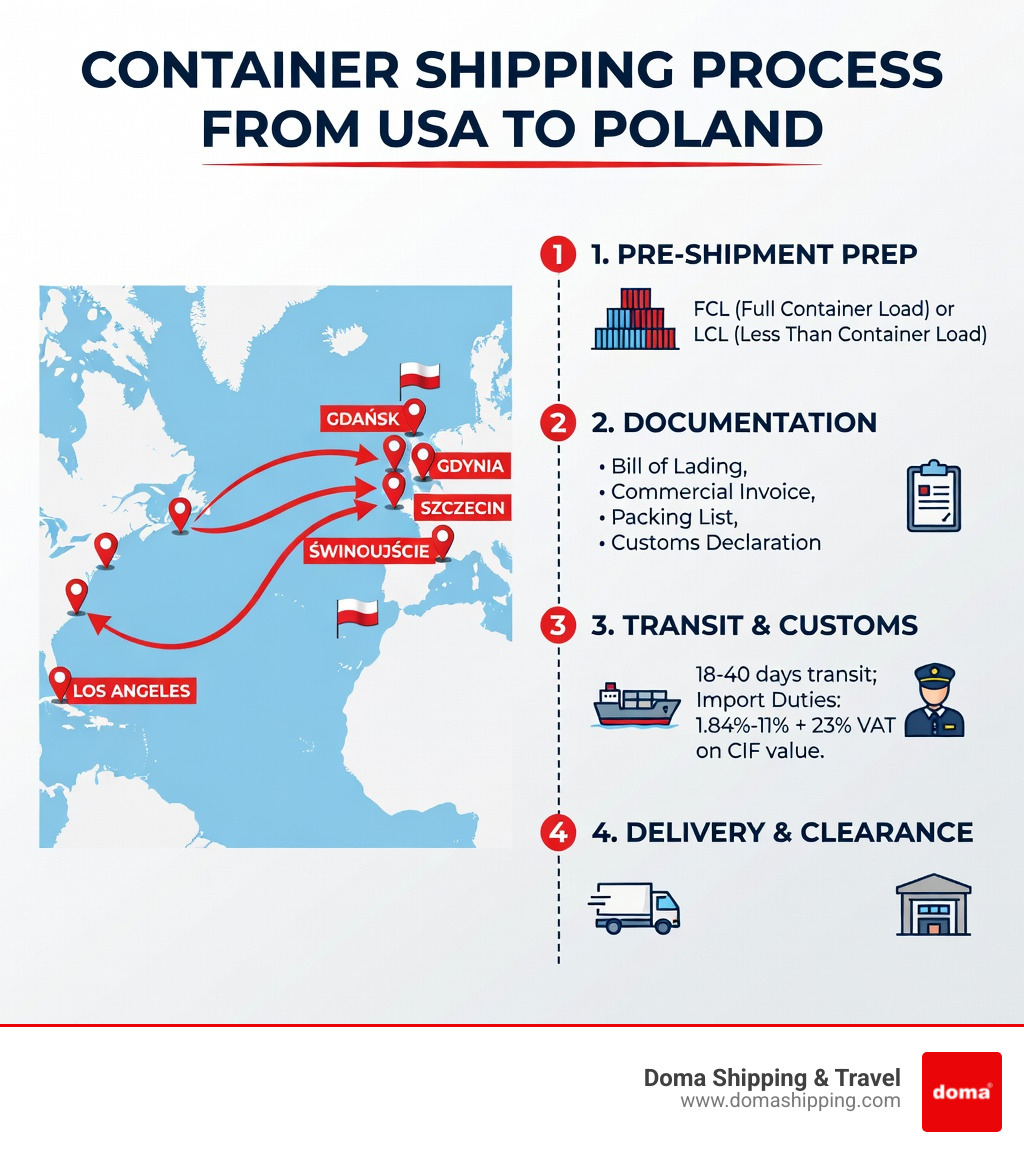
When we look at the map of the Baltic Sea, Poland stands out as a primary destination for international cargo. Selecting the right port is the first step in ensuring your Container Shipping to Poland experience is seamless. The country has invested heavily in its maritime infrastructure, creating world-class facilities capable of handling the largest vessels.
The Port of Gdańsk is the largest and deepest port in Poland. It serves as a major gateway for the entire Central and Eastern European region. Its deepwater container terminal (DCT Gdańsk) is the only terminal on the Baltic Sea capable of receiving the world’s largest container ships directly from Asia and the Americas. For those utilizing Full Container Load Shipping, Gdańsk offers unparalleled capacity and rapid inland connections.
Located just a few miles from Gdańsk, the Port of Gdynia is a specialized container hub. It is often the preferred choice for shipments originating from the United States due to its long history of handling trans-Atlantic routes. Gdynia is known for its efficiency and high-quality service, particularly for consolidated cargo and specialized equipment.
On the western side of the Polish coast, the port complex of Szczecin and Świnoujście provides a vital link to Western Europe and Scandinavia. While smaller in container volume than Gdańsk or Gdynia, these ports are essential for cargo destined for Western Poland or Germany. They are frequently served by feeder vessels—smaller ships that transport containers from major European “base ports” like Hamburg or Rotterdam to their final Polish destination.
Gdynia holds a special place in the history of Polish maritime trade. For decades, it has been the primary port of entry for Polish-American families relocating or sending items back home. Today, it operates as a modern transshipment hub with two major terminals: the Baltic Container Terminal (BCT) and the Gdynia Container Terminal (GCT).
The modern infrastructure in Gdynia allows for rapid vessel turnarounds. When we coordinate a shipment to this port, we take advantage of sophisticated vessel schedules that ensure your cargo does not sit idle. Because Gdynia is a dedicated container port, the logistics chain—from the moment the ship docks to the moment the container is loaded onto a truck or train—is highly optimized. This efficiency is a key factor in managing the overall timeline of your international move or commercial export.
Planning is the foundation of a successful international shipment. One of the most important decisions you will make is choosing between Full Container Load Shipping (FCL) and Less Than Container Load Shipping (LCL).
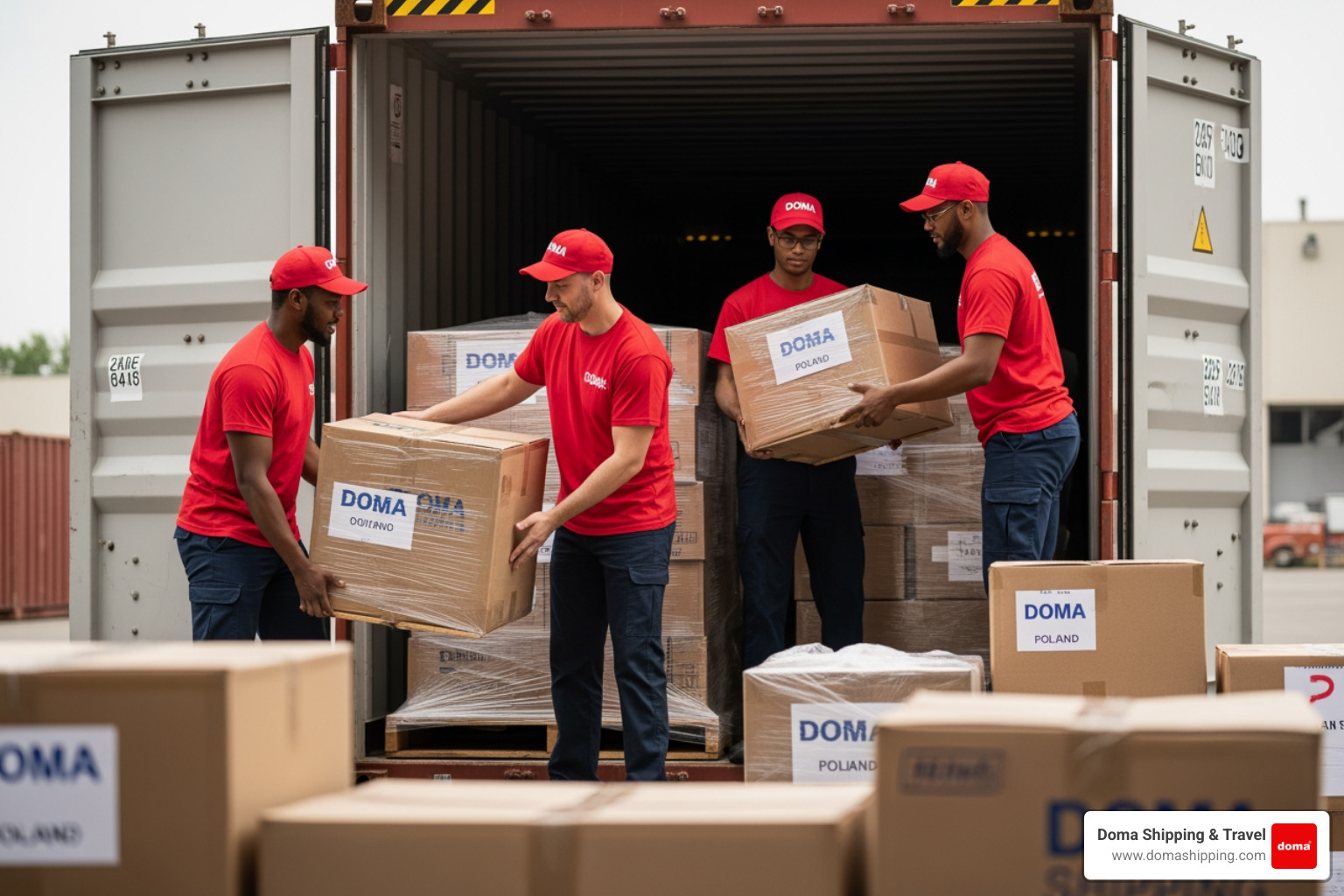
FCL means you have the exclusive use of a 20ft or 40ft container. This is ideal for large household moves, vehicle transport, or high-volume commercial goods. It offers the highest level of security since the container is sealed at the point of origin and only opened at the final destination or by customs officials.
LCL, or shared container shipping, is a practical solution for smaller volumes. We consolidate your cargo with other shipments destined for Poland, allowing you to pay only for the space you occupy. This is measured in cubic meters or linear feet. It is a fantastic option for those sending furniture, a few dozen boxes, or smaller pallets.
| Feature | FCL (Full Container) | LCL (Shared Container) |
|---|---|---|
| Volume | Best for 15+ cubic meters | Best for 1-14 cubic meters |
| Security | Sealed, exclusive use | Shared space, consolidated |
| Loading | Loaded at your location or warehouse | Loaded at a consolidation warehouse |
| Handling | Minimal handling of goods | More handling during consolidation |
| Flexibility | High (you control the schedule) | Moderate (vessel departs when full) |
Not all cargo is created equal. Some items require special handling due to their chemical or physical properties. These are known as hazardous goods or IMO cargo (International Maritime Organization). Shipping these items to Poland requires strict adherence to the International Maritime Dangerous Goods (IMDG) Code.
If you need to ship paints, chemicals, lithium batteries, or certain automotive parts, we must ensure they are properly classified into one of the nine IMO classes. Required documentation includes:
Proper labeling and specialized packing are mandatory. Failure to comply with these safety standards can lead to significant delays at the port or even the refusal of the carrier to load the cargo. Our team ensures that every piece of hazardous cargo meets both US export and Polish import requirements.
The “paperwork mountain” is often the most daunting part of Container Shipping to Poland. However, with over 30 years of experience, we have streamlined this process to ensure your goods clear customs without unnecessary hurdles.
If you are moving back to Poland permanently after living in the USA, you may be eligible for “Mienie Przesiedleńcze” (Resettlement Property) status. This can provide significant relief from certain import duties. For more details on the legal and procedural requirements, see our guide on Wysyłka auta z USA do Polski – mienie przesiedleńcze.
Poland follows the unified customs regulations of the European Union. However, there are specific local applications you should be aware of.
How long does it take for a container to cross the Atlantic? The answer depends largely on your point of origin in the United States and the specific route the vessel takes.
Shipments from ports like New York, Norfolk, or Savannah are generally the fastest. A direct or semi-direct trans-Atlantic crossing usually takes between 18 and 25 days to reach a Polish port. These routes are stable and less affected by global geopolitical disruptions compared to Pacific routes.
Shipping from Los Angeles or Seattle involves a much longer journey. The vessel must typically pass through the Panama Canal before heading across the Atlantic. This transit can take 40 days or more. Some alternative routes might even go through Asia and around the Cape of Good Hope, which can extend the duration to 80-90 days.
Most large container ships from the USA dock at major European hubs like Hamburg (Germany) or Rotterdam (Netherlands). From there, your container is transferred to a feeder vessel for the final leg of the journey to Gdynia or Gdańsk. This transfer usually adds about 3-7 days to the total transit time but allows for more frequent service options.
When we manage Container Shipping to Poland from our hubs in the Chicago area, we account for the inland transit to the port. Here are some general estimates:
Please keep in mind that seasonal factors, such as winter weather in the North Atlantic or port congestion during peak holiday seasons (especially November), can influence these timelines.
Once your container arrives at the port and clears customs, the journey isn’t over. It still needs to reach its final destination, whether that’s a warehouse in Warsaw, a home in Kraków, or a business in Wrocław.
Poland has one of the most extensive freight rail networks in Europe. Using rail for the long-haul portion of inland distribution is not only efficient but also reduces the carbon footprint of your shipment. Major intermodal terminals in cities like Poznań, Łódź, and Warsaw serve as hubs where containers are transferred from trains to trucks for the final “last mile” delivery.
For shorter distances (typically under 300km from the port), trucking is the most common method. Since Poland joined the EU in 2004, billions have been invested in the highway network, making road transport faster and more reliable than ever before. We offer Door to Door Shipping services where we manage the entire process from your driveway in the USA to the recipient’s address in Poland.
In the modern logistics world, visibility is key. We utilize GPS fleet tracking and digital freight platforms to provide real-time updates on your shipment’s location. Whether your container is on a ship in the middle of the Atlantic or on a truck traversing the Polish A1 highway, you can stay informed about its progress.
FCL (Full Container Load) means you rent the entire 20ft or 40ft container for your exclusive use. LCL (Less than Container Load) means you share the container space with other shippers, paying only for the volume your goods occupy. FCL is faster and more secure for large loads, while LCL is a practical choice for smaller shipments.
The mandatory documents include the original Bill of Lading, a detailed Packing List, a Commercial Invoice (for commercial goods), and a Power of Attorney for the customs broker. If you are relocating, you will also need proof of residence in the USA for at least 12 months and a valid Polish ID or passport.
Transit times vary by origin. From the East Coast (New York/New Jersey), it typically takes 20-25 days. From the Midwest (Chicago), including inland transport, it takes about 30-35 days. From the West Coast (California), the journey can take 40-50 days.
Container Shipping to Poland is a complex but manageable process when you have the right partner. At Doma Shipping & Travel, we bring over 30 years of experience to every shipment. From our headquarters in the Chicago area—including locations in Niles, Des Plaines, and Schiller Park—we provide a bridge between the United States and Europe.
Our comprehensive approach to Full Container Load Shipping and LCL services ensures that your personal belongings, vehicles, or commercial freight arrive safely and efficiently. We handle the logistics, the documentation, and the coordination with Polish authorities so you can focus on your move or your business.
Whether you are navigating the requirements for Resettlement Property or managing a complex commercial supply chain, our team is here to ensure your international delivery is secure and professional. Let us help you navigate the Baltic gateways and the Polish heartland with the expertise that only decades of dedicated service can provide.