
International shipping rates are not a single number — they shift based on a combination of factors that can catch even experienced shippers off guard.
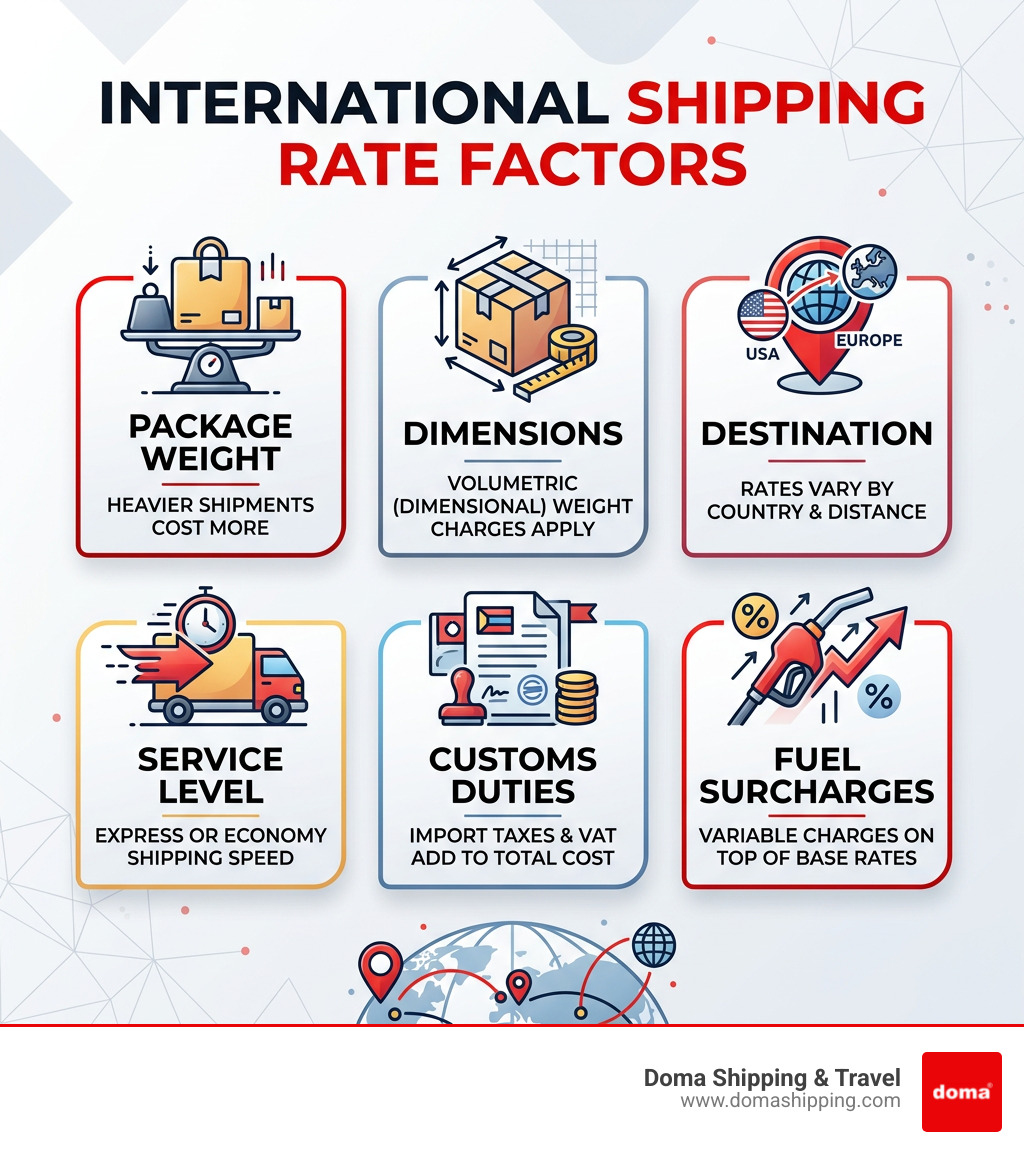
Here is a quick overview of what shapes the rate you encounter when shipping from the USA to Europe:
| Factor | What It Means |
|---|---|
| Package weight | Heavier shipments require more resources to transport |
| Dimensions | Carriers may charge by volumetric (dimensional) weight, not just actual weight |
| Destination | Shipping to Poland or Germany differs in rate structure from shipping to the UK or other regions |
| Service level | Express delivery involves a higher investment than economy or standard freight |
| Customs & duties | Import taxes and VAT add to the total amount assessed at destination |
| Fuel surcharges | Carriers apply variable surcharges on top of base rates |
| Shipment type | A small parcel, a container load, or a vehicle each follow different logistics structures |
For individuals and families in the USA sending packages, furniture, or vehicles to Poland or elsewhere in Europe, understanding these variables is essential before arranging a shipment. A rate that looks straightforward on the surface can look very different once customs duties, dimensional weight adjustments, and service fees are factored in.
This article breaks down each of these elements so you can approach your next international shipment with clarity and confidence.
When we look at how international shipping rates are structured, it is helpful to think of them as a puzzle where several pieces must fit together. For our clients in the Chicago area—from the busy streets of Schiller Park to the residential neighborhoods of Algonquin—the journey of a parcel begins long before it reaches the shores of Gdynia or Hamburg.
The primary driver of any rate is the physical profile of the shipment. While weight is the most obvious factor, the distance the package travels plays an equally vital role. Shipping from our facilities in Melrose Park or Des Plaines to a central European hub involves complex logistics networks, fuel consumption, and labor.
Fuel surcharges are another variable that often fluctuates. These are percentages added to the base rate to account for the changing volatility of global oil markets. Because these surcharges change monthly or even weekly, the rate you see today might be slightly different next month. Furthermore, International Parcel Shipping involves handling fees that cover the administration of moving goods across borders, ensuring that every document is in order for a smooth transit.
For those who need their items to arrive quickly, express services offer the highest level of priority. When evaluating the international shipping rates for these premium options, we are essentially looking at the value of time and certainty.
Express services typically provide:
While the investment for express handling is higher, the peace of mind it provides for urgent documents or time-sensitive shipments is often the deciding factor for many families.
One of the most common surprises in the logistics world is “Dimensional Weight” (also known as volumetric weight). Carriers have limited space on airplanes and ships. A large box filled with pillows takes up more room than a small box filled with lead, even if the pillows weigh much less.
To account for this, international shipping rates are often calculated based on whichever is greater: the actual weight or the dimensional weight. The formula typically involves multiplying the length, width, and height of the box and dividing by a specific “DIM factor.”
To manage these rates effectively, we recommend:
For larger moves involving furniture or bulk goods, Shipping Smarter: Everything You Need to Know About International Container Transport provides deeper insights into how to maximize every cubic inch of a shipping container.
When we talk about the “Total Landed Value,” we are referring to the total requirements involved in getting an item from your hands in the USA to the final recipient in Europe. This includes the shipping process itself, but it also encompasses several government-mandated fees and compliance steps that are outside of a carrier’s control.
Import Duties and VAT Most European countries, including Poland, apply a Value Added Tax (VAT) and import duties on goods entering the country. These are calculated based on the declared value of the items and the shipping charges. For general guidance on customs valuation and cross-border procedures, shippers can also review resources from the World Customs Organization.
HS Codes Every item in international trade is assigned a Harmonized System (HS) code. This code tells customs officials exactly what is inside the box so they can apply the correct tariff rate. Using the wrong code can lead to delays or higher-than-expected fees.
De Minimis Thresholds Some countries have a “de minimis” value, which is a threshold below which no duties or taxes are collected. However, these thresholds have become much stricter in the European Union in recent years, meaning almost all commercial shipments are now subject to VAT.
Shipping to Poland and the broader EU requires strict adherence to documentation standards. Since we have over 30 years of experience in this specific corridor, we understand the nuances of Polish customs better than most.
Customs brokerage is a critical part of the process. A broker acts as the intermediary between you and the government, ensuring that all paperwork is filed correctly. For our clients shipping Household & Personal Belongings Shipping, this often involves proving that the items are used personal goods to qualify for duty exemptions during a permanent relocation.
It is also vital to stay informed about prohibited items. Items like combustible materials, certain electronics with loose lithium batteries, and perishable foods are often restricted or require special permits. Electronic trade documents are now the standard, allowing for faster clearing times as the paperwork often “arrives” at the destination customs office before the physical package does.
The choice between express and economy logistics usually comes down to a balance of urgency and budget.
Economy Services Economy shipping is the backbone of international logistics for non-urgent items. These shipments often travel via sea freight or consolidated air cargo. While the transit timeframe is longer—ranging from a few weeks to a month or more—the international shipping rates for economy services are structured to accommodate heavy or bulky items more efficiently. This is the preferred method for sending seasonal clothing, books, or household supplies to relatives in Poland or elsewhere in Europe.
Express Services As discussed, express is all about speed. It is the “door-to-door” solution that minimizes the time your goods spend in transit. For a business in Schaumburg sending samples to a partner in Warsaw, or a family in Palos Hills sending an important shipment, the speed of express justifies the higher investment.
Beyond just moving a box from point A to point B, modern international logistics offers several “value-added” services that enhance the shipping experience.
Our Door-to-Door Shipping service simplifies the entire process by handling the pickup from your home in the Chicago suburbs and managing every step until it reaches its final destination in Europe.

When shipments exceed the size limits of standard parcel services, we move into the realm of specialized freight. This is where the complexity of international shipping rates truly scales up.
Full Container Load (FCL) If you are moving an entire household or a large commercial order, FCL is the most efficient choice. You have the exclusive use of a 20-foot or 40-foot container. This offers the highest level of security and allows for a streamlined loading process at your location or our warehouse. You can learn more about this at Full Container Load Shipping.
Less Than Container Load (LCL) For shipments that are too big for a parcel but not large enough to fill a whole container, LCL allows you to “share” container space with other shippers. You only pay for the volume you use, making it a sophisticated way to manage rates for medium-sized shipments.
Vehicle Shipping Shipping cars or motorcycles requires specialized knowledge of RoRo (Roll-on/Roll-off) or containerized vehicle transport. We specialize in Car Shipping from USA to Poland, ensuring that all US export titles and Polish import registrations are handled with professional care.
Relocating across the Atlantic is a major life event. Whether you are moving from Roselle to Rzeszów or Glenview to Gdańsk, the logistics of your personal belongings must be handled with sensitivity.
Household goods shipping involves more than just moving boxes; it involves moving memories. We provide comprehensive support for overseas relocation, including the transport of motorcycles and other high-value personal assets. For those specifically looking to move a bike, our Motorcycle Shipping from USA to Poland service covers the unique crating and securing requirements needed for safe ocean transit.
The speed is primarily determined by the service level selected (Express vs. Economy) and the mode of transport (Air vs. Sea). However, external factors like weather, port congestion, and the efficiency of the local postal or courier network in the destination country also play significant roles. Generally, air-based services are the fastest, while sea-based freight is designed for volume rather than velocity.
Customs is often the “wild card” in international shipping. If documentation is incomplete or if an item requires an intensive inspection, a shipment can be held for several days or even weeks. Providing accurate HS codes, detailed packing lists, and clear descriptions of the contents is the best way to ensure your shipment moves through customs as quickly as possible.
Common restrictions include:
Navigating international shipping rates and the complexities of global logistics doesn’t have to be a solo journey. At Doma Shipping & Travel, we bring over three decades of expertise to every shipment, focusing specifically on the vital corridor between the USA and Europe.
From our roots in Chicago and our many locations—including Niles, Des Plaines, and Schaumburg—we have built a reputation for reliability and professional service. We don’t just move boxes; we facilitate the connections between families and businesses across continents. Whether you are sending a small parcel to a loved one or coordinating a complex Door-to-Door Shipping move, our team is here to ensure your goods arrive safely, efficiently, and with all regulatory requirements fully met.
By understanding the factors that influence rates—from dimensional weight to customs duties—you can make informed decisions that ensure the best outcome for your international shipping needs. Reach out to us at one of our many Illinois locations to learn more about how we can support your next overseas shipment to Poland or beyond.