Understanding the Financial Commitment of Transporting Your Vehicle Overseas
International vehicle transport from the United States to Poland and other European countries is shaped by your shipping method, vehicle size, and destination requirements. While the keyword shipping car from usa to europe price is commonly searched, the most important planning step is understanding the full scope of the shipmentfrom export preparation in the USA to customs handling and final delivery in Europe.
Key Factors in Shipping a Car from the USA to Europe
| Shipping Method |
Planning Considerations |
Transit Time |
Best For |
| RoRo (Roll-on/Roll-off) |
Operational vehicle required; limited flexibility |
2-4 weeks |
Standard running vehicles |
| Shared Container (LCL) |
Consolidation required; some flexibility |
3-6 weeks |
Single vehicles; limited declared items |
| Exclusive Container (FCL) |
Highest protection and control |
3-6 weeks |
High-value cars; multiple vehicles; non-runners |
| Air Freight |
Fastest and most specialized handling |
1-2 weeks |
Luxury, classic, or urgent shipments |
Additional items to plan for as part of an international shipment:
- Origin and destination port handling
- Documentation, export filing, and customs clearance services
- EU import duty (depending on vehicle type and status)
- VAT and local taxes (vary by country)
- Marine cargo insurance options
- Inland delivery within Europe
Moving your vehicle across the Atlantic involves more than booking space on a vessel. Youre navigating export regulations, selecting between RoRo and container shipping (FCL/LCL), arranging insurance, and preparing for European customs procedures.
Many shippers focus only on ocean transport, but successful planning requires understanding the complete end-to-end process, including port handling and import formalities.
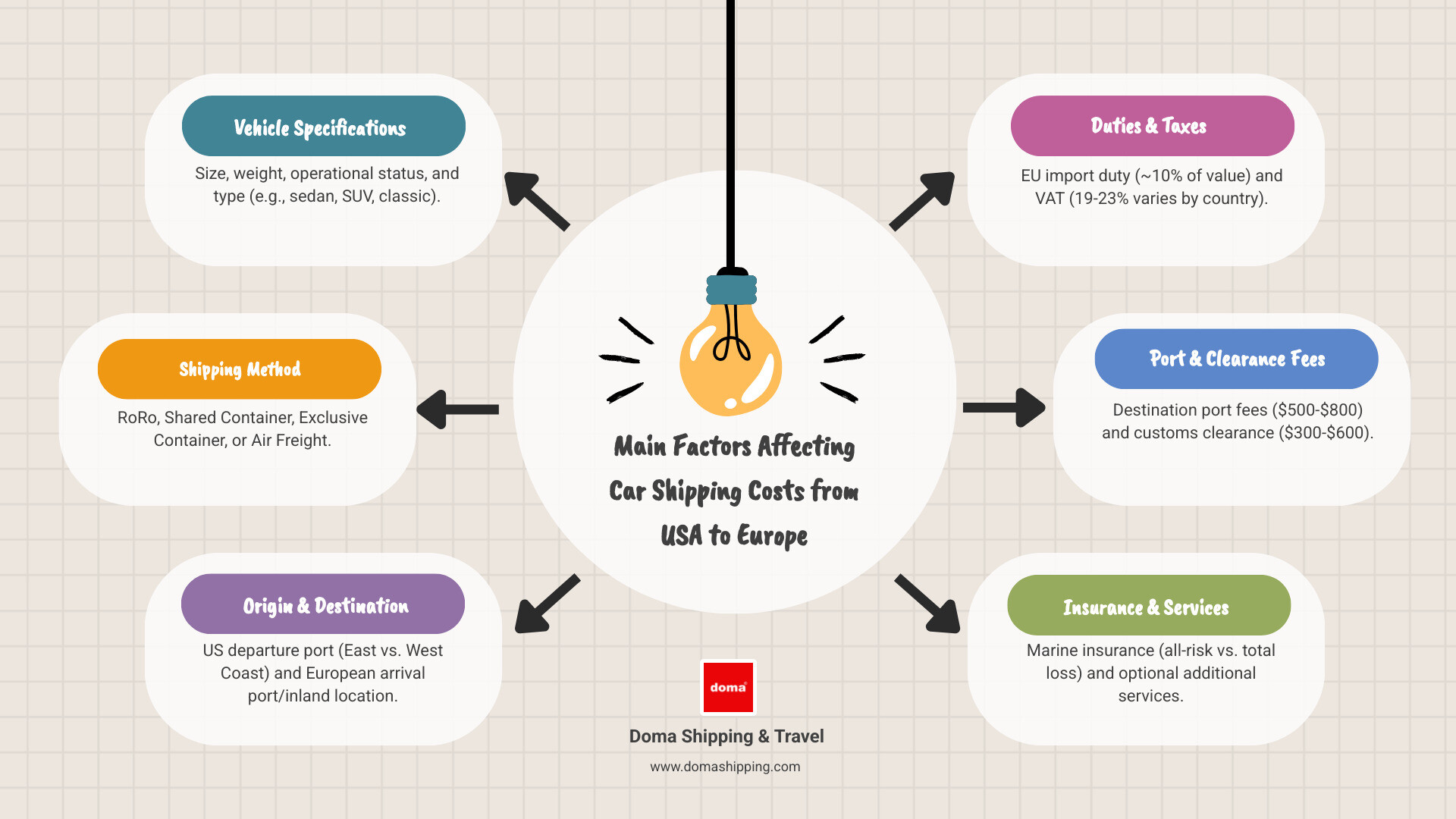
The three main factors that shape your shipment plan are:
- Your shipping method RoRo, container (LCL/FCL), or air freight
- Your vehicle specifications size, weight, operational status
- Your destination requirements port selection, customs procedures, local taxes, inland delivery
This guide breaks down the international process so you can prepare accurately and avoid documentation issues or clearance delays. Well walk through each shipping option, explain required paperwork, and outline what typically happens at arrival ports in Europe.
Whether you’re relocating, sending a classic car to a collector, or shipping a vehicle for an extended stay, understanding these steps helps you make informed decisions for your international shipment.
Find more about shipping car from usa to europe price:
Deconstructing the Financials: What Determines the Final Value of Your Shipment?
Planning an international vehicle shipment from the USA to Poland or other European countries requires understanding the operational components that shape the overall shipmentnot just ocean transport, but also handling, documentation, and customs requirements.
Vehicle Specifications and Origin
The characteristics of your vehicle and where it starts in the USA influence routing, handling needs, and the documentation process.
- Vehicle dimensions and weight: Larger and heavier vehicles require more space and may require different loading arrangements.
- Operational vs. non-operational status: Non-operational vehicles typically require container shipping and specialized loading support. RoRo shipping generally requires vehicles to be fully operational.
- Inland transport to a US departure port: The shipment begins at your vehicles location and must be moved to the selected export port for overseas departure.
- Departure port selection: The chosen US port affects scheduling, documentation timelines, and vessel availability.
Shipping Method and Destination Port
The chosen method and European port of arrival determine the clearance path and onward delivery options.
- RoRo shipping: Operational vehicles are driven onto the vessel and secured for overseas transit.
- Container shipping (LCL/FCL): Vehicles are loaded and secured inside a container, providing protection and allowing controlled handling.
- Air freight: Used when speed and specialized handling are the priority.
- Main European ports: Hubs like Bremerhaven (Germany), Rotterdam (Netherlands), and Antwerp (Belgium) commonly serve as entry points for vehicles moving into the EU.
- Inland European destinations: If the final destination is inland (including locations in Poland), additional delivery planning is required after port arrival.
We provide international delivery planning including delivery to final destinations in Europe. More info about Door to Door Shipping
Insurance and Additional Services
Protecting your vehicle during overseas transit is an important part of international planning.
- Marine cargo insurance options: While carrier liability may apply in limited circumstances, dedicated marine cargo insurance is commonly selected for international vehicle shipments.
- All-risk vs. total loss coverage: Coverage options vary by policy and declared value.
- Declared vehicle value: The declared value is used for customs and insurance documentation.
- Additional services: Depending on routing and port procedures, services may include storage, inspections, or port handling coordination.
For those also moving household items alongside their vehicle, we offer integrated international solutions. More info about Household and Personal Belongings Shipping
Comparing Your Shipping Options: RoRo, Container, and Air Freight
Choosing the right shipping method affects transit planning, handling requirements, and the level of protection your vehicle receives during overseas transport. Each method supports different international shipping needs from the USA to Poland and other European countries.
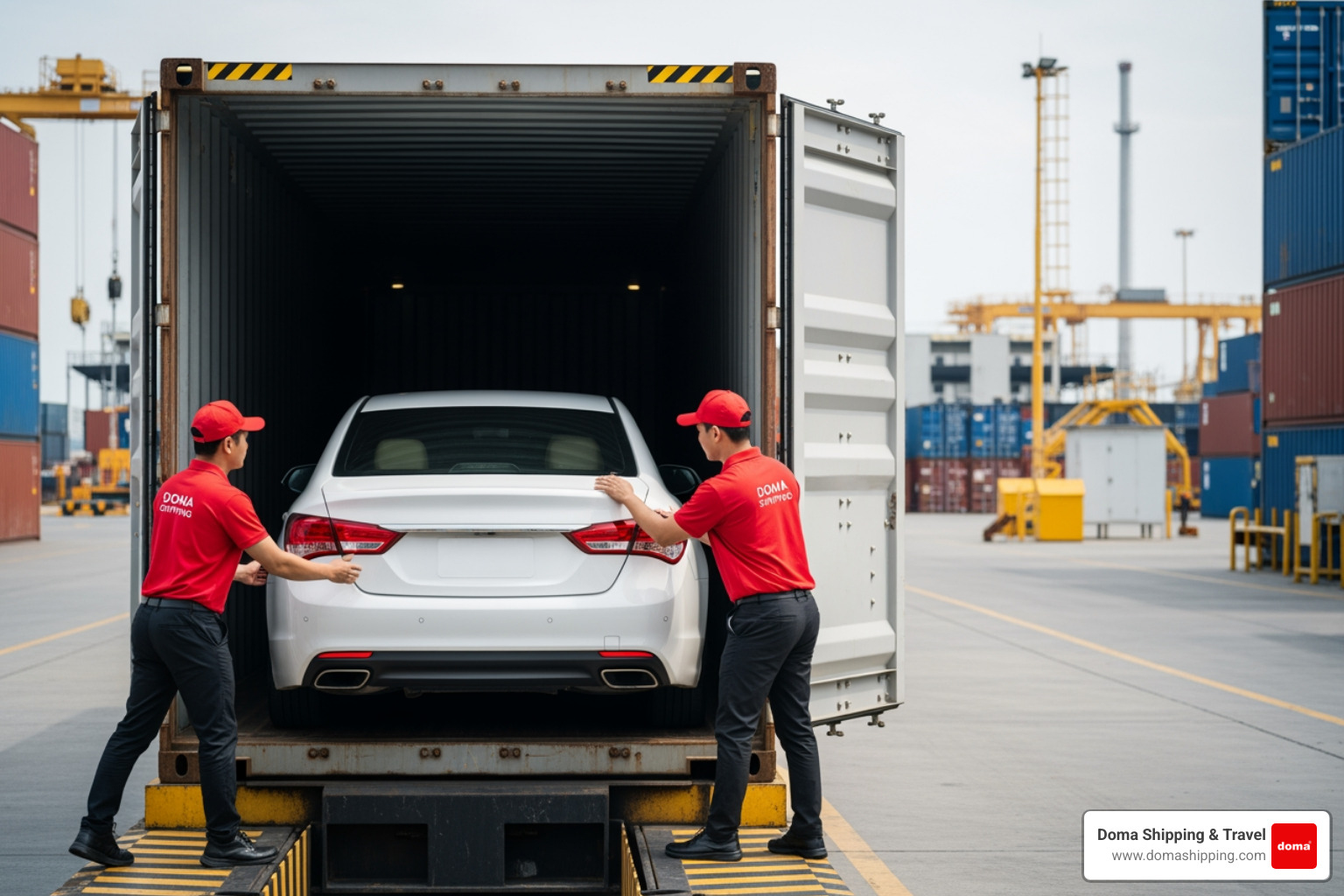
Heres a comparison of the primary methods for shipping your car from the USA to Europe:
| Feature |
RoRo (Roll-on/Roll-off) |
Shared Container (LCL) |
Exclusive Container (FCL) |
Air Freight |
| Protection |
Limited (open to elements) |
Good (enclosed) |
Excellent (fully enclosed) |
Excellent (controlled handling) |
| Flexibility |
Low (must be operational/empty) |
Medium (limited declared items) |
High (multiple vehicles; declared cargo options) |
High (fastest delivery) |
| Typical Use |
Operational standard vehicles |
Single vehicles |
High-value vehicles, non-runners, multiple vehicles |
Luxury, classic, urgent |
| Transit Time |
2-4 weeks |
3-6 weeks |
3-6 weeks |
1-2 weeks |
| Planning Intensity |
Moderate |
Moderate |
Higher |
Highest |
| Personal Items |
Not allowed |
Limited, declared items |
Allowed, declared items |
Not typically allowed |
Roll-on/Roll-off (RoRo) Shipping
RoRo is a straightforward method for shipping operational vehicles. Your car is driven onto a specialized cargo vessel and secured. At the destination port, it is driven off.
- How RoRo works: Vehicles are driven on and off the ship under their own power.
- Vehicle requirements: Your vehicle must be operational and nearly empty of personal belongings, with minimal fuel for safety.
- Typical transit times: RoRo shipments from the USA to Europe take approximately 2-4 weeks.
- Use cases for RoRo: Suitable for standard, operational vehicles when you do not need to ship items inside the car and want a direct port-to-port approach.
Container Shipping: Shared vs. Exclusive
Container shipping offers a higher level of protection and flexibility. Your vehicle is securely loaded into a steel shipping container, shielding it from the elements.
- Shared Container (LCL – Less Than Container Load): Your vehicle shares container space with other cargo moving to the same region. This approach is commonly used for shipping a single car and may allow a limited amount of declared items.
More info about Less Than Container Load Shipping
- Exclusive Container (FCL – Full Container Load): An exclusive container is typically selected for maximum protection, multiple vehicles, non-operational cars, or when shipping declared belongings alongside the vehicle.
More info about Full Container Load Shipping
- Protection and declared items: Container shipping protects the vehicle from weather and debris. Unlike RoRo, container shipping may allow declared items when properly inventoried for customs.
We specialize in helping clients ship vehicles from the USA to Poland and other European destinations. More info about Cars from USA to Poland
Air Freight for High-Value or Urgent Shipments
When speed is the top priority, or for exceptionally high-value vehicles, air freight is an option that prioritizes rapid delivery and controlled handling.
- Fast transit time: Air freight can deliver a vehicle from the USA to Europe in about 1-2 weeks, depending on routing and clearance.
- Specialized handling: Air shipments require detailed coordination for acceptance, hazardous materials checks, and airport procedures.
- Common use cases: Luxury, classic, rare, or time-sensitive vehicles.
- Security considerations: Airports and air cargo processes typically involve controlled access and frequent documentation checks.
Navigating the Complete International Shipping Process
Successfully navigating the international shipping landscape requires careful planning and a clear understanding of each step. From documentation to customs, we guide you through the process to help ensure a smooth journey for your vehicle.

The process involves US export clearance, ocean or air transit, European import clearance, and final delivery.
Essential Documentation for Export and Import
Accurate and complete documentation is the backbone of any international vehicle shipment. Missing or incorrect paperwork can lead to significant delays and additional obligations. We work with you to ensure all necessary documents are prepared.
Here’s a list of commonly required documents:
- Original Vehicle Title: This proves ownership. A lien release letter is needed if there is a lien.
- Bill of Sale: May be needed if you’ve owned the vehicle for less than six months.
- Passport/ID copy: A valid copy of your passport or government-issued ID.
- Power of Attorney: Authorizes your shipping agent to handle export and import procedures.
- Shipper Export Declaration (SED): Provides the US government with shipment information.
- Declaration of Dangerous Goods: Identifies components like airbags and batteries.
- Invoice: For customs valuation purposes.
- Proof of insurance: For the vehicle itself.
- EIN letter: For US citizens, if applicable.
The Journey: Transit Times and Tracking
Once your documentation is in order, your vehicle starts its transatlantic journey.
- Average transit times by method: RoRo takes about 2-4 weeks, container shipping 3-6 weeks, and air freight 1-2 weeks. These are ocean or air transit times and do not include customs clearance.
- Factors causing delays: US Customs inspections, port congestion, weather, and logistical challenges can extend transit times.
- Importance of a licensed shipper: Partnering with a licensed and reputable shipping company is essential. The Federal Maritime Commission (FMC) licenses international freight forwarders, ensuring they meet regulatory standards. We are a fully licensed and bonded international shipper.
You can Verify your shipper’s license with the Federal Maritime Commission (FMC) to ensure you are working with a trusted partner.
Arrival in Europe: Customs, Duties, and Vehicle Registration
Upon arrival, your vehicle undergoes the import process, including customs clearance, payment of duties and taxes, and potential modifications.
- Customs clearance process: Our European partners handle customs clearance, presenting all documentation and adhering to local regulations.
- Import duties: Most vehicles imported into the EU are subject to an import duty based on the vehicle’s value. Exemptions may apply for classic cars or vehicles imported as part of a permanent relocation (mienie przesiedleńcze).
- Value Added Tax (VAT): In addition to import duty, VAT is levied on imported vehicles. The rate depends on the destination country. Exemptions may apply for vehicles owned for at least six months and imported as part of a relocation.
- Vehicle modifications for EU standards: US-spec vehicles often require modifications to comply with European standards before registration. This can include lighting and emissions adjustments. Understanding these requirements for your destination is essential.
- Check vehicle import eligibility with the NHTSA beforehand: It’s wise to Check vehicle import eligibility with the NHTSA beforehand to understand US export requirements.
- Registering the car in a European country: After customs and modifications, the final step is to register your vehicle with local authorities, which requires proof of ownership, customs clearance, and a certificate of conformity.
For those relocating to Poland, we have specialized services to assist with the process, including advice on “mienie przesiedleńcze” (relocation property). More info about Mienie Przesiedlencze from USA to Poland
A Comprehensive Look at the Financials of Shipping a Car to Europe
International vehicle shipping from the USA to Poland and other European countries involves multiple operational elements beyond ocean transport. For accurate planning, it helps to separate the transport leg from documentation, port handling, customs clearance, taxes, and final deliveryoften referred to as the full end-to-end shipment scope.
Understanding the Base Shipping Quote vs. Total Landed Value
When reviewing an ocean transport quote, its important to confirm what services are included and what steps are handled separately.
- What an ocean transport quote typically includes: Vehicle transport by sea from a US departure port to a European arrival port (often port-to-port service).
- What may be separate from ocean transport: Inland transport to the US port, origin and destination port handling, export filing, customs clearance, marine cargo insurance, import duty/VAT, any required vehicle modifications, and inland delivery within Europe.
- Avoiding surprises: Clear scoping and documentation review helps reduce delays and rework during export and import.
- Port-to-port vs. door-to-door service: Door-to-door planning covers pickup, export handling, overseas transport, import clearance, and final delivery to your destination in Europe.
How Vehicle Type Influences the Shipment Plan
The type of vehicle you ship impacts handling and compliance requirements.
- Standard sedans: Typically straightforward to load and transport.
- SUVs and trucks: May require additional space planning and specific loading arrangements.
- Classic cars: Often need specialized securing and careful documentation due to condition and value.
- Luxury vehicles: Commonly shipped in exclusive containers or via air freight depending on handling requirements.
- Non-operational vehicles: Generally require container shipping and special loading support.
We also assist with shipping other types of vehicles, including motorcycles, to Europe. More info about Vehicles from USA to Poland
How to Get an Accurate Assessment
A complete shipment plan starts with accurate shipment details.
- Providing detailed information: Year, make, model, dimensions, weight, and operational status.
- US location: The vehicles location in the USA helps determine pickup and routing to the export port.
- European destination: The destination country/city (including Poland) determines arrival port selection, customs handling steps, and onward delivery requirements.
- Choosing a shipping method: RoRo, container (LCL/FCL), or air freight will determine handling, documentation needs, and scheduling.
Our team can help review shipment details and documentation requirements. Contact us for shipping guidance
Frequently Asked Questions about Shipping a Car to Europe
International vehicle transport often involves questions about documentation, handling rules, and customs procedures. Below are common questions related to planning a shipment from the USA to Poland and other European countries.
Can I ship personal belongings inside my car?
This depends on your chosen shipping method and destination country regulations.
- RoRo restrictions: For RoRo shipping, personal belongings are generally not permitted inside the vehicle. The car must be empty, containing only standard equipment and minimal fuel.
- Container shipping flexibility: Container shipping offers more flexibility. With a shared container, a limited quantity of declared items may be allowed. An exclusive container provides greater flexibility to ship declared belongings alongside your car, provided they are itemized for customs.
- Declaring items for customs: Any items shipped inside your vehicle must be declared on documentation.
- Customs treatment of items: Declared items may be subject to customs duties and taxes depending on the destination country and import basis.
How long does it take to ship a car from the USA to Europe?
Transit times vary by shipping method and route.
- RoRo: Typically 2-4 weeks for ocean transit.
- Container: Generally 3-6 weeks for ocean transit; shared containers may include consolidation time.
- Air Freight: Often 1-2 weeks depending on routing and clearance.
- Customs clearance: Factor in time for export and import customs clearance, which can take several business days.
- Port of departure impact: The selected US port and sailing schedule can influence overall timing.
What are the main European ports for vehicle imports?
Europe has several major ports equipped to handle vehicle imports from the USA, serving as common entry points for the continent.
- Bremerhaven (Germany): A major vehicle handling port for Germany and inland EU destinations.
- Rotterdam (Netherlands): Europes largest port with extensive inland connections.
- Antwerp (Belgium): A key hub for vehicle imports into Belgium and nearby regions.
- Le Havre (France): A primary port of entry for France.
- Barcelona (Spain): A significant port for Spain and Southern Europe.
- Gdynia/Gdansk (Poland): Common ports for shipments destined for Poland, depending on routing and service availability.
Conclusion
Understanding the shipping car from USA to Europe price requires a clear view of all contributing factors. From selecting the right shipping method to preparing documentation and navigating European import regulations, each step is crucial for a successful international move.
We’ve explored how vehicle specifications, shipping method, locations, and additional services, duties, and taxes combine to form your total financial commitment. A base shipping quote is just one piece of the picture; accounting for destination services, import duties, and VAT is essential for proper planning.
The importance of thorough preparation and accurate documentation cannot be overstated. Partnering with experienced professionals, like us at Doma Shipping & Travel, ensures you receive comprehensive guidance and reliable service for your international shipment from the USA to Europe.
Ready to start your vehicle’s European journey? Let us help you plan every detail of the process. Get started with your international shipment today