Why Understanding Overseas Package Delivery Matters
Overseas package delivery connects people, families, and businesses across continents. Whether you’re sending a birthday gift to relatives in Poland, shipping personal belongings to your new home in Germany, or expanding your business into European markets, international shipping involves more than just dropping a box at the post office.
Quick Answer: What You Need to Know About Overseas Package Delivery
- Choose your service – Express, standard air, or ocean freight based on urgency and package size
- Prepare documentation – Customs forms, commercial invoices, and detailed item descriptions are required
- Pack properly – Use sturdy materials and follow carrier guidelines for international transit
- Understand customs – Duties, taxes, and clearance procedures vary by destination country
- Track your shipment – Monitor your package from pickup in the USA through delivery in Europe
The challenge is real: customs regulations change, prohibited items vary by country, and one missing document can delay your shipment for weeks. With services reaching over 180 countries and multiple carriers offering different options, knowing what to expect makes the difference between a smooth delivery and a frustrating experience.
This guide walks you through the complete process of sending packages from the United States to Poland and other European destinations. You’ll learn how to pack correctly, fill out customs forms, choose the right shipping service, and track your package until it arrives safely at its destination.
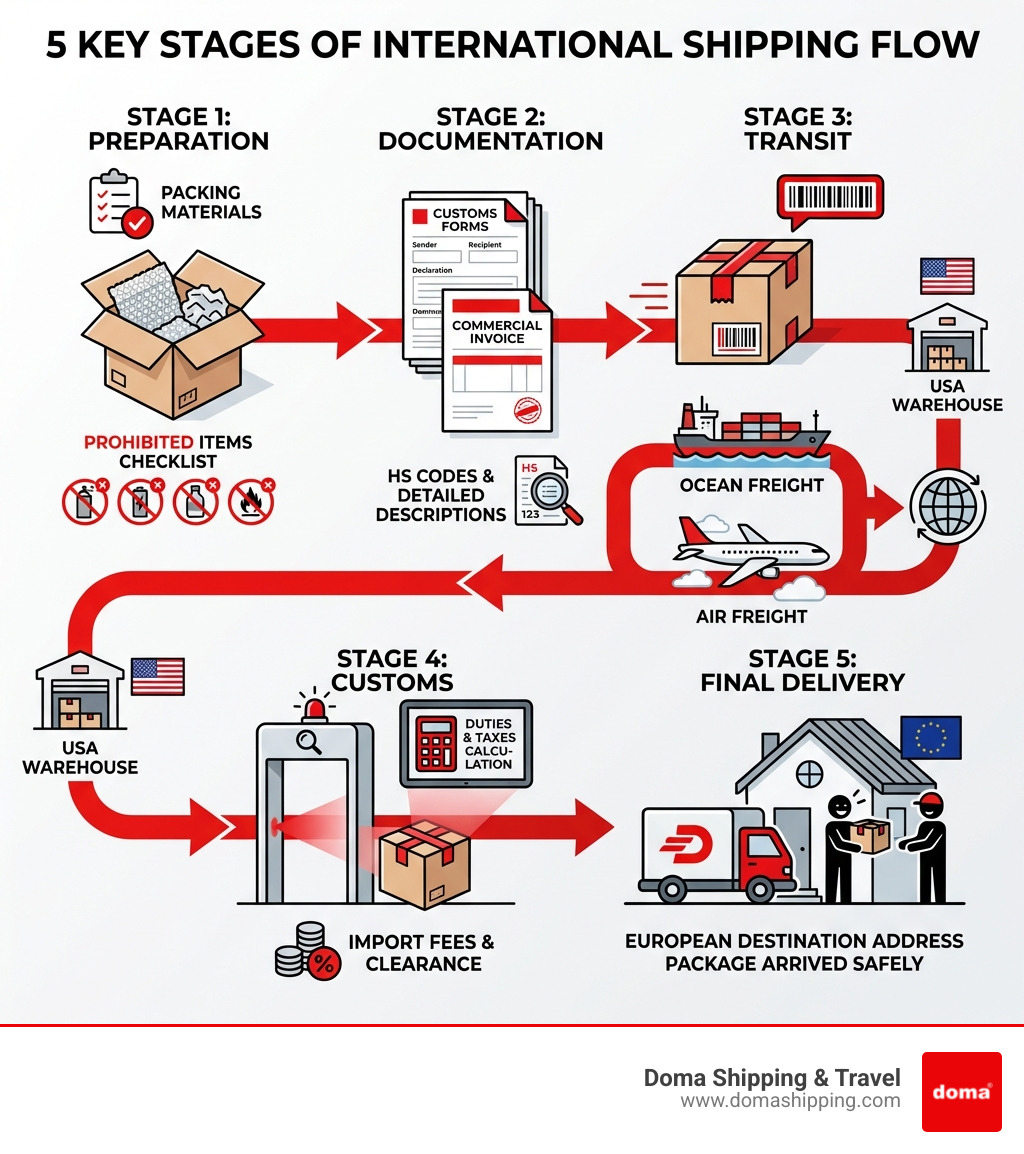
Step 1: Preparing Your Parcel for International Transit
The journey of your package begins long before it leaves your hands. Proper preparation is the cornerstone of successful overseas package delivery. It ensures your items are protected, comply with regulations, and reach their destination without unnecessary delays.

Packaging Best Practices
When preparing your items for international transit from the USA to Europe, think robust and resilient. Your package will travel a considerable distance and pass through various handling points, so strong packaging is non-negotiable.
Here are our top tips for packaging:
- Use a New, Durable Box: A new corrugated box offers maximum strength. Used boxes may have hidden damage, compromising their integrity. For international shipments, especially to Europe, a sturdy outer box is paramount.
- Cushioning Materials: Surround your items with ample cushioning. Bubble wrap, packing peanuts, foam, or crumpled paper can protect against shocks and vibrations. Ensure there’s at least two inches of cushioning on all sides of your item, especially for fragile goods.
- Internal Reinforcement: If shipping multiple items, wrap each item individually to prevent them from knocking against each other. Fill any empty spaces within the box to stop items from shifting during transit.
- Sealing the Box: Use strong, pressure-sensitive packing tape (plastic or nylon-reinforced) that is at least two inches wide. Apply tape generously to all seams and flaps, both top and bottom, forming an “H” pattern. Avoid masking tape, cellophane tape, or duct tape, as they may not withstand the rigors of international shipping.
- Reinforcing Seams: For heavier packages, consider reinforcing the box with additional tape or even strapping. This extra step can prevent the box from bursting open due to weight or rough handling.
How to Address International Packages Correctly
Accurate addressing is critical for timely overseas package delivery. A small error can lead to significant delays or even return of your package.
Follow these guidelines for addressing packages destined for Europe:
- Print Clearly: Always print the return and delivery addresses neatly in capital letters using a pen or permanent marker. Avoid using commas or periods in the address itself.
- Return Address: Your full address in the U.S. (the “return address”) should be placed in the top-left corner of the package. Include your full name or company name, apartment or suite number, full street address, City, State, and ZIP+4 Code, and “USA” on separate lines.
- Delivery Address: The recipient’s full address in Europe should be written in English and placed in the center of the label or package. Include the recipient’s full name or company name, full street address, City, Subdivision (like province, state, county), and Postal Code, and the full Country name on separate lines. For example, when sending to Poland, ensure “POLAND” is clearly written.
- Country-Specific Formats: Many European countries use different address formats. For instance, the postal code might go before the city. To ensure absolute accuracy, we recommend consulting official resources for specific country postal address formats. You can find detailed guidance on country-specific address formats. Additional details on addressing are also available.
- Internal Address Copy: As a best practice, write the recipient’s full name and address on a piece of paper and place it inside your package. This acts as a backup in case the external label becomes damaged or unreadable.
Understanding Prohibited and Restricted Items
Before sending any package overseas, it is essential to understand the distinction between prohibited and restricted items. Prohibited items are forbidden by law or carrier policy and cannot be shipped under any circumstances. Restricted items may be shipped but require special handling, permits, or limitations.
When sending packages from the USA to Europe, common prohibited items typically include:
- Alcohol
- Military Goods
- Drugs (illegal narcotics and certain prescription drugs)
- Tobacco and tobacco products
- Knives (certain types)
- Cash or currency
- Credit/Debit Cards
- Passports
- Perishable Food items
- Certain types of Li-ion Batteries (especially by air cargo)
- Perfumes and Aerosols (often restricted by air due to flammability)
These are general examples, and the specific list can vary significantly between carriers and, more importantly, between destination countries in Europe. Each European country has its own import regulations, and what is allowed in one may be restricted or prohibited in another.
Key Considerations:
- Destination Country Regulations: Always check the specific import regulations of the European country you are shipping to (e.g., Poland, Germany, France). Their customs authority websites are the best source for this information.
- Carrier Restrictions: Even if an item is allowed by the destination country, your chosen carrier may have its own restrictions. For example, some carriers have stricter rules on liquids, certain electronics, or high-value goods.
- Checking Official Sources: It is your responsibility as the shipper to ensure compliance. We always advise checking with the destination country’s customs office or consulting with your international shipping provider for the most up-to-date and accurate information regarding prohibited and restricted items for your specific European destination.
Failing to adhere to these rules can result in your package being seized, returned to sender, or even legal penalties. When in doubt, it’s always best to ask.
Step 2: Navigating International Shipping Services and Documentation
Once your package is expertly prepared, the next crucial step in overseas package delivery involves selecting the appropriate shipping service and carefully preparing all necessary documentation. This phase determines how your package travels and ensures it clears customs smoothly.
Choosing the Right International Shipping Service
The landscape of international shipping services is diverse, designed to meet a wide range of needs concerning speed, package size, and specific requirements. When shipping from the USA to Poland and other European destinations, understanding these options is key to making an informed decision.
Here are the main types of services available:
- Express Shipping: This is the fastest option for urgent overseas package delivery. It typically involves air freight and offers rapid transit times, often within 1-5 business days, depending on the destination. While it provides speed and often includes advanced tracking and some insurance, it is the premium option for time-sensitive deliveries.
- Standard Air Shipping: A balanced option, offering a good compromise between transit time and service features. Packages are transported by air, with transit times usually ranging from 5-10 business days to European destinations. This service often includes tracking and basic insurance.
- Ocean Freight (Container Shipping): Ideal for larger, heavier shipments, or when urgency is not the primary concern. Ocean freight is a suitable solution for bulk goods, furniture, or vehicles. Transit times are considerably longer, typically several weeks, but it can be an effective choice for large-volume shipping.
- Less Than Container Load (LCL) Shipping: If your shipment isn’t large enough to fill an entire shipping container, LCL allows you to share container space with other shippers. This is an effective solution for medium-sized shipments from the USA to Poland and Europe. You can learn more about Less Than Container Load Shipping.
- Full Container Load (FCL) Shipping: For large volumes of goods, or when you prefer exclusive use of a container for security and efficiency, FCL is the preferred choice. This is often used for commercial shipments, large household moves, or vehicles from the USA to Poland and Europe. Explore our Full Container Load Shipping services.
- Door-to-Door Delivery Options: Many services, including ours, offer comprehensive door-to-door solutions. This means we handle the entire logistics chain, from pickup at your location in the USA to final delivery at the recipient’s address in Europe, including all customs clearance processes. This provides convenience and peace of mind for your Door to Door Shipping needs.
Overview of Our International Shipping Services:
At Doma Shipping & Travel, we specialize in comprehensive overseas package delivery from the USA to Poland and other European countries. We offer a range of services custom to your specific requirements, whether you’re sending a small parcel or an entire household. Our expertise spans International Parcel Shipping, Household & Personal Belongings Shipping, and even specialized services like Samochody z USA do Polski (Cars from USA to Poland) and Motory z USA do Polski (Motorcycles from USA to Poland). We aim to simplify the complexities of international logistics, ensuring your items reach their destination safely and efficiently.
Essential Documentation for Your Overseas Package Delivery
Documentation is arguably the most critical component of international shipping. Incorrect or incomplete paperwork is the leading cause of customs delays. For any overseas package delivery from the USA to Europe, you will need to provide specific forms and information.
Key documents and information required include:
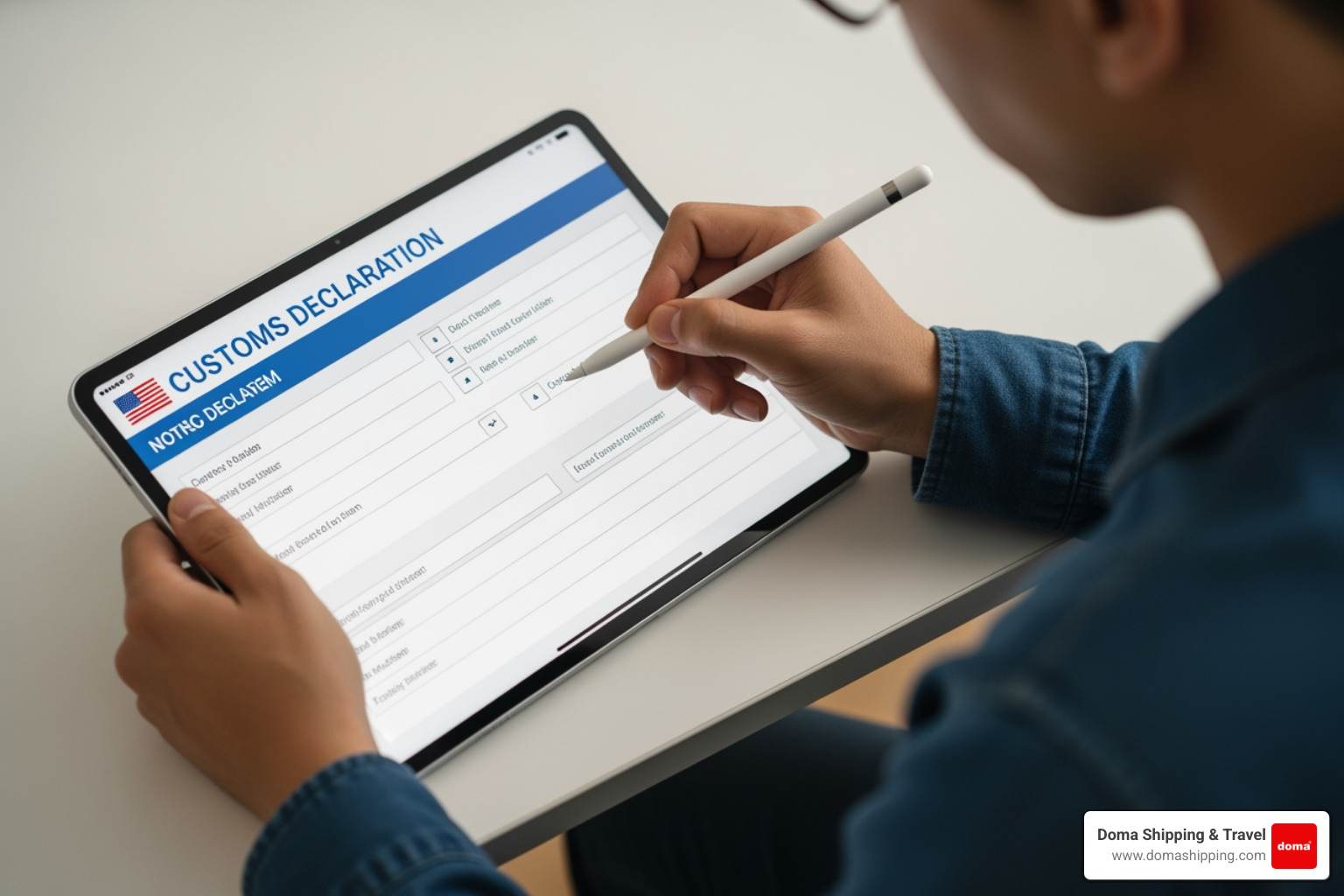
- Customs Declaration Form: This document provides customs authorities with a detailed account of the contents of your package. It’s a mandatory requirement for all international shipments. All packages sent internationally now require more detailed item descriptions. General descriptions like “gifts” or “clothes” are insufficient and will likely lead to delays. Instead, be specific: “men’s cotton t-shirt,” “ceramic coffee mug,” “children’s wooden toy car.”
- Commercial Invoice: For commercial shipments (items sold or intended for resale), a commercial invoice is essential. This document serves as a bill of sale between the sender and recipient, detailing the goods, their value, quantity, and terms of sale. Even for personal shipments, a proforma invoice (similar to a commercial invoice but for non-commercial goods) may be required to declare the value.
- Detailed Item Descriptions: As mentioned, specifics are key. For each item, describe what it is, what it’s made of, and its intended use. This helps customs officers accurately classify the goods and assess any applicable duties or taxes.
- Harmonized System (HS) Codes: These are internationally standardized numerical codes used to classify traded products. Providing the correct HS code for each item in your shipment can significantly expedite customs clearance, as it eliminates guesswork for customs officials. While not always mandatory for personal shipments, including them for commercial goods is highly recommended.
- Proof of Value: You’ll need to declare the value of the items in your package. This helps customs determine duties and taxes. Be honest and accurate; undervaluation can lead to penalties and delays. Keep receipts or other proof of purchase readily available.
We provide assistance with filling out these complex forms to ensure compliance. You can also find general help with customs forms through various online resources. The goal is to provide customs with all the information they need upfront, leaving no room for questions or ambiguities.
Step 3: The Journey of Your Overseas Package Delivery
Once your package is expertly packed, addressed, and all documentation is in order, it starts on its journey. This phase of overseas package delivery is a complex logistical dance, moving your item from its origin in the USA across continents to its European destination.
Explaining the Customs Clearance Process
Customs clearance is a critical checkpoint for all international shipments. It’s the process by which goods are granted permission to enter or exit a country. For packages traveling from the USA to Europe, this process occurs at the European border.
Here’s what happens:
- Role of Customs Authorities: Customs officials in the destination country (e.g., Poland, Germany) review your package’s documentation (customs declaration, commercial invoice) to verify its contents, declared value, and origin. Their primary roles are to collect duties and taxes, enforce import/export laws, and prevent the entry of prohibited or restricted goods.
- Inspections: Packages may be subject to physical inspection. This is a routine part of the process, especially if documentation is unclear or if the package is selected for random checks. Detailed and accurate documentation can help minimize the need for extensive inspections.
- Duties and Taxes Explained: These are fees levied by the destination country’s government on imported goods.
- Duties (Tariffs): Taxes imposed on imported goods. The amount depends on the type of product, its value, and the country of origin.
- Value Added Tax (VAT): A consumption tax applied to goods and services at each stage of production and distribution. Most European countries have VAT, and it is typically collected upon import.
- DDU vs. DDP Terms: Understanding these terms is crucial for determining who is responsible for import fees:
- Delivered Duty Unpaid (DDU): With DDU, the sender is responsible for the shipping service, but the recipient must pay any import duties, taxes, or customs clearance fees upon arrival. This can lead to additional payments for the recipient.
- Delivered Duty Paid (DDP): Under DDP, the sender arranges to cover all transportation fees, customs duties, taxes, and import charges. This means the recipient receives the package with no additional payments required upon delivery, offering a smoother and more predictable experience. We often recommend DDP for a more straightforward delivery for your recipient in Europe.
- Avoiding Delays: The best way to avoid customs delays is thorough preparation. This includes accurate and detailed documentation, precise item descriptions, correct HS codes, and choosing the appropriate DDU or DDP terms. Any discrepancies can lead to the package being held, requiring additional information or payment from either the sender or recipient.
How to Track Your International Package
In the era of global commerce, knowing where your package is at any given moment offers peace of mind. Tracking your overseas package delivery from the USA to Europe is a standard feature provided by most reputable carriers.
Here’s how it typically works:
- Tracking Numbers: Once your shipment is processed, you’ll receive a unique tracking number. This alphanumeric code is your key to monitoring your package’s progress.
- Carrier Websites: The primary method for tracking is usually through the carrier’s official website. You simply enter your tracking number into the designated field to view real-time updates.
- Tracking Services: For broader visibility, especially if your package transitions between multiple carriers or postal services, universal tracking platforms can be invaluable. These services aggregate tracking information from numerous carriers worldwide. For instance, some platforms provide access to tracking for 1,268 international carriers, enabling you to follow virtually any package worldwide with confidence. You can often track package with tracking number directly on such platforms.
- Tracking Statuses Explained: Common tracking statuses you might see include:
- “Information received”: The carrier has received your shipment details.
- “In transit”: Your package is moving through the shipping network.
- “Arrived at facility”: Your package has reached a sorting hub.
- “Customs clearance”: Your package is undergoing customs inspection.
- “Out for delivery”: Your package is on its way to the recipient.
- “Delivered”: Your package has successfully reached its destination.
- “Exception” or “Pending”: Indicates a potential issue or delay, often requiring further action.
- Delivery Notifications: Many carriers and tracking services offer email or SMS notifications for significant status changes, such as “out for delivery” or “delivered.” This keeps both you and your recipient informed throughout the journey.
We offer robust tracking capabilities for your international shipments. You can easily monitor your overseas package delivery through our Tracking paczek page, ensuring you’re always aware of its status from the USA to its final destination in Europe.
Frequently Asked Questions about International Shipping
Navigating the complexities of overseas package delivery often brings up common questions. Here, we address some of the most frequently asked inquiries to further clarify the process.
What is the most important document for sending a package overseas?
While all required documents are important, the Customs Declaration Form (and for commercial goods, the Commercial Invoice) is arguably the most critical. This document tells the customs authorities in the destination country exactly what is inside your package, its value, and other pertinent details.
- Importance of Accuracy: The information on this form is used to classify your goods, assess duties and taxes, and ensure compliance with import regulations.
- Detailed Descriptions: As highlighted earlier, providing detailed, specific, and accurate descriptions of each item is paramount. Generic terms like “gifts” or “clothes” are insufficient and will almost certainly lead to delays.
- Consequences of Incorrect Information: Inaccurate or incomplete information can result in significant delays, your package being held at customs, fines, or even the return or confiscation of your shipment. It’s better to spend extra time ensuring this document is perfect than to face complications later.
Why do I need to provide a recipient’s phone number and email?
Providing the recipient’s phone number and email address is not just a formality; it’s a vital piece of information that significantly contributes to a smooth overseas package delivery.
- Customs Communication: If customs authorities in Europe have questions about the package’s contents, value, or require additional documentation, they can directly contact the recipient. This proactive communication can resolve issues quickly and prevent delays.
- Delivery Coordination: The local delivery agent or courier in Europe may need to contact the recipient to arrange a delivery time, confirm the address, or provide instructions for pickup if direct delivery isn’t possible. This is especially common in certain residential areas or for larger items.
- Courier Contact: In case of unforeseen issues during the final leg of delivery, such as an inaccessible address or a missed delivery attempt, the courier can reach out directly to the recipient for resolution.
- Avoiding Delivery Exceptions: Without contact information, any minor delivery hurdle can turn into a significant problem, potentially leading to the package being held indefinitely or returned to the sender. Providing these details helps ensure a seamless hand-off.
What are the differences between various international shipping carriers?
When considering overseas package delivery from the USA to Europe, you’ll encounter different types of service providers, each with distinct characteristics. While we focus on providing comprehensive logistics solutions, understanding the general categories can help you appreciate our approach.
- National Postal Services: These are government-operated services (like postal services in the USA). They are often used for smaller, lighter packages and documents, covering a vast network of countries. Their strengths often lie in their extensive reach, relying on a global network of postal agreements. However, tracking might be less detailed, and transit times can be longer compared to private options.
- Private Express Couriers: These are independent, globally integrated companies. They are known for speed, advanced tracking, and often a higher level of customer service. They operate their own vast networks of planes and vehicles, providing expedited services and often handling customs brokerage as part of their offering. They are generally suited for time-sensitive shipments and represent a premium service category.
- Freight Forwarders (like Doma Shipping & Travel): We act as intermediaries, specializing in organizing shipments for individuals and businesses. We don’t necessarily own the ships or planes, but we leverage our extensive network and expertise to coordinate the best routes and carriers for your specific needs. This allows us to offer custom solutions, from small parcels to full containers, optimizing for factors like cargo type, destination, and urgency. Our services often include comprehensive customs handling, documentation preparation, and door-to-door logistics, simplifying the entire process for you, especially for complex shipments like household goods or vehicles from the USA to Poland and Europe. We focus on providing a complete, integrated solution that prioritizes efficiency and reliability.
The choice often depends on the urgency, size, value, and specific requirements of your shipment.
Conclusion: Ensuring a Smooth International Shipping Experience
Navigating overseas package delivery from the USA to Europe doesn’t have to be daunting. By understanding the key steps and considerations, you can ensure your packages reach their destination safely and efficiently.
We’ve covered the essentials:
- Preparation: The importance of robust packaging and accurate addressing to protect your items and ensure they are routed correctly.
- Documentation: The critical role of detailed customs forms, commercial invoices, and HS codes in facilitating smooth customs clearance.
- Transit and Tracking: How your package journeys across continents and the value of tracking to monitor its progress.
- Customs: Understanding duties, taxes, and the impact of DDU vs. DDP terms on the recipient.
The journey of an international package is a complex logistical chain, but with careful attention to these details, you can minimize potential delays and ensure a positive experience for both sender and recipient.
At Doma Shipping & Travel, we pride ourselves on over 30 years of experience in providing comprehensive international logistics solutions. From handling your everyday overseas package delivery to managing complex container shipments and even vehicle transport from the USA to Poland and other European countries, our expertise is designed to simplify your global shipping needs. We also offer additional services like online shopping assistance, money transfers, and travel booking, making us a holistic partner for your international connections.
We are here to guide you through every step, ensuring your valuable items arrive safely and on time. To learn more about how we can assist with your specific international shipping requirements, please visit our dedicated page for International Parcel Shipping.