
International large package shipping works differently from sending a standard parcel overseas — and knowing the difference can save you from delays, unexpected surcharges, and customs headaches.
Here is a quick overview of what you need to know:
| Factor | Standard Parcel | Large / Heavy Shipment |
|---|---|---|
| Weight threshold | Up to 70 lbs / 150 lbs | Over 70–150 lbs depending on carrier |
| Size trigger | Under 30 kg, no oversized flag | Any side over 80 cm, or total dims exceed limits |
| Shipping method | Express parcel service | Freight or palletized express |
| Customs docs | Basic customs form | Commercial invoice, HS code, possibly EEI form |
| Weight calculation | Actual or volumetric weight | Chargeable weight (greater of actual vs. volumetric) |
Whether you are a family shipping personal belongings from the USA to Poland, or a business sending industrial equipment to Europe, the moment your shipment crosses certain size or weight thresholds, the rules change entirely.
Major international carriers each define “large” and “freight” differently. Many logistics networks classify anything over 150 lbs as freight — requiring different packaging, palletization, and documentation. Global express networks can handle individual pieces up to 1,000 kg, but that requires its own set of preparations.
Getting this wrong results in significant logistical complications. Oversized surcharges, rejected shipments, and customs delays are all common outcomes when shippers treat a heavy or bulky item like a regular box.
This guide walks you through everything — from size thresholds and volumetric weight to palletization, customs compliance, and choosing the right service level for shipping large items from the USA to Europe.
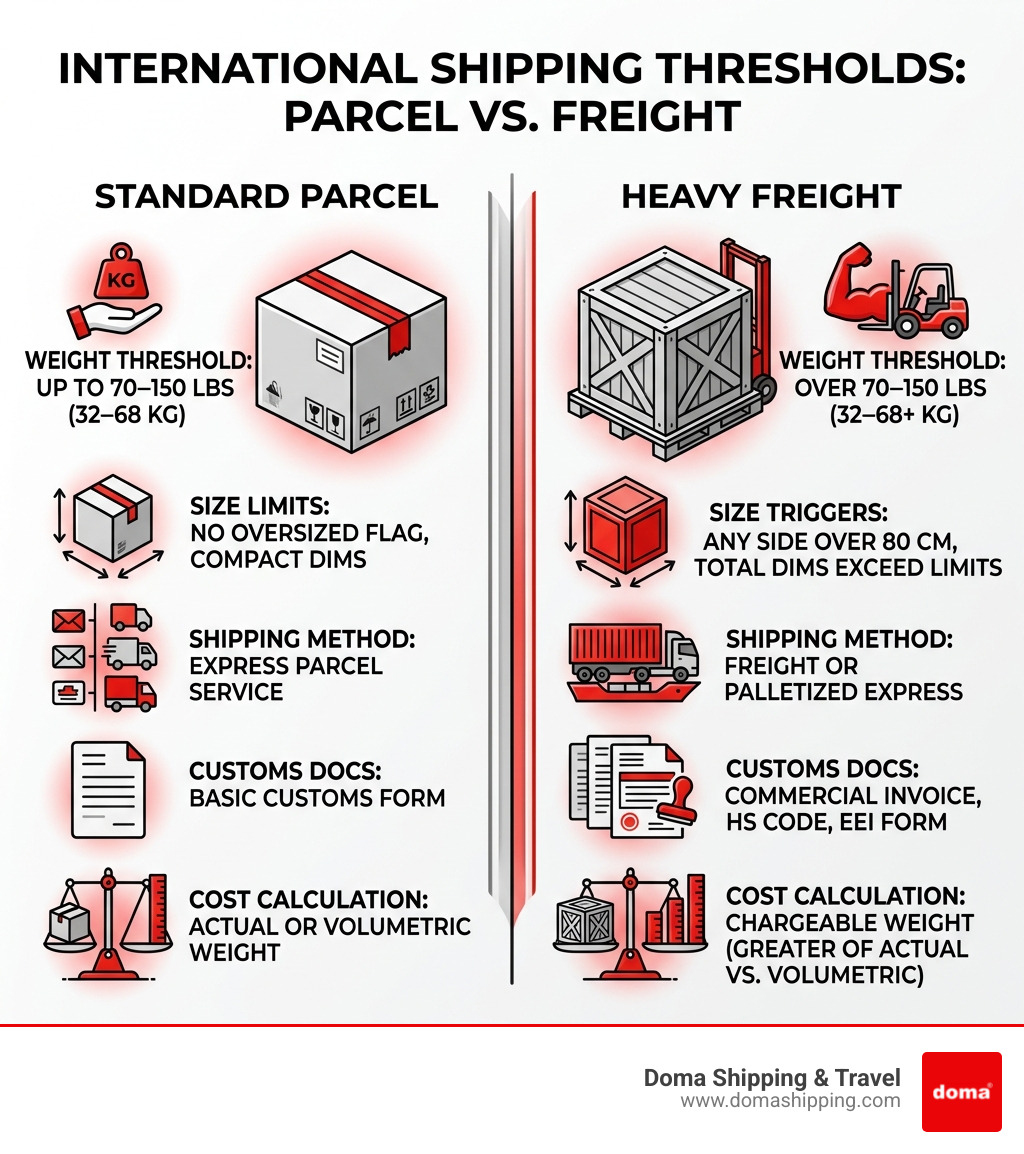
When we talk about international large package shipping, we are stepping out of small padded envelopes and into the realm of heavy-duty logistics. For our clients in the Chicago area—from Melrose Park and Mount Prospect to Roselle and Palos Hills—understanding these requirements is the first step toward a successful delivery to Europe.
A package is generally flagged as “large” or “heavy” based on two primary triggers: its physical weight and its physical dimensions. In international logistics, weight thresholds are strict. For example, most postal services have a ceiling of 70 lbs. Once you exceed this, you are no longer sending a “package” in the traditional sense; you are moving into freight territory.
Dimensions are equally critical. If any single side of your package exceeds 80 cm (about 31.5 inches) or if the girth exceeds specific carrier limits, it may be classified as “out-of-gauge” (OOG) cargo. These items require special handling because they often cannot fit on standard automated conveyor belts in sorting facilities. Instead, they must be moved by hand or forklift, which is why specialized Parcel & Package Shipping services are necessary.
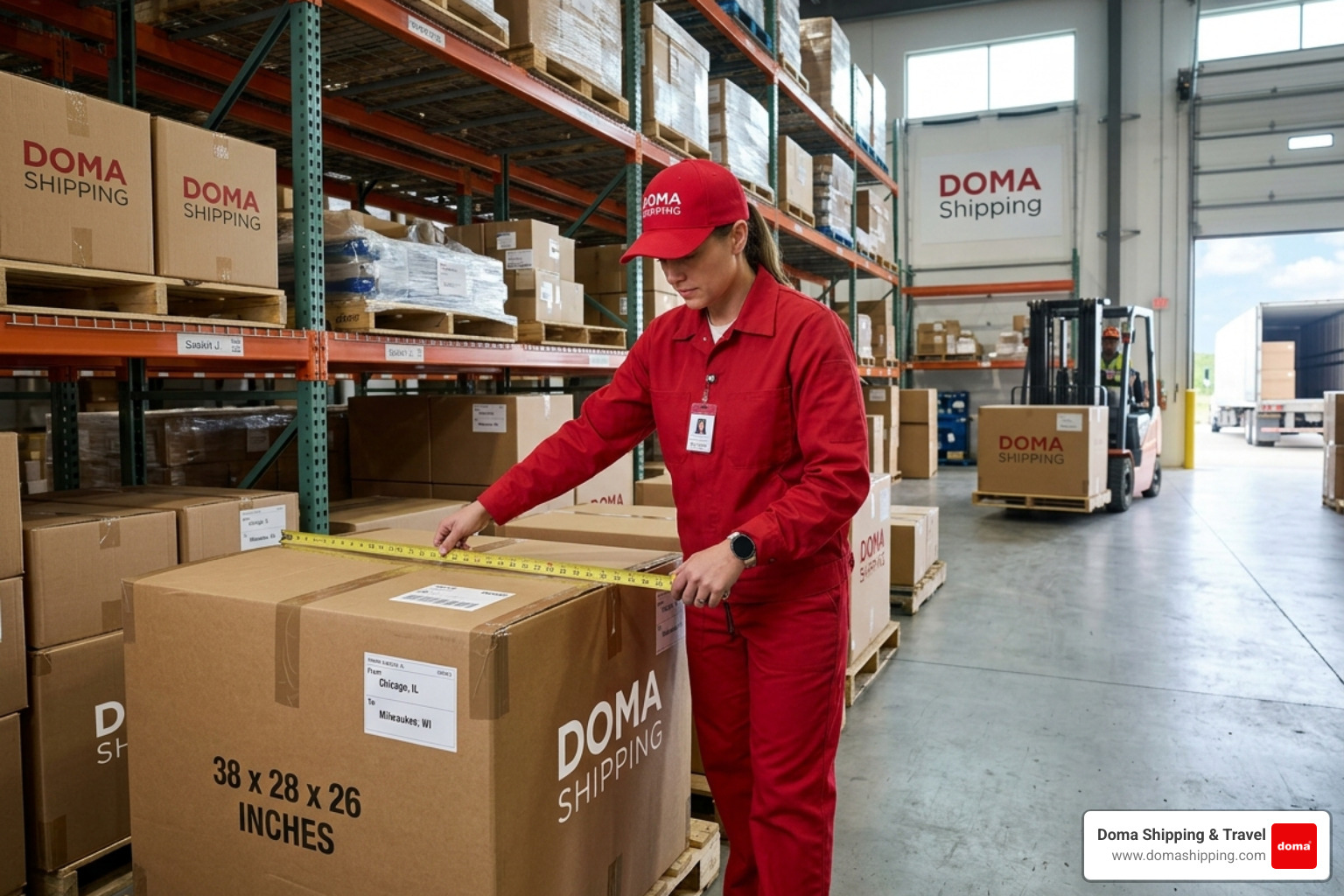
How do you know if your shipment requires a specialized heavy-lift approach? It helps to look at the maximum limits set by major global carriers as of May 2026. While we coordinate the journey from the USA to Poland or other European destinations, we often utilize these networks to ensure your goods move efficiently.
| Carrier Service Category | Max Weight per Piece | Max Dimensions |
|---|---|---|
| Standard Postal Service | 70 lbs | Max length 42″, Max length + girth 79″ |
| Express Priority | 150 lbs (Standard) | 108″ length, 130″ length + girth |
| International Freight | 4,400 lbs | 119″ L x 80″ W x 70″ H |
| Global Express Pallet | 1,000 kg (Palletized) | 300 cm L x 200 cm W x 160 cm H |
If your item is over 150 lbs (68 kg), it is officially classified as freight. This is a significant milestone in international large package shipping. At this point, the item must be palletized. If you are shipping from our locations in Algonquin, Niles, or Park Ridge, we ensure that these heavy items are prepared for the rigors of trans-Atlantic travel, where they will be stacked and moved multiple times before reaching their final European destination.
One of the most common surprises for people new to international large package shipping is the concept of “volumetric weight,” also known as dimensional (DIM) weight. You might be shipping a large, beautiful antique wardrobe that is relatively light, but because it takes up so much space in a cargo hold, the carrier will assess the shipment based on the space it occupies rather than its actual weight on a scale.
Carriers use a specific formula to determine this. In the metric system, the standard volumetric divisor is 5000. The formula looks like this: (Length x Width x Height in cm) / 5000 = Volumetric Weight in kg.
The “chargeable weight” is always the higher of the two: the actual physical weight or the volumetric weight. For example, if you are sending a large crate of specialized foam insulation from Des Plaines to Warsaw, the actual weight might be 50 kg, but the volumetric weight could be 150 kg. The shipment will be calculated at 150 kg. Understanding this is vital for International Parcel Shipping because it influences how you choose to pack your items.
To ensure your shipment is handled correctly and arrives safely, we recommend several strategic packing steps:
When a shipment is too heavy for a person to lift—typically anything over 70 lbs—it must be placed on a pallet. Palletization is the backbone of international large package shipping. It allows for safe handling by forklifts and protects the cargo from the “bumps and bruises” of international hubs.
For shipments heading to Poland or wider Europe, we follow strict guidelines. Pallets should be made of heat-treated wood (ISPM 15 compliant) or plastic to meet international biosecurity regulations. When securing your goods, we use heavy-duty metal or break-resistant plastic banding. This ensures that even if the plane or ship encounters turbulence, your cargo stays firmly attached to its base.
Furthermore, we recommend using double-walled or even triple-walled corrugated boxes for heavy items. For exceptionally dense or high-value items, like industrial generators or medical equipment, a plywood crate with an exterior lock or clamp is often the best choice. For more details on these specialized techniques, see The Heavy Lifter’s Guide to USA to Poland Pallet Transport.
While it might seem complex, there are significant strategic advantages to using professional large package services. For businesses in Glenview, Franklin Park, or Schiller Park, this can be a game-changer for supply chain management.
Every package crossing an international border must pass through customs, but large shipments are often subject to higher levels of scrutiny. Customs officials use the Commercial Invoice to determine the duties and taxes applicable to your shipment.
A critical component of this document is the Harmonized System (HS) Code. This is a standardized numerical method of classifying traded products. Getting this code wrong can lead to your shipment being held at the border or, worse, being assessed at a much higher tax rate. For general background on the classification system itself, see the Harmonized System.
As of late 2025, there have been significant changes in international trade regulations, including the suspension of certain de minimis exemptions. This means that many shipments that previously entered countries duty-free are now subject to assessment. When we provide Customs Support & Clearance, we help navigate these shifting regulations to ensure your large package doesn’t get stuck in a bureaucratic bottleneck.
In addition to the Commercial Invoice, several other documents may be required depending on the nature and value of your shipment:
For those shipping from our hubs in Bensenville or Schaumburg, we ensure all this paperwork is digitized through Electronic Trade Documents (ETD) where possible, which speeds up the clearance process significantly. For more information on our full range of services, visit our USA to Poland Shipping Solutions.
Generally, any package weighing over 70 lbs or having a single side longer than 80 cm is considered “large.” Once a package exceeds 150 lbs, it is usually reclassified as freight and requires palletization.
Carriers compare the actual scale weight of the package to its volumetric weight (Length x Width x Height / Divisor). The chargeable weight is determined by whichever number is larger. This is why compact packing is so important in international large package shipping.
Yes. To enter Poland and the rest of the EU, wooden pallets must be ISPM 15 certified, meaning they have been heat-treated to prevent the spread of pests. Plastic pallets are also a valid alternative.
At Doma Shipping & Travel, we have spent over 30 years perfecting the art of international logistics. Whether you are dropping off a heavy parcel at our Niles location or scheduling a pickup in Roselle, we bring three decades of experience to every shipment. We understand that in international large package shipping, size truly does matter—but so does the expertise behind the move.
From navigating the complexities of volumetric weight to ensuring your heavy machinery is safely palletized and cleared through customs, we provide a seamless bridge between the USA and Europe. We don’t just move boxes; we move your life, your business, and your goals across the Atlantic with the care and precision they deserve.
If you are ready to send a large or heavy shipment to Poland or beyond, let us handle the heavy lifting. Explore our International Parcel Shipping services today and see how easy global logistics can be when you have the right partner.