
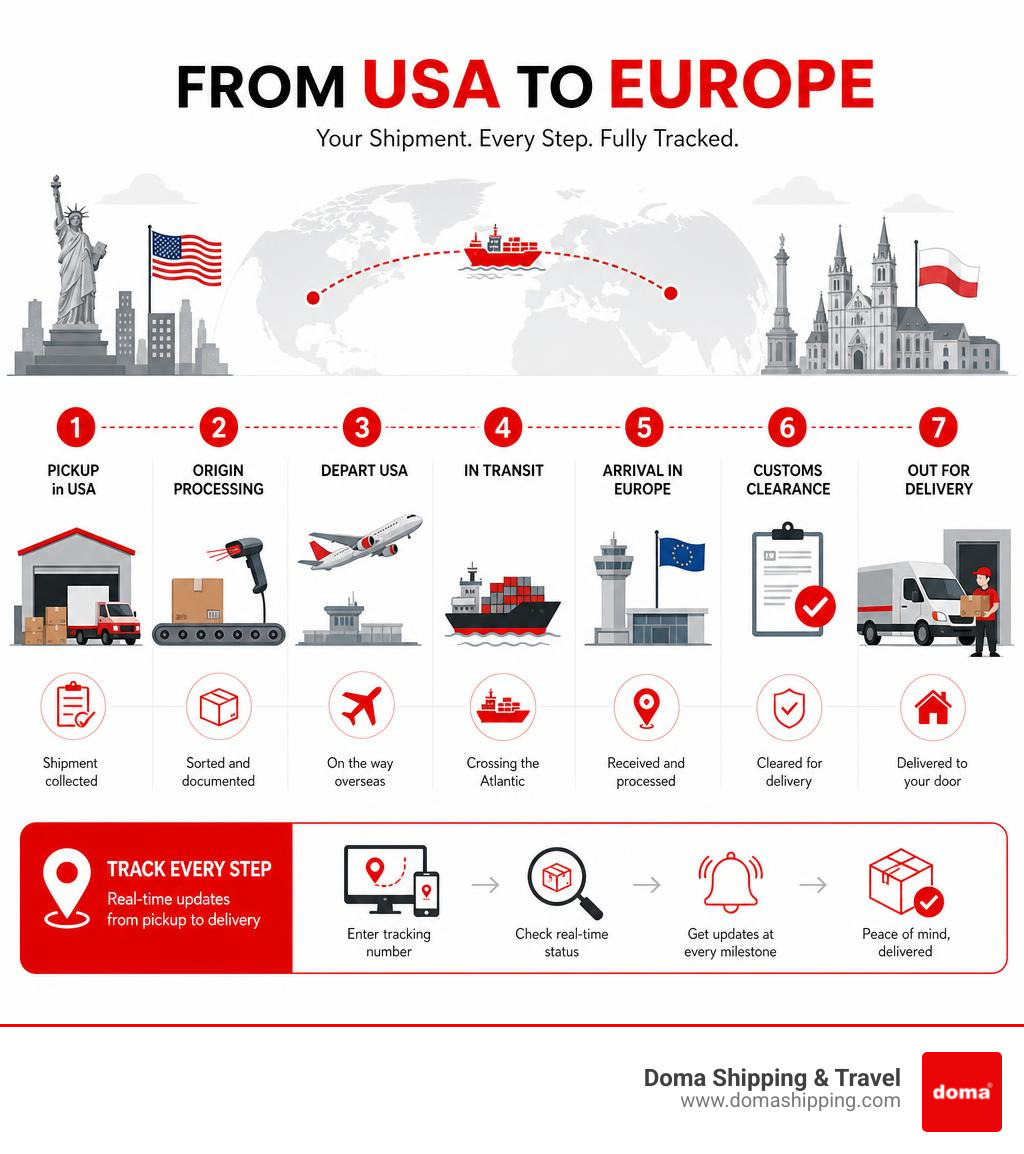
Overseas logistics tracking gives you real-time visibility into where your package or container is at every stage of its international journey — from pickup in the USA to delivery in Poland or elsewhere in Europe.
Quick answer: How to track an overseas logistics shipment
If your status hasn’t updated in over 48 hours, contact your shipping provider with your tracking number — customs clearance is the most common cause of delays.
Sending a package from the United States to Poland or Europe is not like dropping something at a local post office. Your shipment crosses borders, passes through customs, transfers between carriers, and moves through multiple sorting facilities before it reaches the door on the other side of the Atlantic.
That’s a lot of places where something can go wrong — or at least feel uncertain.
Without reliable tracking, you’re left guessing. With it, you know exactly where your belongings are and what’s happening next.
Overseas Logistics is an ISO 9001-2000 certified international courier and freight forwarding company serving 150+ countries. Their web-based tracking system is built around one simple idea: you should always know where your shipment is.
This guide explains exactly how to use overseas logistics tracking — step by step — so you never have to wonder where your package is again.
Essential overseas logistics tracking terms:
International logistics is the backbone of global commerce, connecting manufacturers, retailers, and families across continents. When we speak of overseas logistics, we are talking about the highly coordinated process of planning, implementing, and controlling the flow of goods across international borders.
To understand how your package moves from our Chicago-area facilities to its final destination in Europe, it helps to break down the primary modes of transport used in modern logistics:
Managing these diverse transport channels requires a sophisticated network of warehouses, sorting hubs, and customs brokers. Every handoff—from the truck that picks up your package in Illinois to the ocean vessel crossing the Atlantic—must be recorded.
If you want to dive deeper into how these networks operate behind the scenes, you can read everything you need to know about international parcel tracking to learn how modern logistics providers keep global supply chains moving seamlessly.
To successfully monitor your cargo, you need to understand the documents and reference numbers that make tracking possible. Every shipment is assigned a unique tracking identifier at the time of booking. This identifier acts as a digital passport for your goods.

Depending on how your shipment is sent, your tracking reference will take one of several forms:
To monitor your shipment directly through the carrier’s primary portal, you can access the official tool at Enter your tracking number – OVERSEAS LOGISTICS .
For a complete overview of the tracking process, you can also learn how to track your international shipment online or explore the easiest way to track international shipment to streamline your post-purchase workflow.
Losing track of your tracking number is a common headache, but finding it is usually straightforward. When you book an international shipment, the tracking number is generated immediately after payment and processing.
Here is where you should look:
Once you have located your tracking number, monitoring your shipment online is simple. Follow these steps to get real-time status updates:
If you are shipping multiple packages through different carriers, using a unified tracking tool can save you time. To find the most reliable platforms for managing complex shipments, check out our guide on the best tools to track worldwide parcel services today.
As your package travels from the United States to Europe, it is scanned at various key transit points, such as sorting centers, customs offices, and regional distribution hubs. Each scan triggers a status update in the tracking system.
Understanding what these statuses mean helps you anticipate the arrival of your goods and identify potential delays early.
| Tracking Status | What It Actually Means |
|---|---|
| Pickup / Shipment Created | The shipment has been registered in the system. The physical package has either just been picked up or is being processed at the initial drop-off location. |
| Entry Scan / Arrived at Hub | The package has arrived at a major regional consolidation warehouse (such as our Chicago sorting facility) and is being prepared for export. |
| In Transit | The shipment is currently on its way to the destination country, either aboard an aircraft or an ocean vessel. |
| Customs Clearance / In Customs | The package has arrived in the destination country (e.g., Poland) and is undergoing inspection and document verification by customs authorities. |
| Arrived at Distribution Warehouse | The shipment has successfully cleared customs and is at a local fulfillment center, being sorted for regional delivery. |
| Out for Delivery | The package has been loaded onto a local delivery vehicle and will be delivered to the recipient’s address today. |
| Exception / Delay | An unexpected event has occurred. This could be due to a customs hold, missing documentation, weather issues, or an incorrect address. |
| Delivered | The shipment has been successfully received and signed for at the final destination. |
While modern logistics tracking is highly accurate, updates are not always instantaneous. A tracking status updates only when a physical scan occurs. For example, when an ocean container is crossing the Atlantic, there may be several days without a new scan until the vessel reaches its European port of discharge.
If you encounter an unexpected “Exception” status or fear your package is stuck, you can read about mastering international tracking numbers to resolve lost shipments to learn how to interpret tracking data and resolve common transit issues.
Every single shipment crossing international borders must clear customs. Customs officials verify that the contents of your shipment match your declaration, assess any applicable duties or taxes, and ensure that no restricted or illegal items enter the country.
To ensure a smooth customs clearance process, pay close attention to the following requirements:
For e-commerce brands and businesses managing regular shipments to Europe, manually tracking packages on a carrier website is inefficient. Integrating real-time tracking directly into your own website or ERP system improves operational efficiency and enhances the post-purchase experience for your customers.
This is achieved through a Tracking API (Application Programming Interface) or Webhooks:
Using standardized APIs, businesses can track ocean cargo across major shipping lines, integrating vessel coordinates, container status, and port milestone events into a single, unified dashboard.
To learn more about optimizing your supply chain visibility, read our guide on how to track ocean freight containers effectively. Additionally, you can utilize external resources like Container Tracking — Track Shipments Across Maersk, MSC, CMA CGM, Hapag-Lloyd & More | Shipzy | Shipzy to monitor ocean freight containers across multiple global carriers simultaneously.
It is completely normal for international tracking to go several days without an update, especially during the long-haul transit phase. If your package is on an ocean vessel crossing the Atlantic, no physical scans can occur until the ship docks at its destination port.
Another common cause is customs clearance. While a package is undergoing customs inspection, it remains in a secure facility where transit scans are paused. If your tracking status has not updated for more than 48 to 72 hours after arriving in the destination country, contact customer support to verify that no additional documentation or KYC verification is required.
Yes. Ocean container tracking is managed using either the container number (a unique four-letter and seven-digit code, such as MSKU1234567) or the Bill of Lading (B/L) number.
Modern ocean tracking systems integrate satellite AIS (Automatic Identification System) data, allowing you to monitor the exact geographical location of the container ship carrying your cargo as it moves between global ports.
In the rare event that your shipment is delayed significantly, lost, or arrives damaged, you must act quickly:
To ensure you are fully prepared to handle any transit issues, read our detailed guide on real-time package tracking never lose a shipment again.
Navigating the complexities of international logistics does not have to be a stressful experience. By understanding how overseas logistics tracking works, learning how to locate your tracking numbers, and knowing how to interpret transit statuses, you can monitor your shipments with confidence.
At Doma Shipping & Travel, we bring over 30 years of experience to every shipment we handle. From our primary hubs and offices across the Chicago area—including Chicago, Melrose Park, Roselle, Mount Prospect, Palos Hills, Algonquin, Niles, Park Ridge, Des Plaines, Glenview, Franklin Park, Schiller Park, Bensenville, and Schaumburg—we specialize in safe, reliable international shipping from the USA to Poland and throughout Europe.
Whether you are shipping personal belongings, commercial containers, or vehicles, our team manages the entire process, including customs clearance and door-to-door delivery, with absolute care.
Ready to check on an active shipment or plan your next delivery? Visit our tracking paczek portal today to see exactly where your cargo is on its journey to Europe.