
If you’re looking for holiday rush shipping tips that actually apply to sending packages overseas — from the USA to Poland or elsewhere in Europe — here’s what you need to know upfront:
Quick answers for international holiday shippers:
Every December, people learn the hard way that international shipping has its own rules — and the holiday rush makes everything harder. Carriers hit capacity limits. Customs offices slow down. A gift meant to arrive before Christmas can end up sitting in a distribution hub for weeks.
For families and individuals sending packages from the USA to Poland or other European countries, the stakes are even higher. You’re not just racing against a carrier cutoff date — you’re navigating customs regulations, ocean or air transit times, and documentation requirements that don’t pause for the holidays.
The good news: with the right preparation and timing, you can get your packages there safely and on time — without the last-minute panic.
This guide walks you through everything you need to know, from key shipping deadlines to packaging, customs compliance, and managing returns after the season ends.
Explore more about holiday rush shipping tips:
When managing international logistics during the peak winter season, time is your most valuable asset. The period between Thanksgiving and Christmas can feel incredibly short—for instance, some years feature only 28 days between these major holidays, compressing the peak shipping window significantly. For those shipping from our key Illinois hubs in Chicago, Melrose Park, Mount Prospect, Roselle, Palos Hills, Algonquin, Niles, Park Ridge, Des Plaines, Glenview, Franklin Park, Schiller Park, Bensenville, and Schaumburg, understanding the precise timeline of ocean and air transit is the first step toward a successful season.
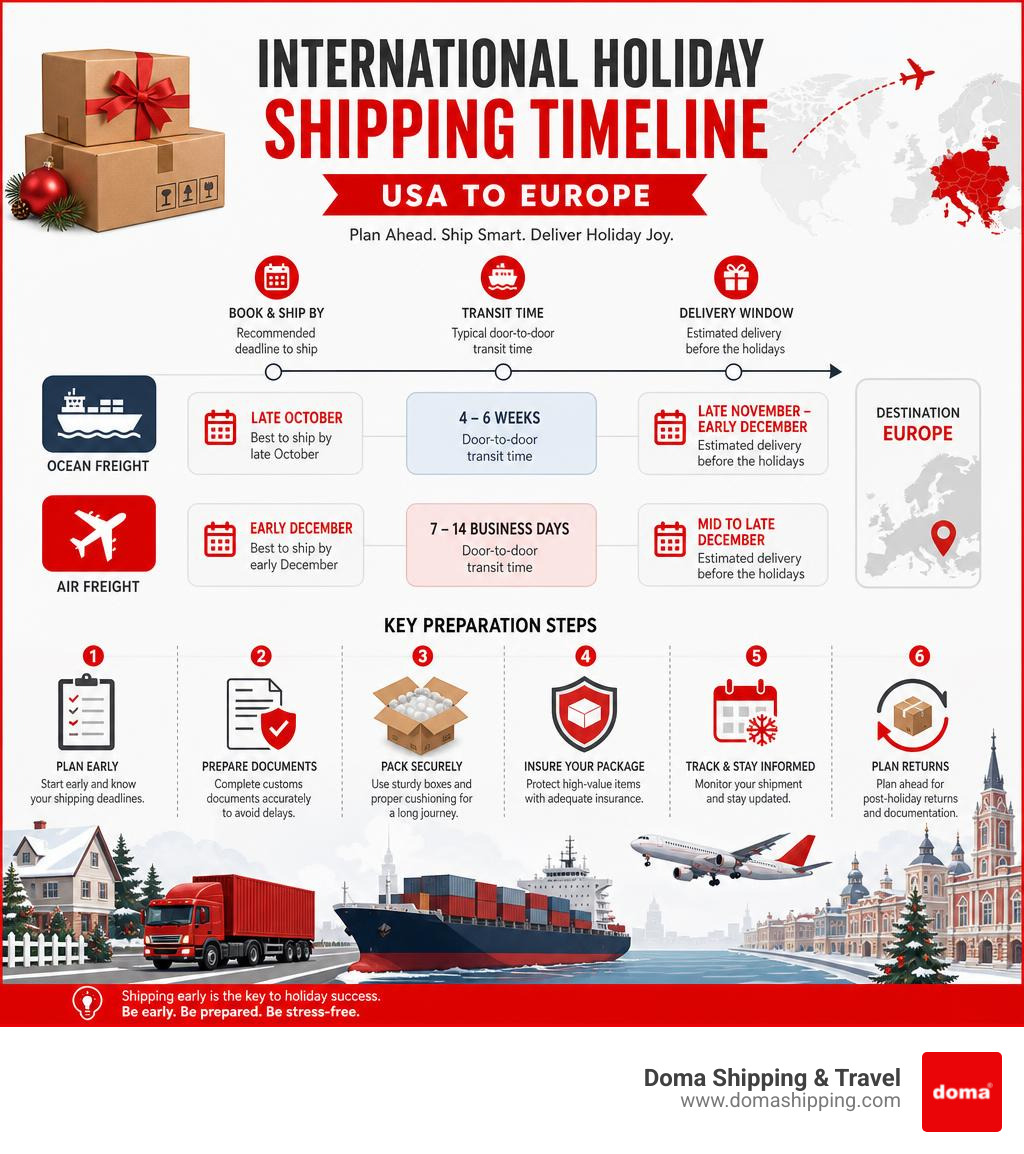
Ocean freight remains the most reliable method for larger shipments, heavy boxes, and holiday freight. However, ocean vessels must cross the Atlantic, clear European ports, and transition to local European road networks. This process typically requires 4 to 6 weeks under normal conditions. During the holiday rush, port congestion in Europe and winter weather across the Atlantic can easily add another week to transit times.
For expedited needs, air cargo reduces transit times to approximately 7 to 14 business days. However, air cargo space becomes highly competitive as retail volume spikes. According to regional insights on 2025 Holiday Shipping Deadlines and Best Practices – Parcel Pending, early preparation is the golden rule to ensure your items do not get caught in warehouse backlogs.
To guarantee that your packages arrive before the holidays, you must align your preparation with strict carrier cutoff dates. The major domestic and international carriers establish firm deadlines each year. For standard ground shipping services within the United States (which many use to route packages to consolidation warehouses), cutoffs typically land between December 14 and December 17.
For those looking at local Illinois carrier networks, specific regional guidelines published in resources like Holiday Shipping: Here Are Illinois’ Package “Ship-By” Dates and What you need to know ahead of holiday shipping deadlines emphasize that waiting until the final week of December for standard shipping is highly risky.
For overseas delivery to Poland and wider Europe:
Despite your best efforts, last-minute holiday orders and late gift ideas are inevitable. In fact, statistics show that nearly 35% of shoppers make purchases in the final week before major holidays. Managing these late requests requires a balance of expedited shipping options and clear communication.
When handling last-minute shipments, air transport is your only viable path. Express air options bypass the slower ocean routes, but they require flawless execution. Ensure that your packages are dropped off early in the morning at our designated terminals, such as our Melrose Park or Schaumburg locations, to ensure same-day processing.
Equally important is managing the expectations of the recipient. Because winter weather can disrupt even the most reliable air networks, providing real-time tracking information is essential. Over 50% of holiday shoppers actively track the status of their shipments to ensure timely arrival. Providing transparent updates reduces anxiety and builds trust.

Preparing for the peak season means securing your packaging materials long before the winter rush begins. A common pitfall for many shippers is running out of high-quality boxes, heavy-duty packing tape, or cushioning materials in late November when retail demand peaks. By stockpiling these essential supplies in September or October, you avoid the stress of supply shortages.
For businesses and individuals alike, choosing the correct box is the foundation of safe transit. We strongly recommend using brand-new, double-walled corrugated boxes. Reused boxes lose up to 50% of their structural strength after just one journey, making them highly susceptible to collapsing under the weight of other cargo during ocean transit. For detailed guidance on selecting the best containers for your gifts, consult The Ultimate Guide to Holiday Gift Shipping: Best Boxes and Baskets.
International transit involves multiple handling points, temperature variations, and movement on ocean vessels or aircraft. To protect delicate items, porcelain, or specialty food items, you must master the art of cushioning.
A single labeling mistake can result in your package being held at a port or returned to the United States. During the busy holiday season, sorting facilities handle millions of parcels daily, leaving no room for illegible or incomplete addresses.
Always write the recipient’s full name, street address, postal code, city, and country clearly. For shipments to Poland, ensuring the correct five-digit postal code (e.g., 00-001) is formatted properly is vital. Additionally, include the recipient’s local phone number. European couriers often send text updates or call the recipient to coordinate the final delivery.
Ensure that old shipping labels, barcodes, or addresses are completely removed or covered if you must reuse an outer container. Finally, provide highly accurate weight and measurement details. Mismatches between declared weight and actual weight can trigger automated sorting rejections and manual audits, delaying your shipment by days.
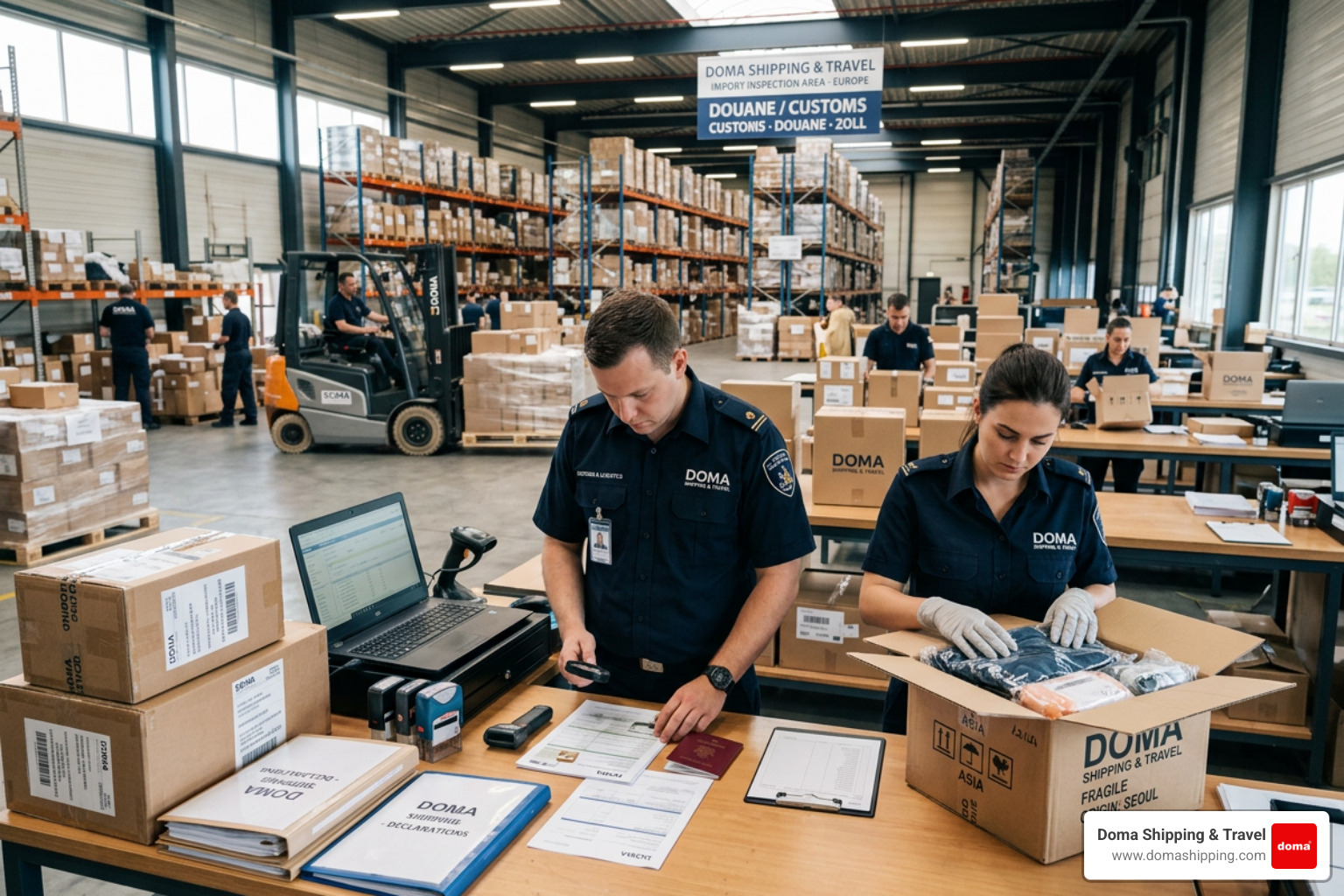
Every international package must clear customs before it can be delivered to its final destination in Europe. During the holiday season, customs offices experience massive volume increases, meaning that even minor paperwork errors can cause significant delays. In July, a small documentation discrepancy might be resolved in 24 hours; in December, that same error could take over a week to correct.
To ensure seamless clearance, you must provide a detailed and accurate customs declaration. Avoid vague descriptions like “gifts” or “holiday items.” Instead, write specific descriptions such as “woolen knit sweaters,” “porcelain holiday ornaments,” or “packaged gingerbread cookies.” Clearly state the quantity, material, and value of each item. For a deeper look into expediting this process, check out The Need for Speed: A Guide to Express Shipping from the USA to Europe.
European import regulations are strict, particularly regarding agricultural products, food items, and restricted goods. Shipping prohibited items can lead to the immediate confiscation of your entire package.
When sending holiday packages to Poland and other European countries, keep the following restrictions in mind:
To ensure your thoughtful gestures are received warmly and without issues, consult our detailed resource on Surprise Them in Poland: A Guide to Sending Thoughtful Gifts.
Winter weather is one of the most unpredictable variables in holiday logistics. Blizzards in the American Midwest can close airports and delay road transport, while North Atlantic storms can slow ocean carriers. Because these weather disruptions ripple across global networks, building a time buffer into your shipping schedule is essential.
In addition to weather, port congestion peaks in November and December. To bypass these bottlenecks, we utilize route optimization strategies, directing freight through regional ports that experience lower seasonal traffic.
As a shipper, the best way to mitigate these delays is to plan for “worst-case” scenarios. Always ship your packages at least one to two weeks earlier than the official carrier cutoffs. To explore faster routing options during peak congestion, read about Express Lane to Europe: Unlocking the Fastest International Shipping Options.
For businesses and frequent shippers, choosing the right transportation mode is a critical decision. Balancing speed, volume, and logistics requirements helps keep your seasonal operations running smoothly.
| Logistics Factor | Air Freight Cargo | Ocean Freight Cargo |
|---|---|---|
| Average Transit Time | 7 to 14 business days | 4 to 6 weeks |
| Best Suited For | High-value, lightweight, urgent gifts | Heavy cargo, bulk pallets, large household items |
| Customs Processing | Rapid electronic clearance | Groupage or container-level inspection |
| Weather Sensitivity | High (flights can be grounded easily) | Moderate (storms can delay sea routes) |
| Dimensional Weight Impact | Significant impact on overall volume | Minimal impact compared to actual weight |
Understanding these differences allows you to structure your fulfillment strategy effectively. For those managing multiple shipments, utilizing parcel consolidation strategies can dramatically streamline your logistics, allowing you to group smaller packages into a single, organized shipment.
If you manage an e-commerce store or ship high volumes of packages during the holidays, manual processing is your enemy. Shaving just one minute off the packaging and labeling of each parcel can save hours of labor over the course of the season.
By integrating your online store with modern logistics APIs, you can automate the generation of customs declarations and shipping labels. Automation tools can cut fulfillment times by up to 40%, ensuring that orders placed in the morning are processed and ready for transit by the afternoon.
Furthermore, partnering with a reliable third-party logistics provider allows you to leverage established supply chains, secure cargo space, and navigate the complex rules of international transport. For insights on planning your logistics budget during the peak season, read our guide on budgeting for international shipping.
Once your shipment arrives in Europe, the final mile of delivery is just as critical as the transatlantic journey. During the holiday rush, national postal services in European countries often face severe backlogs due to local delivery surges.
To overcome this, we utilize regional distribution hubs and partner with trusted local European couriers. By routing packages through specialized terminals and sorting facilities, we bypass congested national postal networks, ensuring that your package is delivered directly to the recipient’s door safely and efficiently.
While the focus of the holiday season is getting packages delivered before December 25, smart shippers and business owners must also prepare for what happens after the holidays. The post-holiday period brings a massive surge in returns and exchanges. In fact, “National Returns Day” typically occurs in early January, but the return window often extends well into February.
Managing international returns—known as reverse logistics—is significantly more complex than domestic returns. It requires moving goods back across borders, which involves re-navigating customs, verifying original declarations, and managing transport across the ocean or air. To understand how retail operations prepare for this seasonal shift, you can review 12 Holiday Shipping Tips for Store Owners To Prepare for 2026 – Shopify Australia.
Whether you are a business selling to European customers or an individual sending gifts that might need to be exchanged, having a clear, written policy is essential. This policy should be easily accessible and simple to understand.
Your international return policy should clearly outline:
To make the return process as seamless as possible, proactive preparation is key. Providing the recipient with the necessary tools upfront can prevent headaches later.
One of the best practices is to include a pre-printed return shipping label and a blank customs declaration form inside the original package. If a return is necessary, the recipient simply needs to fill out the form, secure it to the box, and drop it off at a designated local European terminal.
Additionally, you must clearly mark the return customs documentation as “Returned Goods” to avoid paying duplicate import tariffs upon re-entry into the United States. This simple step ensures that your returned inventory can be restocked quickly and without unnecessary financial penalties.
To ensure your packages arrive in Poland in time for Christmas Eve (Wigilia), which is the primary holiday celebration in Poland, timing is everything.
For ocean shipments, we highly recommend dropping off your packages at one of our Chicago-area locations by late October or the first week of November at the absolute latest. For air shipments, packages should be processed and dispatched by the first week of December.
Shipping early not only guarantees timely delivery but also gives your package a safe buffer against winter weather delays and customs backlogs. For a step-by-step walkthrough of the entire process, check out How to Send a Package to Poland: A Comprehensive Guide.
European customs regulations strictly prohibit or restrict several common holiday items. You cannot ship meat, dairy products (including homemade sausages or traditional cheeses), alcohol, tobacco, aerosols, perfume, or prescription medications.
Additionally, packaging materials that appear damaged, damp, or have suspicious tears can trigger manual customs inspections, delaying the package. To ensure your gifts comply with all import laws, read our guide on Surprise Them in Poland: A Guide to Sending Thoughtful Gifts.
Protecting fragile items during a long ocean journey requires sturdy materials and smart packing. Use a brand-new, double-walled corrugated box. Wrap every glass jar, bottle, or delicate ornament individually in high-quality bubble wrap.
Fill all empty spaces inside the box with packing peanuts or air pillows so that nothing can shift during transit. Finally, use the double-box method for highly delicate items. For more advice on choosing the right gifts and ensuring they arrive in perfect condition, read How to Choose the Perfect Surprise Delivery for Your Polish Loved Ones.
Navigating the holiday shipping rush doesn’t have to be a source of seasonal stress. By understanding the unique requirements of international transit, preparing your packaging materials early, and respecting customs regulations, you can ensure that your packages reach your loved ones or customers in Poland and Europe safely and on time.
At Doma Shipping & Travel, we bring over 30 years of experience in international logistics and freight forwarding to every shipment we handle. Whether you are sending a small package of holiday gifts, shipping a container of commercial goods, or transporting vehicles and personal belongings, our team is dedicated to providing reliable, safe, and efficient transport from our convenient Chicago-area terminals directly to Europe.
Let us handle the logistics so you can focus on celebrating the season. For specialized assistance with sending gifts, flowers, and packages overseas, explore Doma Shipping’s specialized gift and package shipping services and let us help you deliver your holiday wishes across the ocean.