
Finding reliable international moving companies is one of the first things people search for when planning an overseas relocation. Moving to another country is a major logistical commitment, requiring careful planning depending on how much you’re shipping, where you’re going, and what services you need.
Here’s a quick overview of the most important things to know before you choose an international mover:
| Factor | What to Know |
|---|---|
| Primary shipping method | Ocean freight (LCL or FCL container) |
| Fastest shipping method | Air freight (5–12 days) |
| Best time to move | Winter months — typically offers greater container availability |
| Key credential to verify | FMC (Federal Maritime Commission) license |
| How far ahead to book | At least 6–8 weeks; 3–6 months is ideal |
| Key logistics considerations | Port procedures, destination handling, storage, and customs duties |
International moves are more complex than domestic ones. You’re not just hiring a truck — you’re coordinating ocean or air freight, customs clearance, import documentation, and delivery on the other side of the world. One missing document can delay your entire shipment by weeks.
The good news: with the right planning and the right shipping partner, moving your belongings overseas can be a smooth and well-coordinated process.
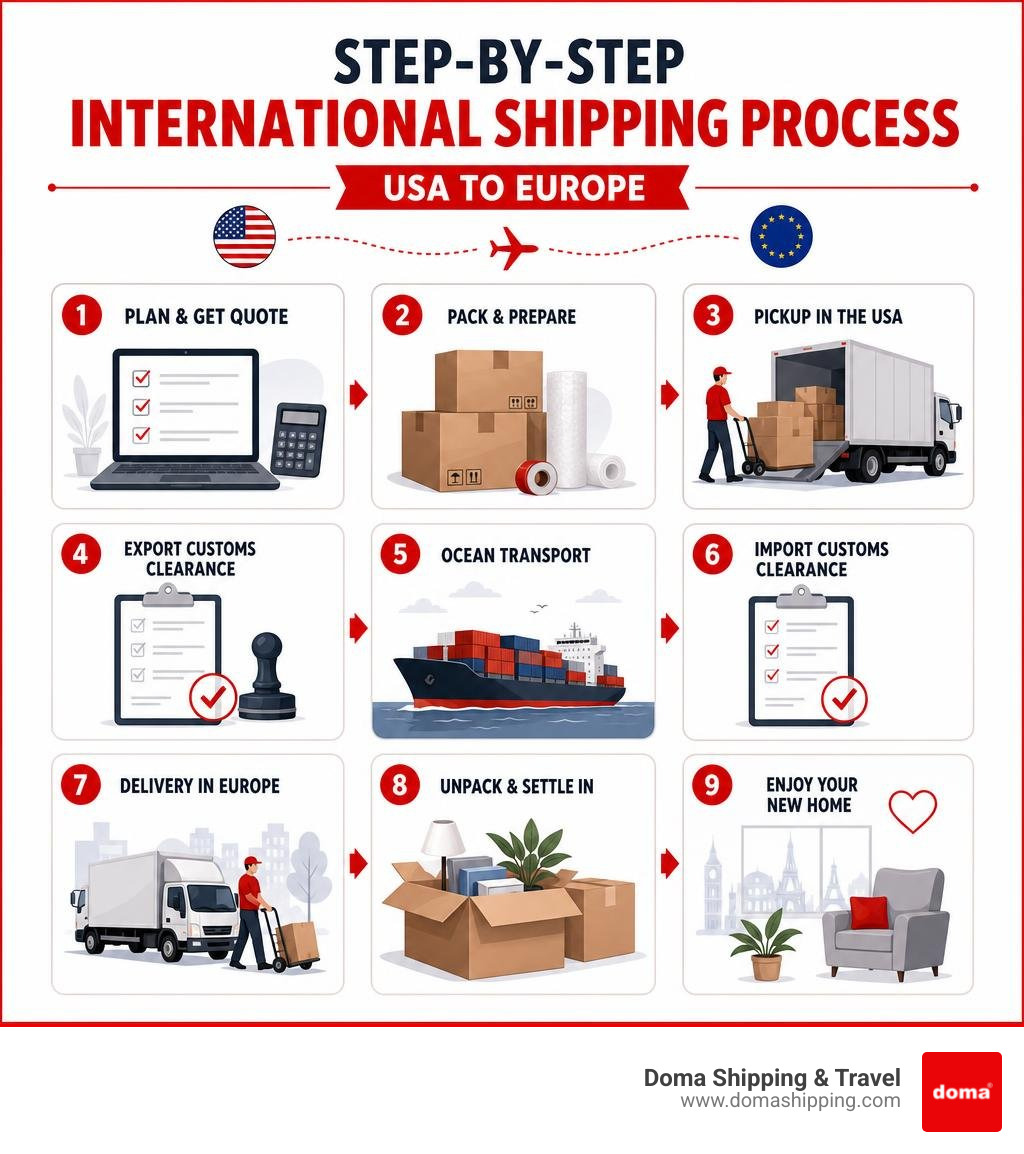
International relocation terms simplified:

When you are preparing to send your life across the ocean, you cannot afford to leave your belongings with just anyone. Selecting a logistics partner requires careful vetting. The industry is highly regulated, and understanding these regulations protects your family from common pitfalls.
The most critical credential to verify is licensing with the Federal Maritime Commission (FMC). Any company operating as an ocean transport intermediary or freight forwarder must hold active FMC credentials to legally arrange ocean shipments. This certification ensures that the company complies with strict financial bonding requirements and industry standards.
Before booking, we highly recommend researching third-party reviews and verifying the physical presence of the company. If you are coordinating a move from the Chicago area, you want a provider deeply rooted in local infrastructure. For example, our operations span key Illinois hubs including Chicago, Melrose Park, Mount Prospect, Roselle, Palos Hills, Niles, Park Ridge, and Schaumburg. Working with a company that has physical warehouses and local offices in these communities ensures direct, accountable service rather than dealing with an online-only broker.
Another non-negotiable factor is transit insurance and liability coverage. By law, standard carrier liability is minimal – often just $0.60 per pound. For an overseas journey, this basic coverage is entirely insufficient. A reputable provider will offer comprehensive all-risk marine insurance, which covers the actual replacement value of your items in the rare event of damage or loss during transit.
To learn more about what to look for in a global logistics provider, read our detailed guide on Going Global: Why You Need Certified International Movers for Your Move.
Strategic planning is the key to balancing transit timelines with your relocation requirements. The transport method you select is the single largest variable in determining the overall structure of your move.
| Shipping Method | Typical Transit Time | Volume Capacity | Best Suited For |
|---|---|---|---|
| Ocean Freight (LCL) | 6 to 10 weeks | Flexible (measured in cubic feet) | Small apartments, partial households, boxed personal effects |
| Ocean Freight (FCL) | 4 to 8 weeks | 20ft or 40ft dedicated container | Full household moves, vehicles, large furniture |
| Air Freight | 5 to 12 days | Highly restricted by weight/volume | Essential items, urgent documents, high-value goods |
For residents preparing a shipment from the Midwest, understanding local logistics routes is essential. Our team specializes in managing these pathways efficiently. Learn more about optimizing your cargo routing in our resource on The Best Ways to Manage Container Shipping from Chicago. For a deeper understanding of how container shipping is structured, explore our guide on understanding container shipping logistics.
For nearly all household relocations to Europe, sea transit is the standard choice. While air cargo offers rapid turnaround times—making it ideal for immediate essentials—it is calculated based on weight and volume, which can be less practical for furniture and large boxes.
Ocean transit is calculated based on the space your cargo occupies in a shipping container. Although sea transit requires more advanced planning due to longer delivery timelines, it provides the capacity to transport entire households, including heavy furniture and personal vehicles, with high efficiency.
If you select ocean freight, you must choose between Full Container Load (FCL) and Less than Container Load (LCL) shipping:
For those planning a move to Europe, we have compiled strategic tips on how to execute this process seamlessly. Read more in our guide on How to Ship a Container to Europe.

The physical transportation of your goods is only half the battle; navigating international customs is where the real complexity lies. Every European country enforces strict import regulations, and incomplete paperwork can lead to port storage penalties or customs delays.
When relocating personal effects, most European nations, including Poland, offer duty-free import exemptions for used household goods. However, to qualify for these exemptions, you must satisfy specific criteria:
Our experienced coordinators handle the heavy lifting of customs documentation, ensuring your shipment complies with all destination laws. For specific insights into shipping to Poland, consult our dedicated article on How to Ship a Container to Poland. For a broader overview of the paperwork required for international relocations, check out our American International Movers Complete Guide.
Finding a trustworthy partner requires looking beyond simple search results. Always verify that the company holds an active Federal Maritime Commission (FMC) license and belongs to reputable international trade networks. Request a detailed, binding service agreement that outlines all potential destination handling procedures and port requirements upfront.
If you are moving from Northern or Western Chicago suburbs, it is highly beneficial to work with a mover that has a strong local presence. Working with an established provider with physical offices and warehouses in communities like Algonquin, Niles, or Park Ridge ensures direct accountability and reliable service standards.
The international shipping industry experiences peak seasonal demand during the summer months (June through September). During this period, carrier capacity is tight, and port congestion is common. Scheduling your move during the winter or off-peak months (October through April) typically results in greater container availability, more flexible scheduling options, and smoother transit times.
Entrusting your life’s possessions to an unlicensed mover is an immense risk. Unlicensed operators often act as unregulated brokers, outsourcing your shipment to third parties without your knowledge. They may lack the required liability insurance, leaving you with no recourse if items are lost or damaged. Furthermore, unlicensed companies are a common source of moving scams, where cargo is held hostage at destination ports until excessive, unquoted fees are demanded.
Relocating across the ocean is a monumental milestone, but it does not have to be a source of overwhelming stress. By choosing an experienced, FMC-licensed partner with deep roots in the Chicago logistics community, you can ensure that your belongings are handled with care, precision, and complete regulatory compliance.
With over 30 years of experience in international freight forwarding, Doma Shipping & Travel provides comprehensive, door-to-door shipping from the USA to Poland and Europe. From small parcel shipping to full container logistics, vehicle transport, and customs clearance, our team manages every detail of your journey. We also offer convenient online shopping assistance, secure money transfers, and travel booking services to simplify your entire relocation.
Ready to plan your move? Explore our international parcel shipping services and let us help you take the next step toward your new home.