
The best way to move across country — or across an ocean — depends entirely on how much you’re moving, where you’re going, and how much of the process you want to handle yourself. If you’re relocating from the USA to Poland or Europe, the calculus looks very different from a domestic truck rental.
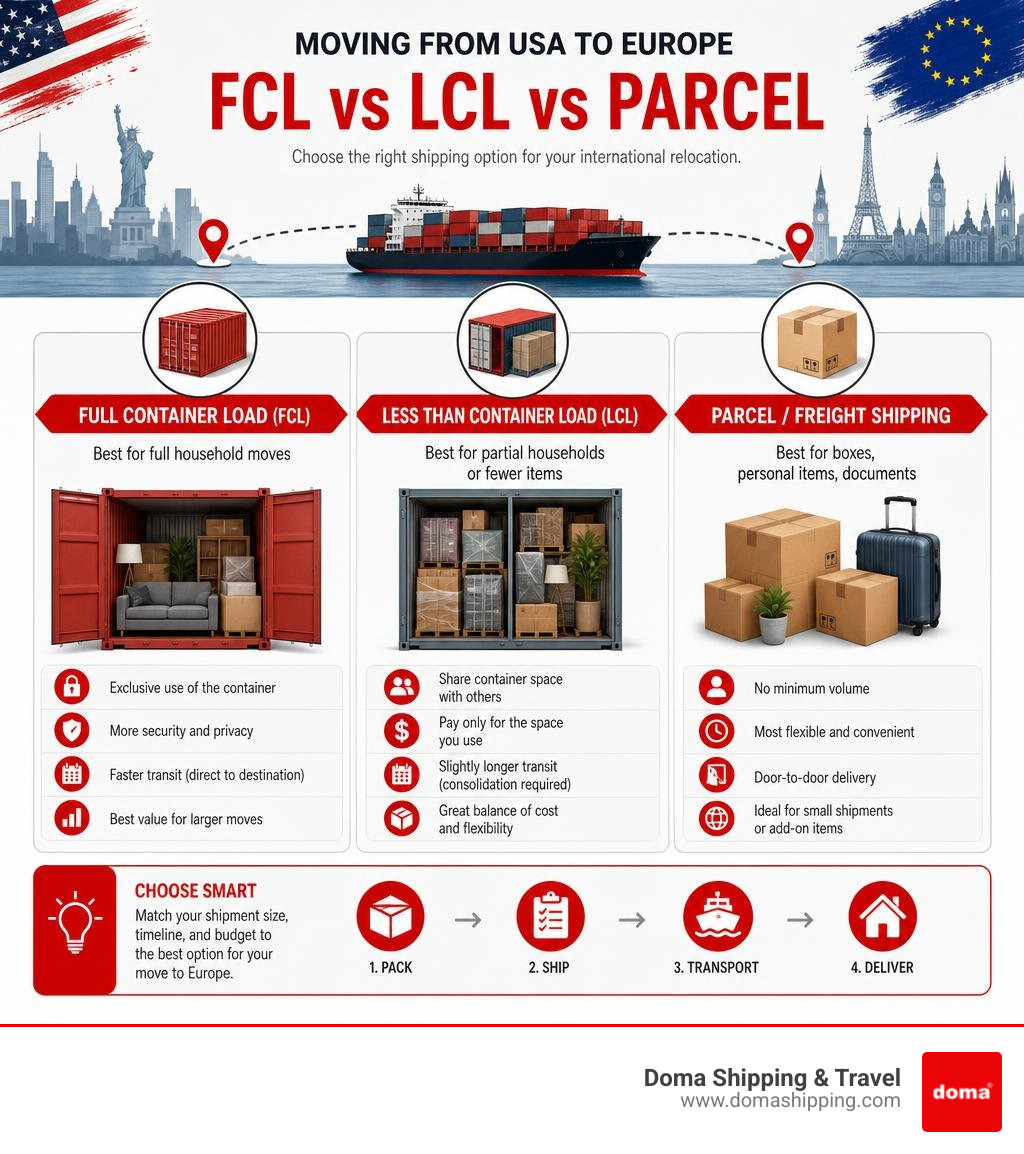
Here’s a quick breakdown of the main international relocation options:
| Method | Best For | Key Advantage |
|---|---|---|
| Full Container Load (FCL) | Full household moves | Exclusive, secure space |
| Shared Container (LCL) | Partial households or fewer items | Ship only what you have |
| Parcel/freight shipping | Boxes, personal items | Flexible, no minimum volume |
Moving is rarely straightforward. Whether you’re leaving Chicago’s northwest side for Kraków or Warsaw, the process involves more than just packing boxes. You’re navigating customs paperwork, international transit timelines, and the very real fear that something irreplaceable gets lost somewhere over the Atlantic.
For Polish-Americans and anyone permanently relocating to Europe, the domestic moving advice you’ll find online — rent a truck, drive yourself, hire local movers — simply doesn’t apply. Transatlantic relocation is its own discipline.
This guide focuses specifically on what that process actually looks like: container options, customs requirements, packing for a long ocean voyage, and how to make sure your belongings arrive safely on the other side.
Basic best way to move across country terms:
When your relocation extends past domestic state lines and crosses the Atlantic Ocean, the logistical framework changes entirely. Standard interstate moving trucks are replaced by massive ocean-going vessels, and traditional highways give way to maritime shipping lanes. For anyone embarking on a transatlantic journey from the Chicago area to Poland or other European destinations, ocean freight is the most reliable, secure, and established method to transport household goods.

Ocean freight relies on standardized shipping containers that are engineered to withstand the rigors of sea travel. This method provides a level of structural protection that long-distance road transit simply cannot match. Instead of your belongings being subjected to thousands of miles of road vibrations, bumps, and constant shifting inside a domestic trailer, they are securely packed, sealed inside a steel container, and loaded onto a large cargo ship.
Furthermore, navigating international borders requires strict adherence to customs clearance protocols. A successful transatlantic move hinges on proper documentation, compliance with European import regulations, and the coordination of port logistics on both sides of the ocean. Working with experienced professionals who understand these complex maritime procedures is essential. For a broader look at how to structure this transition, you can consult our guide to international moving companies.
For families transporting the contents of an entire home, Full Container Load (FCL) shipping stands out as the premier option. When you choose FCL, you secure the exclusive use of an entire 20-foot or 40-foot ocean container. This means your household goods are the only items loaded into that specific container, providing maximum security and logistical control.
FCL shipping is highly recommended for large-volume relocations because it minimizes handling. Once our professional packing teams load your belongings into the container at your residence in areas like Mount Prospect, IL, Park Ridge, IL, or Glenview, IL, the container is sealed with a high-security bolt seal. This seal remains intact throughout the entire rail and ocean transit, only being broken by customs officials or upon arrival at your final destination in Europe.
This exclusive-use model also streamlines transit timelines. Because the container does not need to be consolidated with other shipments or sorted at intermediate warehouses, it travels directly from the port of origin to the destination port. This makes FCL the best way to move across country borders when you are relocating a multi-bedroom household and want to ensure the highest standard of safety and predictability. To understand how this process works from your doorstep to your new home abroad, read our guide to door-to-door container shipping.
Not everyone relocating across the ocean is moving the contents of a large family home. If you are moving a one-bedroom apartment, shipping select heirloom furniture, or simply transporting a collection of personal effects, paying for an entire container is unnecessary. This is where Less Than Container Load (LCL) shipping, also known as shared container shipping, becomes the ideal solution.
LCL shipping allows multiple individuals to share the space inside a single shipping container. Your packed and palletized belongings are measured by volume and loaded alongside other consolidated cargo bound for the same European destination. This method ensures that you only utilize and secure the exact amount of space your items require, making it highly efficient for smaller shipments.
For our clients in Chicago suburbs like Roselle, IL, Algonquin, IL, and Schaumburg, IL, shared container shipping provides a flexible way to manage a international move without compromising on safety. Each shipment within the shared container is individually labeled, inventoried, and secured on heavy-duty pallets to prevent any contact with other cargo. To learn more about how consolidated shipments are organized and transported, check out our relocation transport guide.
Crossing international borders means entering different regulatory environments. When shipping household goods from the United States to Europe, your shipment must pass through a formal customs clearance process. This is not a step that can be rushed or treated as an afterthought; compliance with import regulations is mandatory to avoid delays, fines, or seizure of your belongings.
European customs authorities require a precise accounting of all items entering their territory. The key to a smooth transition lies in meticulous preparation and understanding the specific rules of your destination country. For example, Poland offers duty exemptions for personal effects under specific relocation frameworks, provided you meet residency requirements and document your belongings correctly. To help organize your timeline and keep track of essential relocation tasks, you can utilize this comprehensive international moving checklist.
The foundation of customs compliance is the paperwork. Without accurate and complete documentation, your ocean container cannot be cleared at European ports like Gdynia or Gdańsk. The primary documents required for an international household relocation include:
Our professional logistics teams handle the complexities of customs filing on your behalf, ensuring that all paperwork is completed in both English and Polish to satisfy international authorities. For an in-depth look at how to navigate these regulatory requirements specifically for Poland, see our guide on handling international removals.
The physical journey across the ocean is long, often taking several weeks. During this time, the shipping container will experience the natural movement of the vessel on the open sea. Proper preparation and professional packing are the single most important factors in ensuring your belongings arrive in pristine condition.
Standard retail cardboard boxes and packing tape are not designed for international maritime transit. Ocean freight requires heavy-duty, double-walled corrugated boxes, specialized padding, and industrial shrink-wrap. Furthermore, for LCL shipments, items must be professionally palletized — stacked securely on a wooden or plastic pallet, strapped down, and completely wrapped in protective film to create a single, immovable unit.
The following table outlines the key preparation requirements for FCL versus LCL shipments to help you understand how your belongings will be handled:
| Requirement | Full Container Load (FCL) | Less Than Container Load (LCL) |
|---|---|---|
| Primary Packing | Heavy-duty boxes & custom wrapping for all furniture | Heavy-duty boxes & extra-strength padding |
| Palletization | Optional; items can be loose-loaded to maximize space | Mandatory; all cargo must be secured on standard pallets |
| Sealing | Container sealed with high-security bolt seal at origin | Pallets wrapped and sealed individually before container loading |
| Handling | Loaded at origin, unloaded at destination | Handled at consolidation and deconsolidation warehouses |
To protect your items from moisture, temperature fluctuations, and movement during ocean transit, our professional packing teams employ specialized techniques:
Ensuring these standards are met prevents the heartbreak of damaged heirlooms upon arrival. For guidance on selecting the right services to protect your valuables, read about choosing international moving services.
The primary difference lies in the volume of your shipment and the exclusivity of the container space. FCL (Full Container Load) means you rent and have exclusive use of an entire steel shipping container. This is ideal for large moves, allows for direct transit, and minimizes physical handling. LCL (Less Than Container Load) involves sharing container space with other shippers. Your items are secured on pallets and consolidated into a shared container, making it the perfect choice for smaller shipments of boxes or select furniture. For a detailed breakdown of how container logistics are organized, refer to our container shipping guide.
Preparing for Polish customs requires creating a highly detailed, numbered inventory list matching every box in your shipment. You must also gather documentation proving your residency in the United States for at least 12 consecutive months (such as tax returns, utility bills, or employment records) and your intention to establish residency in Poland. This documentation is essential to qualify for the “mproperty of resettlement” duty exemption, which allows you to import your personal effects with relief from customs duties. For a step-by-step walkthrough of this specific process, see our moving to Poland guide.
Yes, shipping a personal vehicle — such as a car, motorcycle, or SUV — is highly common. Vehicles can be secured inside your exclusive FCL container alongside your household goods using specialized wheel chocks and high-strength tie-down straps. Alternatively, they can be shipped via dedicated auto transport containers. You will need to provide original vehicle titles, registration, and comply with European emissions and customs regulations upon arrival. To explore the details of vehicle shipping and international relocation timelines, read our guide on moving to Europe in 2026.
Relocating across the globe is a monumental milestone. The best way to move across country borders and oceans is to partner with an experienced, reliable logistics provider who understands the unique challenges of international transit.
For over 30 years, Doma Shipping & Travel has proudly served the Polish-American community across the greater Chicago area. From our offices and warehouses in Chicago, IL, Mount Prospect, IL, Roselle, IL, Algonquin, IL, Niles, IL, and Park Ridge, IL, we provide comprehensive, end-to-end relocation solutions. Our deep roots in the community, bilingual (Polish/English) support staff, and complete customs handling ensure that your transition to Poland or Europe is handled with the utmost care, professionalism, and respect.
Whether you are shipping a few boxes of personal items or coordinating a full household container relocation, we are here to manage every detail of the journey. To begin planning your transatlantic move with a trusted partner, explore our international parcel shipping services.