
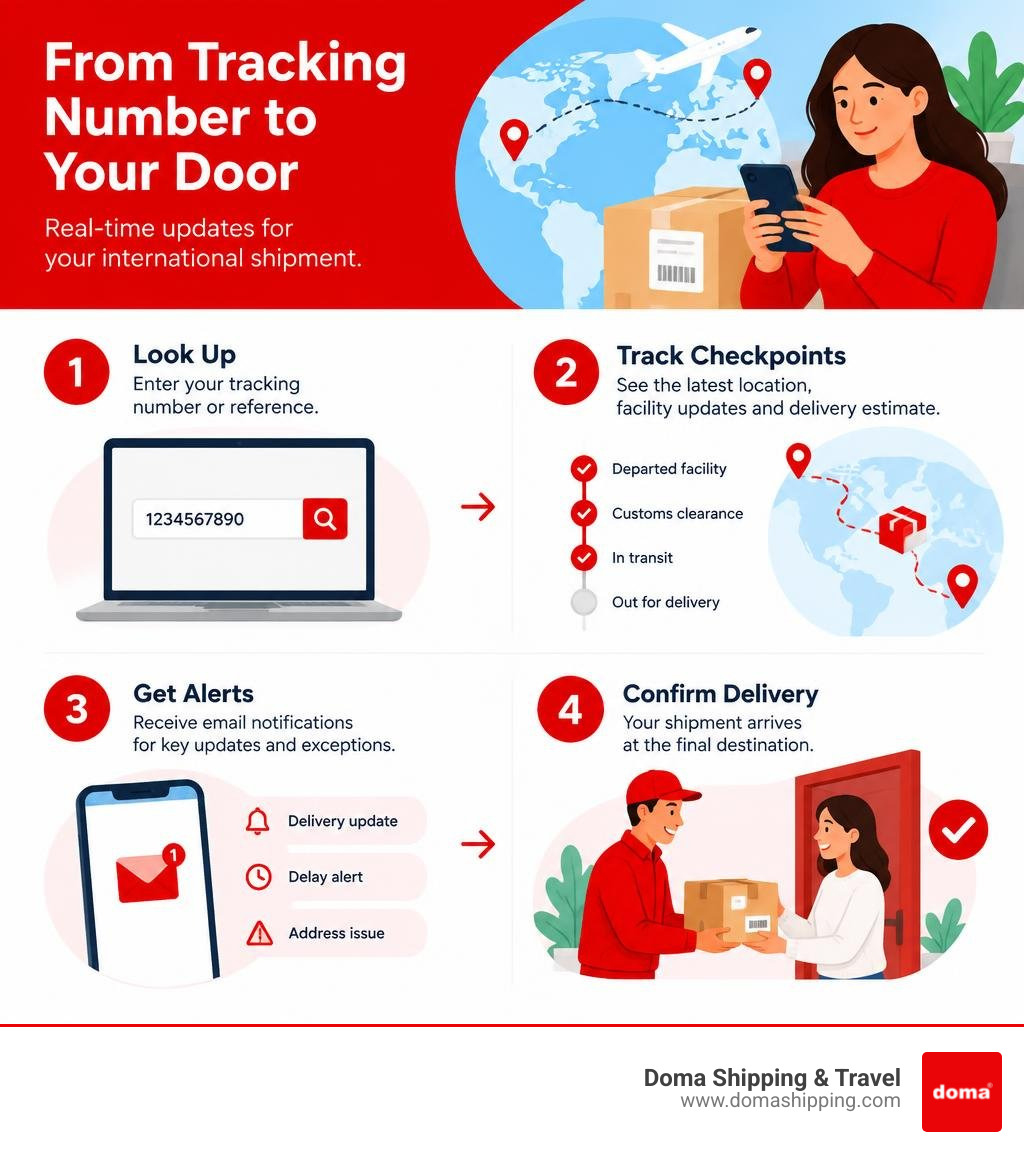
For real-time international shipping tracking, open your carrier’s tracking page and enter your shipment PIN (tracking number) or reference number. You can then review the latest checkpoint, delivery estimate, and any exception that needs action. Mastering international shipping tracking gives senders and recipients clear visibility into every stage of a cross-border journey.
To stay ahead of problems:
Tracking matters most when a shipment crosses borders. A package may move through several facilities, customs steps, and delivery networks before it reaches its final destination. Updates are generally added at facility checkpoints, so a short gap does not always mean the package is lost. For a broader look at how international shipments move through carrier networks, see this guide to professional international courier tracking.
For families and businesses shipping from the United States to Poland or elsewhere in Europe, the same habit applies: keep your shipment reference, watch for customs or address requests, and act quickly when an exception appears. Clear tracking visibility helps replace uncertainty with practical next steps.
Similar topics to international shipping tracking:
Understanding carrier service tiers helps set realistic expectations for cross-border transit windows and checkpoint intervals. Logistics providers structure their cross-border shipping networks to accommodate varying package weights, dimensions, and delivery urgency, ensuring seamless customs clearance and last-mile connectivity.
| Service Tier | Typical Weight Range | Typical Transit Window | Key Tracking Feature |
|---|---|---|---|
| Courier Delivery | 0 – 150 lbs (Parcels) | 1 to 3 Business Days | Milestone facility scans & real-time delivery estimates |
| Express Forwarding | 0 – 150 lbs (Parcels) | 3 to 5 Business Days | Detailed checkpoint alerts & customs clearance updates |
| Standard Parcel | 0 – 70 lbs (Small Parcels) | 2 to 8 Business Days | End-to-end postal and courier network visibility |
| Less-Than-Truckload (LTL) | Over 150 lbs (Palletized) | Varies by destination lane | Skid-level tracking with individual pallet IDs |
When coordinating international parcel logistics, choosing between express courier and standard parcel distribution depends heavily on customs handoffs and sorting hub structures. Exploring the easiest way to track international shipment operations reveals that time-definite express services undergo barcode scans at every consolidation point, airport sorting terminal, and regional transfer station. For larger business dispatches, mastering international parcel tracking allows logistics coordinators to monitor multi-piece consignments as they clear European customs entry points.
Freight shipments weighing over 150 lbs require consolidated logistics and heavy-cargo handling. Modern freight forwarding networks employ skid-level tracking, assigning unique identifier barcodes to individual pallets within a consolidated load. This ensures full visibility as cargo transfers between domestic sorting docks, ocean or air freight terminals, and destination distribution hubs across Europe.

Accessing accurate milestone information requires using the appropriate tracking numbers and lookup portals. Leveraging real-time package tracking tools provides immediate clarity on location and processing stages.
Every international consignment carries a primary tracking identifier (PIN) or customer reference number. To monitor progress through an online portal:
Proactive notifications eliminate the need for repeated manual searches by delivering automated status updates directly via email or SMS. Shippers and consignees can configure these preferences during label creation or via the shipment tracking page:
For high-volume merchants and logistics managers, integrating tracking capabilities into internal dashboards automates monitoring across multiple carriers.

Understanding standardized status taxonomies helps interpret tracking milestones and distinguish routine processing from actionable delivery exceptions. Reviewing guidelines on professional international courier tracking provides additional context on carrier event codes.
Carriers generally utilize seven standardized core delivery statuses supported by distinct sub-status codes to define shipment progress:
Proof of Delivery (POD) serves as formal verification that an international consignment reached its designated recipient.
Operational hurdles such as severe weather, international customs clearance procedures, and incomplete delivery addresses require prompt corrective measures.
When an “Address Correction Required” scan appears, immediate intervention prevents the parcel from being returned to the sender. Senders or recipients should access the carrier’s customer support chat or support hotline with their PIN ready to update suite numbers, street spellings, or postal codes. Delivery redirection to an alternative local holding facility can also be arranged if the recipient cannot receive packages at the original address.
Checkpoint scan gaps often occur during long-haul transport phases, such as cross-country trucking or international maritime and air transit. If a tracking status shows no new updates for 48 to 72 hours, it frequently indicates the shipment is traveling between intermediate hubs rather than experiencing an active failure. However, if updates stall beyond three to five business days, contacting customer support helps initiate a facility dock search or customs status inquiry.
If a delivery attempt fails because no authorized recipient was available to sign, couriers leave a physical delivery notice outlining subsequent steps.
Most international carriers retain undelivered packages at their regional service center or retail partner depot for up to 5 business days. If the consignee does not collect the parcel or arrange redelivery within this window, the item is initiated for return to sender or transferred to an undeliverable freight holding facility.
Gaps in tracking scans typically occur while a shipment is undergoing international line-haul transit between major logistics hubs, awaiting scheduled customs inspections, or transferring between intermodal freight containers. Until the package reaches the next physical sorting facility and passes beneath an automated scanner, the previous checkpoint remains visible.
Yes, an authorized third party can collect an international parcel on your behalf from a designated retail depot. The representative must present their own government-issued photo ID, a clear copy of the recipient’s photo ID matching the package destination address, and a signed letter of authorization referencing the tracking PIN.
Mastering international shipment tracking transforms complex global transport into a predictable, transparent process. By securing tracking numbers promptly, setting automated alerts, and understanding checkpoint statuses, both senders and recipients can navigate cross-border deliveries with complete confidence. For comprehensive support with your overseas logistics, container consolidation, and transatlantic parcel journeys from the USA to Poland and wider Europe, rely on the dedicated team at Doma Shipping & Travel and explore our full range of international shipment tracking solutions.