
To track a shipment worldwide, copy the tracking number from your receipt or shipping confirmation and enter it in a world wide shipping tracker. Check the latest scan, its date, and the carrier shown. If the parcel changes carriers on its way to Europe, look for a new tracking number or check the destination carrier’s site.
Tracking shows reported scans, not a live location at every moment. A gap in updates may simply mean your parcel is traveling between facilities or waiting for customs processing. Keep your shipment details handy so you can follow up if it remains stalled. For broader context on how international postal networks exchange tracking data, the Universal Postal Union maintains global standards for cross-border mail tracking.
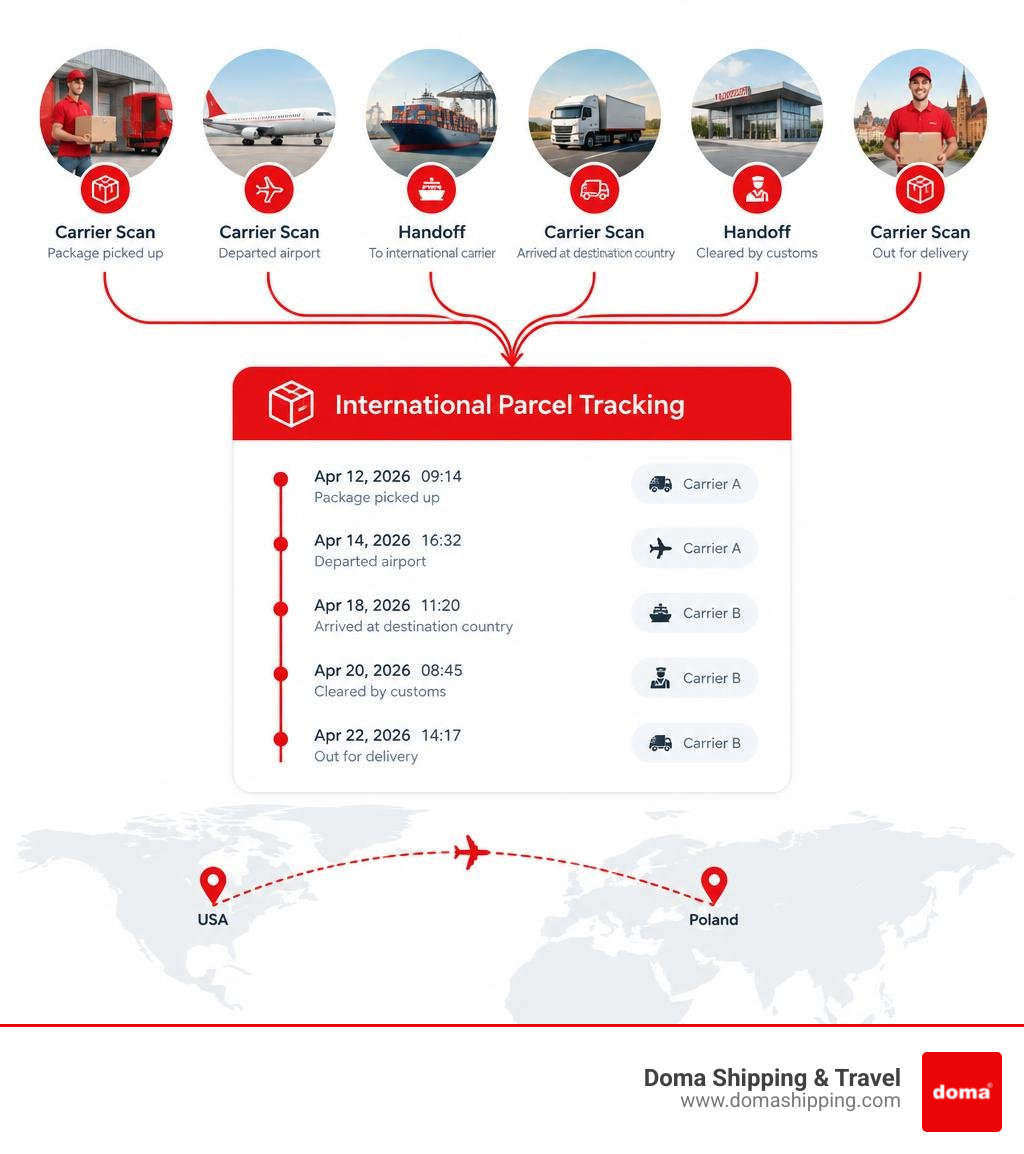
Simple world wide shipping tracker word guide:
Managing an international package journey requires orchestrating dozens of handoffs between distinct transport networks. Today, finding the easiest way to track international shipment progress involves modern universal platforms that automatically detect 2,500+ carriers worldwide—and up to 3,000+ carriers across broader courier aggregators. These tools unify disparate tracking streams into a single clear interface.
Instead of navigating multiple disjointed regional portals, logistics software uses RESTful APIs and real-time webhooks. When an export agent scans a parcel at an origin facility in Chicago, Franklin Park, or Des Plaines, that checkpoint triggers an instant data payload.
These platforms rely on international standards, such as the Universal Postal Union (UPU) S10 format and ISO alpha-2 country codes. The system decodes the prefix and suffix letters on a barcode to identify the origin network, handling service, and final European destination country without requiring manual carrier selection.
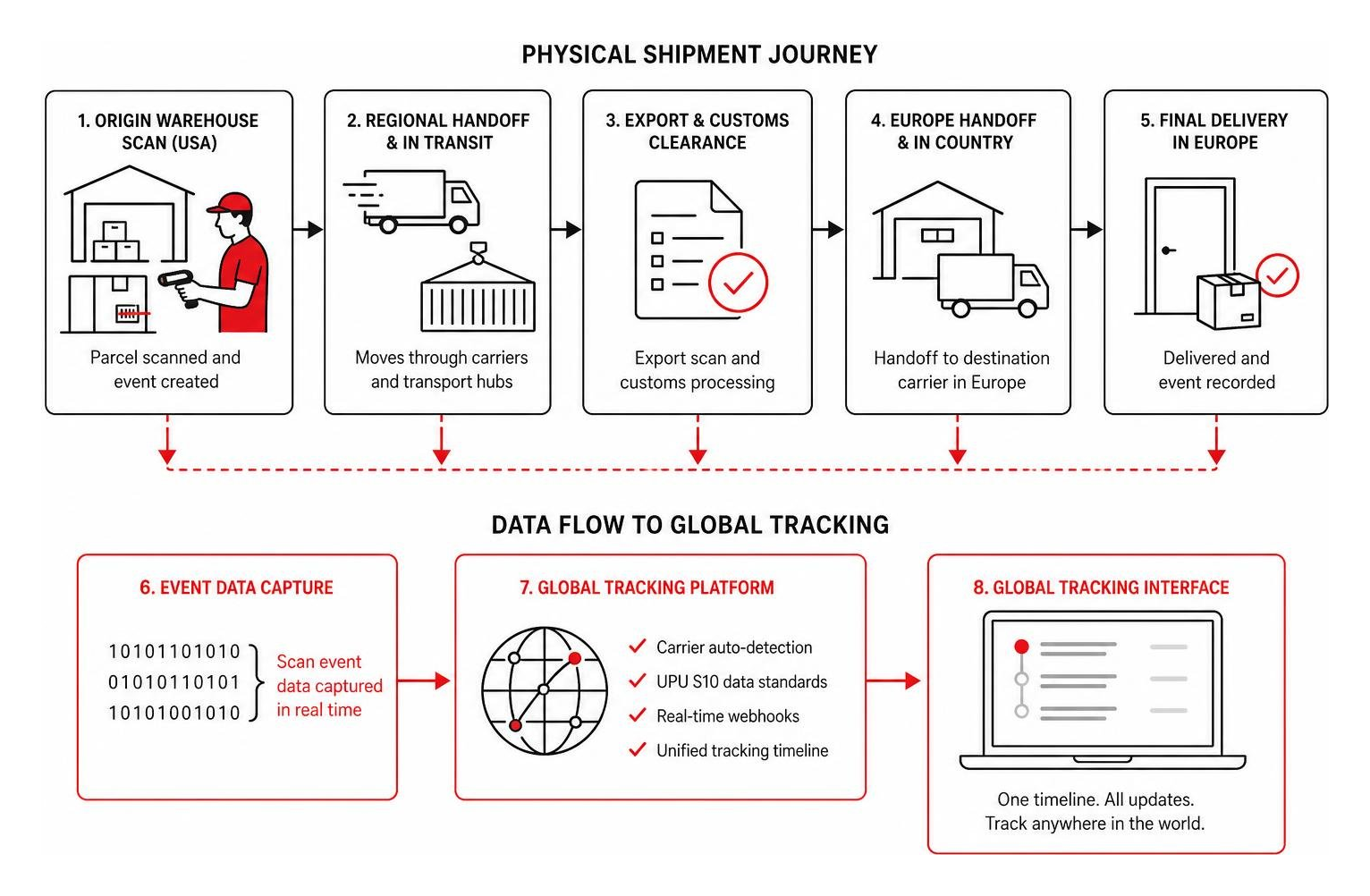
An effective global tracking platform consolidates every stage of transit so you never lose visibility over critical cargo. Implementing real-time package tracking never lose a shipment again capabilities relies on several core features:
Cross-border freight rarely travels from an American doorstep to a European destination under a single logistics provider. Learning everything you need to know about international parcel tracking means recognizing how multi-leg journeys operate.
The first leg involves initial domestic consolidation from local hubs across Illinois—such as Schaumburg, Niles, or Melrose Park—to an international gateway terminal. From there, an international line-haul carrier moves the cargo across the Atlantic via air freight or ocean container vessel.
Upon reaching the port of entry in Europe, the shipment clears border inspections before being transferred to a destination postal authority or regional courier. A quality tracking platform monitors the master shipment number alongside linked secondary tracking IDs, ensuring continuous visibility as custody shifts between operators.
Deciphering international checkpoint scans can be confusing when carriers use technical logistics jargon. Tracking updates reflect physical scans at sorting hubs, export facilities, and border agency inspection points.
| Tracking Status Message | Logistics Transit Stage | Meaning & Operational Context | Typical Duration |
|---|---|---|---|
| Electronic Data Received | Origin Manifest Creation | The shipping label is generated; goods await physical handover at the consolidation warehouse. | 2–4 business days |
| Departure from Outward Office of Exchange | International Export Hub | The package has cleared export customs and is sorted for international air or ocean departure. | 2–10 business days |
| Sent to Airline / Handed to Carrier | International Line-Haul | Cargo is loaded onto an aircraft or ocean vessel transiting across the Atlantic. | 3–14 business days |
| Arrival at Inward Office of Exchange | Destination Border Entry | The shipment has arrived in the destination country and entered the import sorting facility. | 1–3 business days |
| Import Customs Scan / Inspection | Customs Clearance Checkpoint | Border agencies inspect parcel declarations, verify contents, and assess import duties. | 2–10 business days (regular) / 2–4 weeks (peak) |
| Handoff to Final Delivery Agent | Last-Mile Delivery Network | The parcel is transferred to local European postal or courier routes for doorstep delivery. | 1–3 business days |
The terms “Office of Exchange” refer to specialized international sorting facilities where mail and cargo exchange custody between national borders. When a status reads Departure from outward office of exchange, it signifies that your shipment has cleared origin security checkpoints and export customs, entering the queue for international transit.
Once the shipment lands in Europe, it registers an Arrival at inward office of exchange scan followed by an Import Customs Scan. During this stage, customs authorities examine the shipping documentation, tariff classifications, and commercial invoices.
Standard customs processing typically takes between 2 and 10 business days. During peak holiday shipping periods or when detailed valuation inspections are necessary, border clearance can extend to 2 to 4 weeks.
One of the most frequent tracking questions arises when a status remains on Electronic data received or Shipping notice received for several days. This milestone indicates that the digital documentation and barcode have been created in the system, but the parcel is currently moving through consolidation, palletizing, and container loading before receiving its first physical hub scan.
A 2 to 4 day gap before the first scan is standard operational procedure in international logistics. When a parcel shows Sent to airline, tracking updates may pause while the cargo is physically transiting across the Atlantic or awaiting processing at the destination port. Understanding how to manage these intervals is essential when reviewing lost in transit: how to track your global shipments easily.
Large personal effects, commercial cargo, and household relocations move across global trade lanes using multimodal logistics networks that combine road transport, air freight, and ocean shipping. Keeping cargo visible across these complex routes requires specialized monitoring tools.

Understanding never lose a package again with overseas logistics tracking requires using the correct tracking identifiers for different shipping methods.
Tracking large freight consignments differs from checking standard courier packages. Following a step-by-step guide to tracking international priority shipping involves identifying the specific document numbers tied to your shipment:
For ocean freight moving from US ports to Europe, maritime monitoring tools use the Automatic Identification System (AIS). Transponders on cargo vessels broadcast real-time VHF radio signals detailing vessel position, Speed Over Ground (SOG), Course Over Ground (COG), and navigation status.
Advanced tracking interfaces aggregate live feeds from networks like AISstream, plotting approximately 20,000 active vessels on interactive maps. When vessels navigate open ocean corridors beyond land-based VHF receiver range, satellite AIS receivers capture positions.
Logistics mapping software uses dead reckoning algorithms to estimate ship positions between satellite updates, keeping the vessel’s journey visible along transatlantic routes.
Even with sophisticated logistics systems, international shipments can experience unexpected delays due to weather disruptions, port congestion, or regulatory compliance reviews.
Knowing how to address exceptions prevents unnecessary stress. Reviewing lost in transit: your guide to professional international courier tracking helps you take the right corrective steps when a package stalls.
Customs delays usually occur due to missing commercial invoices, vague item descriptions, or required value declarations. If a package remains stationary at a customs checkpoint for more than 10 business days:
Regarding package health and handling safety, official guidance from both the World Health Organization (WHO) and the Centers for Disease Control and Prevention (CDC) confirms that international packages carry an extremely low risk of transmitting viruses or pathogens, as these organisms cannot survive extended transit on porous surfaces like cardboard and packaging materials.
Understanding the limitations of international tracking platforms helps set realistic expectations throughout your parcel’s journey:
Yes. Entering your alphanumeric tracking number into a universal tracker allows the system to analyze the code format, identify the originating carrier, and pull milestone scans across international borders. Discovering the best tools to track worldwide parcel services today helps you monitor cross-border consignments without needing separate logins for every carrier.
Modern delivery estimates combine carrier schedules with historical transit performance data. Comprehensive logistics analyses tracking over 450,000 completed shipments show that delivery estimates become significantly more accurate once the cargo clears destination customs, frequently predicting doorstep arrival within half-hour delivery windows.
When an overseas shipment arrives at its destination country, it undergoes import customs inspection and transfer to the local postal network. Tracking updates may temporarily pause while the parcel awaits customs clearance and sorting at the destination facility. Once released to the local carrier, domestic transit scans will resume.
Tracking international shipments requires clear visibility across carrier handoffs, customs checkpoints, and multimodal transport legs. A modern tracking approach simplifies monitoring, keeping you informed from the initial dispatch scan to final doorstep delivery across the Atlantic.
At Doma Shipping & Travel, we bring over 30 years of specialized experience to international logistics, operating trusted locations across the greater Chicago area—including Chicago, Melrose Park, Mount Prospect, Roselle, Palos Hills, Algonquin, Niles, Park Ridge, Des Plaines, Glenview, Franklin Park, Schiller Park, Bensenville, and Schaumburg.
We provide dependable shipping exclusively from the United States to Poland and European destinations, offering comprehensive parcel transport, container shipping (FCL and LCL), full customs clearance, and bilingual Polish-English customer support.
When you need complete peace of mind for your overseas cargo, track your international shipment with our dedicated monitoring services.