The Best Way to Move Internationally: What You Need to Know Before You Go
The best way to move internationally depends on your timeline, the volume of belongings you’re shipping, and your destination — but for most people relocating from the USA to Europe, the process breaks down into a handful of core decisions.
Here’s a quick overview of what the best international move looks like:
- Start 12–18 months early — visa applications, apostilled documents, and school enrollment all take longer than expected
- Choose sea freight for household goods — ocean freight is significantly more efficient for large volumes than air freight
- Decide early what to ship, store, or sell — shipping only what is irreplaceable saves time and effort
- Sort your admin in the right order — banking, health insurance, and tax notifications need to happen before you leave
- Work with a professional international mover — one with verified credentials and experience handling customs clearance
Moving abroad is rarely a quick process. For families, it’s realistically a 12 to 18 month project. For solo movers, expect at least 3 to 6 months of active preparation. The total investment for a family of four — covering visas, shipping, temporary housing, and schooling — requires careful financial planning depending on destination and lifestyle.
Most problems don’t come from a lack of planning. They come from doing things in the wrong order.
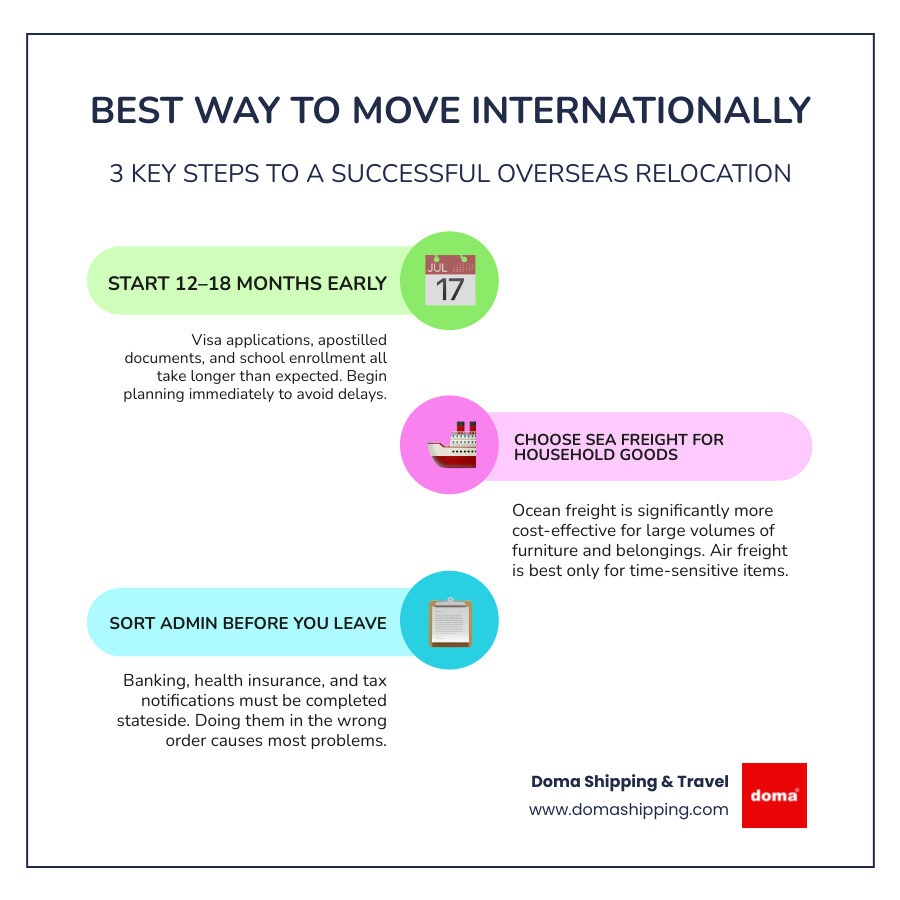
Best way to move internationally word list:
Planning Your Timeline: The Best Way to Move Internationally
When it comes to establishing the best way to move internationally, treating the move as a sequential project is your greatest defense against chaos. Many aspiring expats make the mistake of booking transportation before their visas are approved, or packing boxes before they have researched local customs regulations.
To ensure a seamless transition from the United States to Europe, you need a structured approach. A timeline helps you visualize deadlines, coordinate third-party services, and manage your stress levels. Here is our recommended Step-by-step guide to moving abroad to help keep your relocation on track over a 12-month period.
Establishing Your Foundation 6 to 12 Months Ahead
The first six months of your planning phase should focus entirely on legal, financial, and strategic groundwork. This is not the time to buy packing tape; it is the time to secure your right to enter and reside in your destination country.
- Passport Validity: Check the expiration dates on all family passports. Many European nations require your passport to be valid for at least six months beyond your intended stay or visa expiration date. If you are close to that window, renew immediately.
- Identify Your Visa Pathway: Whether you are relocating for work, retirement, study, or family reunification, identify your visa requirements. Consulate appointments for European countries (such as Poland, Spain, or France) often book out four to eight weeks in advance—and up to three to four months during peak seasons.
- Apostille Vital Records: Most European governments require official documents (birth certificates, marriage licenses, and university diplomas) to be authenticated under the Hague Convention. This process, known as obtaining an apostille, must be completed in the state where the document was issued and can take several weeks.
- Consular Registration & Financial Prep: Research your destination’s banking requirements and begin organizing your financial portfolio. We recommend saving at least six months’ worth of your target monthly budget to cover unexpected relocation expenses.
For a deeper dive into the administrative steps required during this early phase, consult this comprehensive pre-departure checklist.
Finalizing Logistics 1 to 3 Months Before Departure
With your visa in hand and your documents apostilled, you can transition into physical logistics. This phase is about tying up loose ends in the United States and preparing for your arrival in Europe.
- Secure Temporary Housing: Do not sign a long-term lease for an apartment or house sight unseen. The best way to move internationally is to book temporary accommodation (such as a furnished apartment or rental) for your first four to eight weeks. This gives you time to explore neighborhoods in person and avoid rental scams.
- School Registration: If you are relocating with children, secure their school placement as early as possible. International school programs often have waitlists that require six to twelve months of advance notice, so early registration is essential.
- Notify Utilities and Banks: Inform your current utility providers, credit card companies, and banks of your departure date. Unlocked smartphones are essential for international moves; contact your carrier to ensure your devices can accept foreign SIM cards or eSIMs.
- Consult Logistics Professionals: This is the ideal window to finalize your shipping arrangements. Reviewing a detailed guide to moving to Europe can help you coordinate container bookings and understand port requirements.
Shipping Your Belongings Overseas: Sea Freight vs. Air Freight

Once you decide what to bring, you must choose how to transport it. The two primary methods for international shipping are sea freight and air freight. Understanding the operational differences between these methods is key to planning a successful relocation.
Full Container Load (FCL) vs. Less than Container Load (LCL)
If you select ocean transport, your shipment will fall into one of two categories:
- Full Container Load (FCL): You rent an entire shipping container (typically 20-foot or 40-foot) exclusively for your belongings. A standard 20-foot container offers approximately 33 cubic meters of usable space, which is generally sufficient to transport the contents of a two-to-three-bedroom home. FCL is highly secure and faster than shared shipping, as the container is sealed at your home and opened only at customs or your final destination.
- Less than Container Load (LCL): If you are only shipping a few rooms of furniture or several large boxes, you do not need an entire container. With LCL, your items are measured by volume (cubic meters) and consolidated into a shared container with shipments from other individuals. This is an excellent option for smaller moves, with rates typically structured per cubic meter.
To understand how to pack and organize these loads, consult our guide on shipping personal belongings safely.
Why Sea Freight is the Best Way to Move Internationally for Large Volumes
For large-scale household relocations, ocean transport is the industry standard.
- Capacity: Ocean containers can accommodate heavy furniture, large appliances, and even personal vehicles.
- Efficiency: From an economic standpoint, ocean freight is incredibly efficient for large volumes compared to air freight. For example, shipping a 20-foot container from North America to Europe typically takes 4 to 8 weeks, making it the preferred choice for full household relocations.
- Suitability for Vehicles: If you plan to transport a family car, sea freight offers specialized options like Roll-on/Roll-off (RoRo) or secure containerized vehicle transport.
To explore how to coordinate these large shipments, view our dedicated household shipping services.
When to Choose Air Freight for Time-Sensitive Items
Air freight is a premium service characterized by rapid transit times, typically taking only a few days rather than weeks. However, it is structured by weight rather than volume, making it a more specialized option.
Because of this pricing structure, air freight is generally reserved for:
- High-value electronics or irreplaceable family heirlooms.
- Essential documents and immediate-use clothing.
- Relocations where an employer is covering all transport expenses without volume restrictions.
For the vast majority of personal moves, a hybrid approach is best: send your primary household goods via sea freight and carry your daily essentials with you on the plane.
Deciding What to Ship, Store, or Sell
One of the most challenging aspects of relocating is deciding what happens to your physical belongings. Shipping items across the Atlantic is a major undertaking, and downsizing is often the most practical path forward.
| Option |
Best For |
Key Considerations |
Financial Impact |
| Ship |
Irreplaceable heirlooms, high-quality furniture, specialized equipment |
Customs duties, voltage compatibility, transit times |
Higher initial investment, saves replacement expenses |
| Store |
Temporary relocations (1-2 years), sentimental items |
Long-term storage facility fees, climate control |
Ongoing monthly fees; may exceed the value of the items |
| Sell |
Common appliances, standard furniture, easily replaceable goods |
Time required to host sales or list online |
Generates immediate liquidity to fund your relocation |
Evaluating Your Belongings for an Overseas Move
Before committing to shipping any item, ask yourself these practical questions:
- Is it voltage-compatible? The United States operates on a 110V system, while Europe uses 220V. While small electronics (like laptops and smartphones) are dual-voltage, large appliances (like microwaves, blenders, and hair dryers) will require heavy-duty transformers or simply won’t work efficiently. It is almost always better to sell your US appliances and buy new ones upon arrival.
- Will it fit? European homes, apartments, and stairwells are generally smaller than their American counterparts. Your oversized sectional sofa or king-size bed frame may not physically fit through the doorway of a historic apartment in Krakow or Paris.
- What is the replacement value? Compare the rate to ship an item against the expense of purchasing a similar item in your new country. If you are shipping a standard, mass-produced bookshelf, the shipping volume fees will likely exceed the value of the bookshelf itself.
Navigating International Logistics and Customs Regulations
Entering a foreign country with a container full of household goods requires strict adherence to customs regulations. Every country has specific laws governing what can be imported duty-free as “personal effects” and what requires special permits or taxation.
Choosing the Best Way to Move Internationally with Professional Movers
Attempting to coordinate ocean freight, port logistics, and customs clearance on your own is incredibly risky. Working with certified international movers ensures that your shipment complies with international maritime laws and destination customs requirements.
When evaluating international moving companies or premium relocation services, look for the following trust indicators:
- FMC Licensing: Any company shipping household goods from the US by sea must be licensed or registered with the Federal Maritime Commission (FMC).
- FIDI Accreditation: Look for movers affiliated with FIDI, the global alliance of professional international moving companies, which guarantees adherence to strict quality standards.
- Customs Expertise: Ensure your provider offers comprehensive customs clearance handling as part of their service package, rather than leaving you to navigate the port authority alone.
For a detailed breakdown of how to vet these providers, read our guide on selecting reliable moving services.
Essential Paperwork and Customs Documentation
To clear customs in Europe without facing delays or unexpected storage fees, you must prepare a comprehensive documentation package. This typically includes:
- Detailed Inventory List: A line-by-line packing list detailing the contents of every box, often translated into the local language of your destination country.
- Proof of Residency Change: Documents proving you are establishing residency in the destination country (such as a work contract, lease agreement, or visa).
- Customs Declaration Forms: Specific country forms declaring that your items are personal household goods owned for at least six months, qualifying them for duty-free entry.
- Tax Notifications: Written confirmation to the relevant tax authorities regarding your departure from the US and your tax status transition.
Managing Essential Expat Admin: Banking, Health, and Pets
Relocating your physical body and belongings is only half the battle; you must also transition your digital and administrative life.
- Multi-Currency Banking: Before leaving the US, open a multi-currency account with financial platforms like Wise or Revolut. This allows you to hold, convert, and transfer funds between USD and EUR (or local currencies like Polish Zloty) with minimal transaction fees. Do not close your US bank accounts immediately; you may still need them for residual tax payments, insurance refunds, or US-based income.
- International Health Insurance: Do not assume your US health insurance will cover you abroad. While many European countries offer excellent public healthcare, you will often need a private international health insurance policy to cover you during your initial transition period or to satisfy your visa requirements.
- Phone Plans: Ensure your mobile phone is unlocked by your US carrier. Upon landing, you can purchase a local prepaid SIM card or set up an eSIM plan to obtain a local phone number immediately.
Relocating Your Pets Safely
If you are moving with a four-legged family member, pet relocation requires meticulous planning. The process of moving a pet internationally requires careful planning to cover airline-approved travel crates, veterinary certificates, and flight bookings.
To import a pet from the US to Europe, you must meet the following requirements:
- ISO Microchip: Your pet must be implanted with an ISO 11784/11785 compliant 15-digit microchip. This must be done before or on the same day as their rabies vaccination.
- Rabies Vaccination: The rabies vaccine must be administered after the microchip is active. You must wait at least 21 days after the primary vaccination before your pet can enter the European Union.
- EU Health Certificate: A USDA-accredited veterinarian must complete an EU non-commercial health certificate, which must then be endorsed by the USDA Animal and Plant Health Inspection Service (APHIS) within 10 days of your flight.
- Quarantine Rules: While most European countries do not require quarantine for pets arriving from the US with proper documentation, countries like the UK, Ireland, or Malta have additional tapeworm treatment requirements that must be administered by a vet 24 to 120 hours before arrival.
Frequently Asked Questions about Moving Internationally
What is the most reliable way to ship household goods overseas?
The most reliable and secure method for shipping large volumes of household goods is ocean freight container shipping (FCL or LCL) managed by a professional international logistics provider. Professional packing services are highly recommended, as marine cargo insurance policies often require professional packing to cover potential transit damage.
How far in advance should I start planning an international move?
We recommend starting the planning process 12 months in advance. This provides ample time to navigate visa applications, obtain apostilles, downsize your home, secure shipping container space, and complete pet health requirements without facing rushed deadlines.
Can I ship my personal vehicle to Europe?
Yes, you can ship personal vehicles to Europe via containerized shipping or Roll-on/Roll-off (RoRo) vessels. You will need to provide the vehicle’s original title, proof of insurance, and registration. Be prepared for local customs clearance procedures, which may require vehicle modifications to meet European safety and emissions standards upon arrival.
Conclusion
The best way to move internationally is to break the journey down into manageable, logical steps with the help of trusted partners. By planning your timeline early, decluttering your home, and understanding the logistics of ocean freight, you can turn a complex global relocation into an exciting new chapter.
At Doma Shipping & Travel, we have spent over 30 years helping families and individuals make successful transitions across the globe. Based in Chicago, we proudly serve communities across the greater Chicago area, including Melrose Park, Mount Prospect, Roselle, Palos Hills, Algonquin, Niles, Park Ridge, Des Plaines, Glenview, Franklin Park, Schiller Park, Bensenville, and Schaumburg.
We specialize in end-to-end logistics solutions, offering bilingual (Polish/English) customer support, complete customs handling, and real-time shipment tracking for your peace of mind. Whether you are shipping a single parcel, a shared container, or a full household to Poland or elsewhere in Europe, we provide the reliable service you need.
Ready to take the first step on your international journey? Explore our international parcel shipping services to see how we can support your move today.