
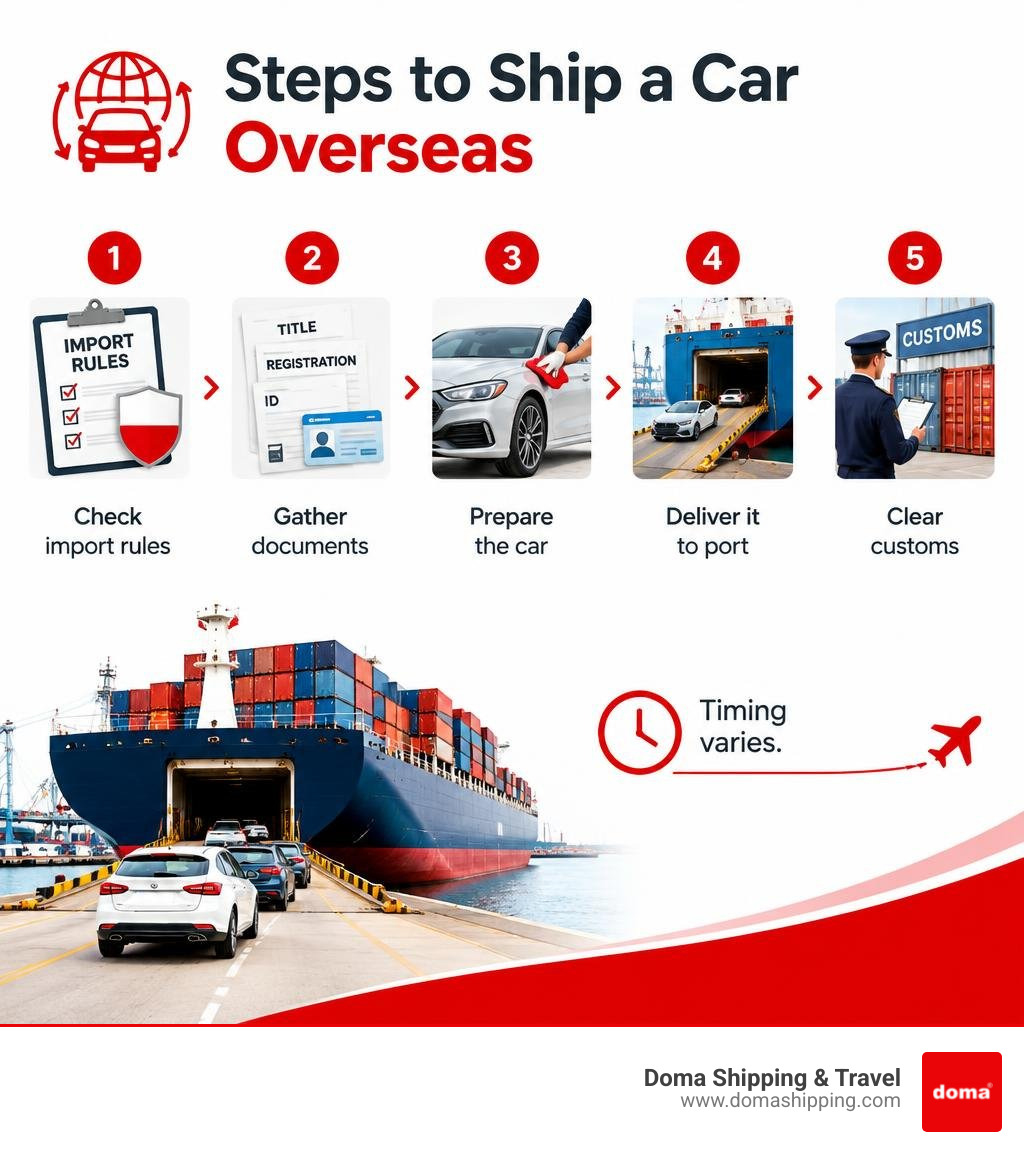
To ship a car overseas, first confirm that Poland will accept your vehicle and check its import requirements. Gather your title, registration, ID, and any lender or leaseholder permission. Then arrange shipping, clean the car, remove personal items, and confirm the fuel limit and port drop-off rules before delivery.
For a shipment from the Chicago area to Poland, shipping arrangements, including the departure port, documentation support, and destination handling, are agreed individually for the route and service selected. Confirm availability for any European destination other than Poland before making plans.
Handy ship car overseas terms:
Before you book transport, you must determine whether your automobile qualifies for legal export from the United States and meets the entry criteria of your destination country. U.S. Customs and Border Protection (CBP) enforces strict rules regarding vehicle ownership. You must demonstrate clear proof of ownership via an original certificate of title without unendorsed liens. Following a practical guide to shipping your wheels overseas will help keep your preparations organized from the start.
If you plan to ship a financed or leased vehicle, you cannot export it using a standard title alone. Financing institutions and leasing companies maintain a legal interest in the property. You must secure an official, notarized letter of authorization printed on the lender’s letterhead that explicitly permits international export and maritime transit.
Carrier acceptance also depends on destination regulations. For example, Poland and the broader European Union impose stringent technical, environmental, and road-safety standards. Certain modifications, structural damage, or missing documentation can cause customs authorities to reject a vehicle at the arrival port. Always confirm route availability, technical eligibility, and required permissions with our team before committing to transport.
A vehicle’s physical footprint directly affects freight planning, vessel placement, and overall freight handling. Ocean carriers assess space using measurement tons (MT), cubic meters, or linear dimensions.
Vehicles exceeding standard dimensions or weighing more than common limits—such as specialized commercial trucks exceeding 20 measurement tons—may require specialized carrier planning or restricted loading arrangements. Always provide exact dimensions (length, width, height) and curb weight when requesting an assessment for your specific route.
Planning an overseas vehicle shipment requires coordinating document validation, inland transport from the Chicago area, terminal operating hours, and carrier or port cut-off requirements for the selected route.
| Stage / Factor | Key Considerations |
|---|---|
| Document Validation | Confirm title requirements, lienholder permission, and any Power of Attorney requirements before delivery. |
| Inland Freight to Port | Arrange transport from the Chicago area to the departure terminal selected for the shipment. |
| Port Receiving Windows | Confirm the terminal’s receiving appointment and carrier cut-off requirements for the booked sailing. |
| Ocean Transit to Europe | Transit arrangements vary by carrier, port pair, vessel availability, and selected service. |
| Customs & Terminal Processing | Follow the applicable document-presentation and inspection requirements at the destination. |
Confirm current port cut-off requirements, receiving appointments, and terminal operating information with the carrier or terminal before dispatching the vehicle.
Exporting a motor vehicle requires an organized document packet. Missing a single signature or presenting an uncertified copy can delay acceptance or result in rejection by terminal authorities. When organizing transit, shipping your car from Illinois to international ports requires early coordination between local transport and marine handlers.
Your core documentation packet should contain:
U.S. Customs requires export documentation to be filed through the Automated Export System (AES) via the Automated Commercial Environment (ACE) in accordance with applicable filing requirements before vessel departure. Port authorities review your Internal Transaction Number (ITN) alongside original ownership titles to verify the car is not stolen and is legally cleared for export.
Understanding complete customs clearance procedures helps ensure compliance with both U.S. export laws and European import standards. Destination customs officials require proof of vehicle value (bill of sale or appraisal), commercial shipping invoices, and destination-specific import declarations.
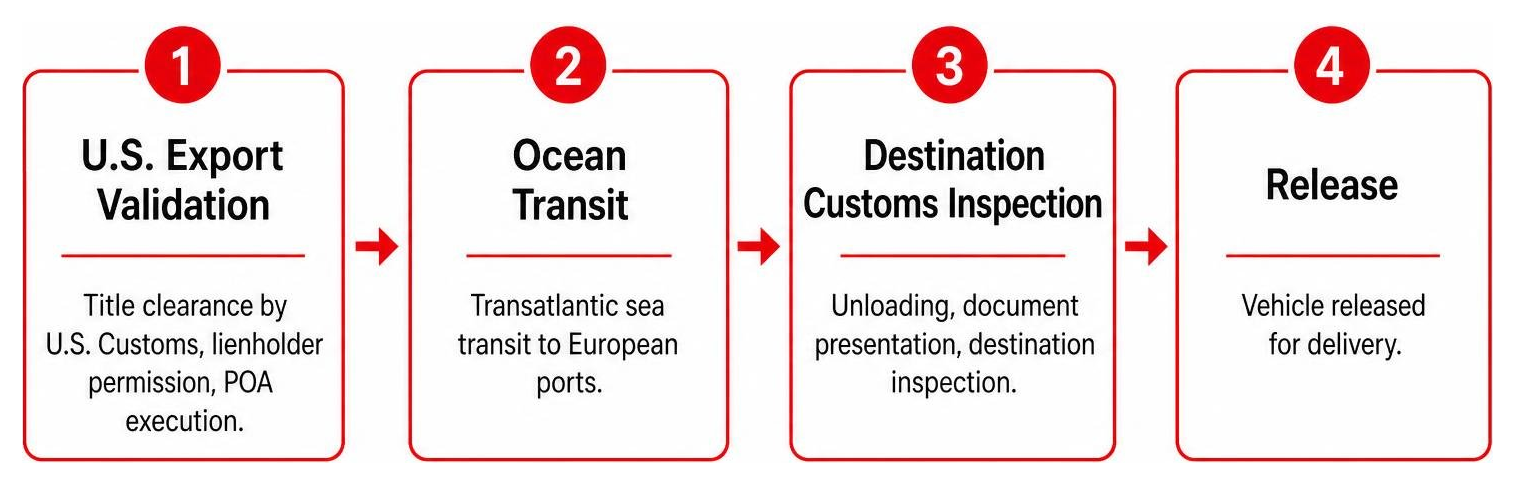
Confirm all current requirements with official U.S. and destination-country authorities to ensure your paperwork matches current regulatory standards.

Physical vehicle preparation is as critical as your paperwork. Ocean carriers and agricultural authorities enforce strict cleanliness and safety protocols:
Importing an automobile into Europe involves specific fiscal obligations, including customs duties, local Value Added Tax (VAT), and destination port handling charges. In Poland and across the EU, standard import duties typically apply to passenger vehicles based on customs value, age, engine displacement, and country of manufacture. Individuals relocating their primary residence to Poland may qualify for duty and tax relief under a formal resettlement property (mienie przesiedleńcze) procedure, provided specific ownership and residence duration criteria are met.
Selecting the appropriate shipping method also shapes your arrival experience. Comparing RORO or container car shipping costs allows you to balance budget, transit protection, and port service options. Roll-on/roll-off shipping transports vehicles on dedicated multi-deck vessels, while containerized shipping secures your car inside a steel ocean container, shielding it from salt spray and weather.
For individuals seeking comprehensive handling from an Illinois garage to a European address, understanding how door to door car shipping actually works clarifies how inland transport, ocean transit, and destination clearance connect.
When your vehicle arrives at a European port for final delivery into Poland, several administrative steps follow:
Always verify route-specific procedures with official authorities and our bilingual logistics team to avoid unexpected border holds.
Once the cargo vessel docks and containers or RORO decks are discharged, the receiving terminal issues an Arrival Notice. You or your authorized agent must settle destination port handling charges, clear customs, and arrange collection.
Ask the destination terminal or appointed agent about collection requirements, storage terms, and any arrangements needed for transfer to an inland processing location. These details vary by port and service.
When picking up your vehicle:
Choosing a dependable logistics partner requires evaluating regulatory compliance, route familiarity, and cargo protection options. Vehicle age restrictions, specialized emissions testing, and fluctuating port handling fees vary widely by destination country.
Review the shipment terms carefully and decide whether separate cargo insurance is appropriate for your circumstances. For general consumer guidance on international vehicle shipping and ocean carrier responsibilities, consult the Federal Maritime Commission guide on shipping your vehicle overseas.
To protect your property, verify that your freight forwarder holds active licensing and bonding through the Federal Maritime Commission (FMC) as an Ocean Transportation Intermediary (OTI) or Non-Vessel-Operating Common Carrier (NVOCC). Licensed intermediaries must maintain financial bonds that safeguard shippers against non-performance or regulatory default.
Working with experienced auto export forwarding companies ensures your transport contract clearly details all included services, ocean freight charges, terminal fees, and customs documentation support without hidden clauses.
You typically need the original Certificate of Title, valid government-issued photo identification (such as a passport or driver’s license), current vehicle registration, and completed carrier shipping instructions. If the automobile is financed or leased, you must provide a notarized letter of authorization from the lender or leasing company. If you are using a representative to manage drop-off or customs, a notarized Power of Attorney is also required.
Your vehicle must undergo a comprehensive cleaning, including the wheels, tires, undercarriage, and interior, to remove all foreign soil, plant material, and debris. You must also ensure the manufacturer’s EPA emissions and DOT safety labels are intact and legible. Verify in advance whether your destination country requires technical lighting adjustments, speedometer conversions, or specialized emissions documentation before registration.
The fuel tank must be at 1/4 capacity or less at the time of delivery to the shipping terminal. Confirm the carrier’s current fuel requirement before delivery, as the permitted level and terminal procedure can vary by shipment.
Shipping an automobile internationally requires careful preparation, from validating titles and securing lender authorizations to ensuring thorough mechanical cleanliness and managing customs clearance. Ensuring your paperwork is complete and your vehicle is prepped to carrier standards helps avoid preventable issues during delivery and destination processing.
For senders in Chicago and surrounding communities—including Melrose Park, Mount Prospect, Roselle, Palos Hills, Algonquin, Niles, Park Ridge, Des Plaines, Glenview, Franklin Park, Schiller Park, Bensenville, and Schaumburg—Doma Shipping & Travel can discuss route and service arrangements for shipments from the U.S. to Poland. Confirm any other European destination directly before making plans.
Explore our dedicated vehicle and machinery shipping services or contact our team to discuss your route requirements, documentation, and personalized freight quote.