
US to Europe shipping involves choosing the right carrier, understanding customs rules, and preparing accurate documentation — all before your package leaves American soil.
Here’s a quick overview of your main options:
| Method | Transit Time | Best For |
|---|---|---|
| Express Air | 1–5 business days | Urgent, smaller packages |
| Priority International | 6–10 business days | Lightweight parcels |
| Standard International | 7–21 business days | Items under 4 lbs |
| Standard Air Freight | 7–14 business days | Mid-size shipments |
| Ocean Freight (LCL) | 4–6 weeks | Larger, non-urgent cargo |
| Ocean Freight (FCL) | 4–6 weeks | Full household or container loads |
A few things every shipper should know upfront:
Shipping from the US to Europe is more straightforward than most people expect — once you understand the key moving parts. Whether you’re sending a small parcel to Germany, relocating personal belongings to Poland, or moving a vehicle overseas, the process follows a clear set of steps.
This guide walks through everything: carriers, customs, documentation, container shipping, and specialized freight.
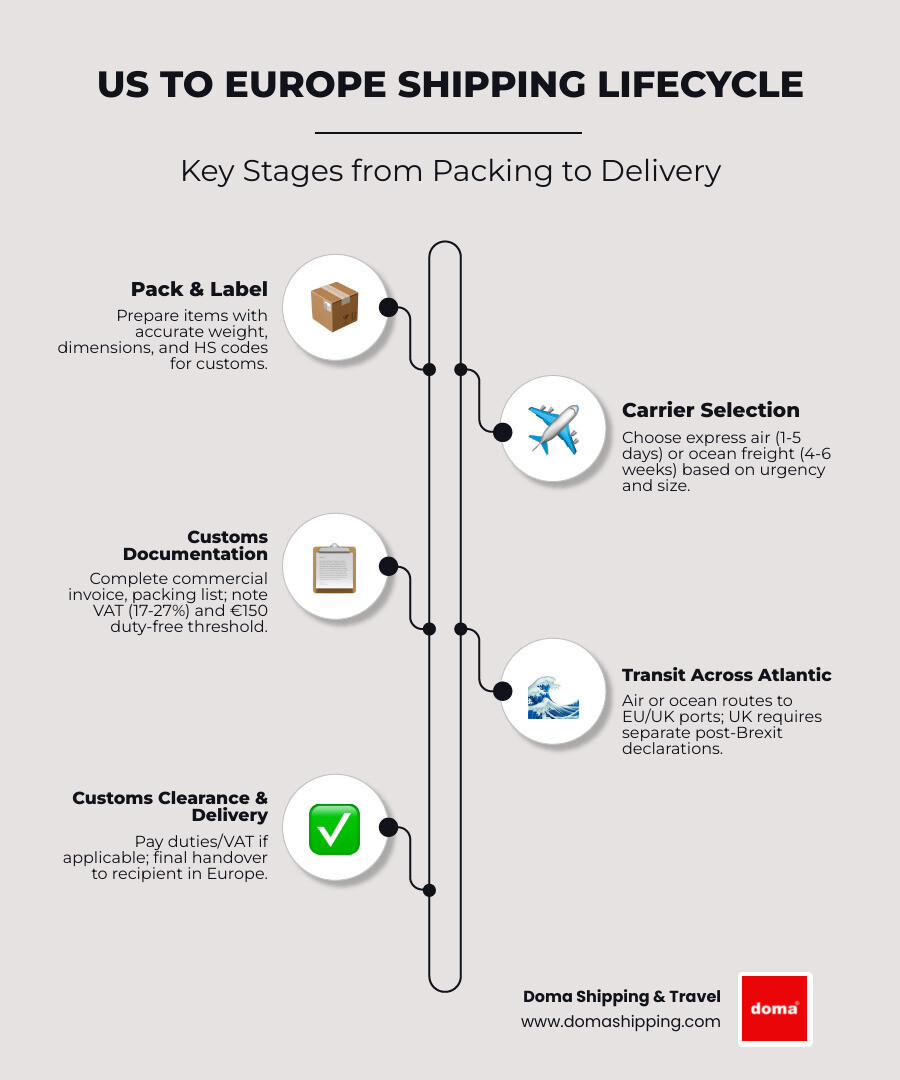
When we look at the logistics of sending goods across the Atlantic, the strategy begins with carrier selection. For residents in the Chicago area—from the busy streets of Niles and Park Ridge to the suburbs of Schaumburg and Algonquin—the choice often boils down to the nature of the items being sent. International logistics providers offer a variety of service levels designed to balance speed and handling requirements. For guidance beyond Chicagoland, see our shipping-to-Europe guides for Wisconsin, Arizona, Colorado and New York.
For smaller, more frequent shipments, international parcel shipping through established networks ensures that even a single box receives professional oversight. The choice between air and ocean transport is the most significant strategic decision. Air transport offers rapid transit for time-sensitive materials, while maritime routes provide the structural capacity needed for larger volumes or heavy machinery.
Transit times vary significantly based on the service level selected. Express delivery options, often utilizing dedicated air networks, can see a package land in major European hubs like Warsaw, Frankfurt, or Paris in as little as 1 to 3 business days. This is ideal for urgent documents or high-value items that require minimal time in the logistics chain.
Economy transit options typically provide a middle ground, with delivery windows ranging from 7 to 14 business days. These services are frequently used for international shipping services from the USA where timing is important but not critical. For those sending larger shipments via ocean freight, the timeline extends to 4 to 6 weeks. This duration accounts for the time required for container consolidation, maritime transit across the Atlantic, and final customs clearance at European ports.
Every service has specific physical limitations that we must respect to ensure a smooth journey. For example, standard international postal services often limit lightweight packages to 4 lbs. If a shipment exceeds this, it moves into a different classification, such as priority handling, which can accommodate boxes up to 70 lbs.
When preparing your shipment, it is vital to understand dimensional weight. This is a calculation used by carriers that considers the volume of a package rather than just its physical weight. If you ship a very large box filled with lightweight packing peanuts, you may find the carrier applies a “chargeable weight” based on the space the box occupies in the cargo hold. To navigate these nuances effectively, many shippers utilize a US to Europe package forwarding service to consolidate multiple items into a single, efficiently packed box, reducing the overall volumetric footprint.
Customs is often the part of us to europe shipping that causes the most concern, but it is simply a matter of accurate paperwork. Since July 2021, the European Union has implemented strict VAT regulations. Unlike in the past, there is no longer a “de minimis” value for VAT; every commercial item entering the EU is subject to Value Added Tax from the first cent of its value.
To ensure your shipment clears customs without unnecessary delays, we must provide:
Professional customs support clearance is essential for navigating these requirements, especially for commercial goods or complex relocations.
The United Kingdom and the European Union use different import systems. Do not apply EU thresholds or procedures to a UK delivery. Confirm the destination-specific requirements with the carrier before booking.
When we facilitate shipments to the UK, we must ensure separate customs declarations are filed. Even if a shipment is transiting through an EU port on its way to the UK, it must comply with British import standards. Navigating these European customs regulations requires staying updated on the evolving trade relationship between the UK and the continent to avoid shipments being held at the border.
For those operating e-commerce businesses from the US, the Import One Stop Shop (IOSS) is a significant development. This electronic portal allows sellers to collect VAT at the moment of purchase for B2C (Business to Consumer) shipments valued at €150 or less.
By using an IOSS identification number, the VAT is pre-paid, which allows the package to move through “Green Channel” customs quickly. This prevents the recipient from being surprised by tax bills upon delivery and ensures a much smoother customer experience across all 27 EU member states.

When the volume of goods exceeds what is practical for air travel, ocean freight becomes the primary method for us to europe shipping. This is the backbone of transatlantic trade, moving everything from household furniture to industrial components.
Ocean logistics are divided into two primary categories: ocean freight to Europe involves managing either shared or dedicated container space.
The choice between Full Container Load (FCL) and Less Than Container Load (LCL) depends entirely on your volume:
For a DOMA shipment, confirm the receiving address, collection arrangements and route to the export port before dispatch. A Chicago suburb in the service area does not establish that DOMA operates a warehouse there. The inland and ocean stages depend on the booked service.
Common destination ports in Europe include Gdynia and Gdansk in Poland, Hamburg in Germany, and Antwerp in Belgium. The transit duration is influenced by the specific route and the number of port calls the vessel makes. Our transatlantic container logistics expertise ensures that we select the most direct routes to minimize time on the water and ensure the safety of the cargo.
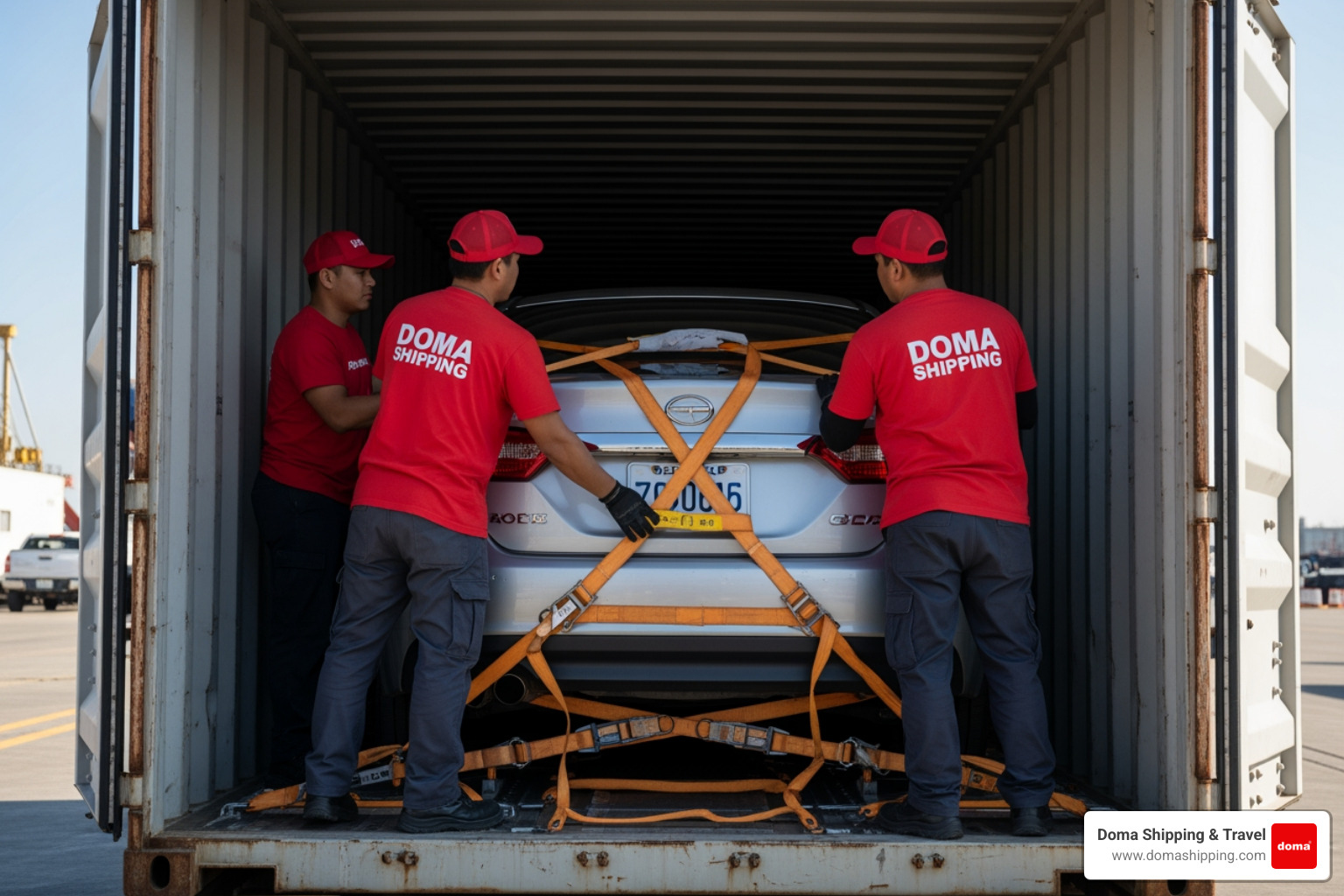
Some items require more than just a sturdy box. Shipping a car, a motorcycle, or an entire household’s worth of memories requires specialized handling and a deep understanding of international transport laws.
Whether you are transporting a car to Poland or moving heavy machinery, specialized logistics ensure these high-value assets are protected against the rigors of sea travel.
Relocating to another country is a major life event. To make the process manageable, a detailed inventory list is the first requirement. This list serves both as a packing guide and a vital document for customs officials to verify that the items are personal effects rather than goods intended for resale.
Packing for an international move is different from a domestic one. Items will experience more movement and humidity changes. We recommend using double-walled boxes, professional-grade bubble wrap, and customized cushioning for fragile items. Our relocation transport guide provides a step-by-step framework for ensuring your belongings arrive in the same condition they left your home in Des Plaines or Glenview.
For vehicles, there are two main shipping methods:
Each method requires specific customs clearance procedures, including the original vehicle title and proof of ownership. For businesses or individuals sending vehicle machinery, ensuring the equipment is clean and free of soil is often a requirement to meet European environmental and agricultural standards.
Prohibited items generally include flammables (like aerosols or perfumes with high alcohol content), perishable food items, explosives, and corrosive materials. Additionally, each European country has specific restrictions. For instance, some countries have very strict rules regarding the importation of medications, tobacco, or specific types of electronics. Always consult a restricted goods list for your specific destination before packing.
Do not assume that an EU import is duty-free because it is worth €150 or less. The low-value customs rules changed on July 1, 2026. Check the applicable procedure, goods classification and any specific relief before dispatch. From July 1, 2026, temporary low-value duty rules cover qualifying IOSS and postal imports; the charge is distinct from VAT and handling fees. Read the official customs relief guidance. Genuine private gifts and relocation goods require a separate assessment.
Commercial shipments require a comprehensive documentation package to clear customs efficiently. This includes a Commercial Invoice (detailing the transaction), a Packing List (detailing the physical contents), and often a Certificate of Origin (stating where the goods were manufactured). Providing accurate HS codes is the most important step for commercial shippers to ensure the correct duty rates are applied.
Navigating the complexities of us to europe shipping requires a partner with deep roots in the industry. At Doma Shipping & Travel, we bring over 30 years of experience to every shipment, whether it’s a small parcel sent from our Niles location or a full container load departing from Schiller Park.
We specialize in comprehensive logistics, from helping you shop online in the US to managing complex relocations and vehicle transport to Poland and beyond. Our goal is to provide a seamless, professional experience that takes the stress out of international trade and personal moves. If you’re ready to start your next transatlantic shipment, learn more about our shipping options and let us help you bridge the distance between the USA and Europe.