
To plan international relocation shipping, start with an inventory of what you will take. Check the import rules for your destination, then get a written quote that spells out shipping, customs handling, delivery, and possible extra fees. Label each box, keep a copy of your packing list, and confirm insurance coverage before your goods leave the USA.
Customs paperwork and port schedules can affect your delivery date, so leave room in your plans for delays. Doma Shipping & Travel provides international shipping from the USA to Poland and other European countries.

Quick international relocation shipping terms:
Use your inventory to identify the shipment volume, fragile items and special handling needs. Ask the team which collection and packing arrangements suit the goods and addresses.
Measure and list your goods before requesting a household-shipping quote. Confirm container or shared-load volume with the team. A parcel calculator is not a complete household relocation estimate.
Prepare a master list before the cartons are closed, using it to reconcile what leaves the origin address with what arrives at the destination. Assign a short reference code to every box and note the contents, approximate weight, measurements, and any handling instruction beside that code. For instance, a record for CHI-04 could identify kitchenware, 18 pounds, 18 × 14 × 12 inches, and fragile handling. Display the code on two sides of the carton and repeat it on the packing list so pickup, customs, and delivery records can be matched accurately.
Use plain, accurate descriptions that distinguish personal belongings from new commercial goods. “Used winter coats and kitchen utensils” is more helpful than “household items.” Keep a digital and paper copy, updating the list if anything changes before handoff. This supports a useful quote discussion and confirms that the collected goods match the paperwork.
Read the quote line by line before booking. Ask which collection, packing, export handling, ocean transport, customs support, destination handling, and final-delivery steps are included. Then identify excluded work, such as access-related services, storage, inspections, documentation changes, or destination charges. The goal is to understand responsibility for each stage and what could change the scope.
Give the shipping team the same inventory, addresses, access details, and preferred service level used to prepare the quote. If the shipment volume, pickup conditions, or destination requirements change, ask for the revised scope in writing before the goods are collected.
Selecting between Full Container Load (FCL) and Less than Container Load (LCL) depends on the measured cubic volume, the dimensions of bulky pieces, the route, and how much flexibility the shipment needs. A 20-foot or 40-foot container may suit some household moves, but usable capacity depends on packing method, furniture dimensions, loading requirements, and carrier arrangements. Ask the shipping team to assess the actual inventory rather than relying on apartment-size rules of thumb.
Compare dedicated and shared containers for the actual load. Confirm how the goods are packed, secured and handed over, and which services are included at each end.
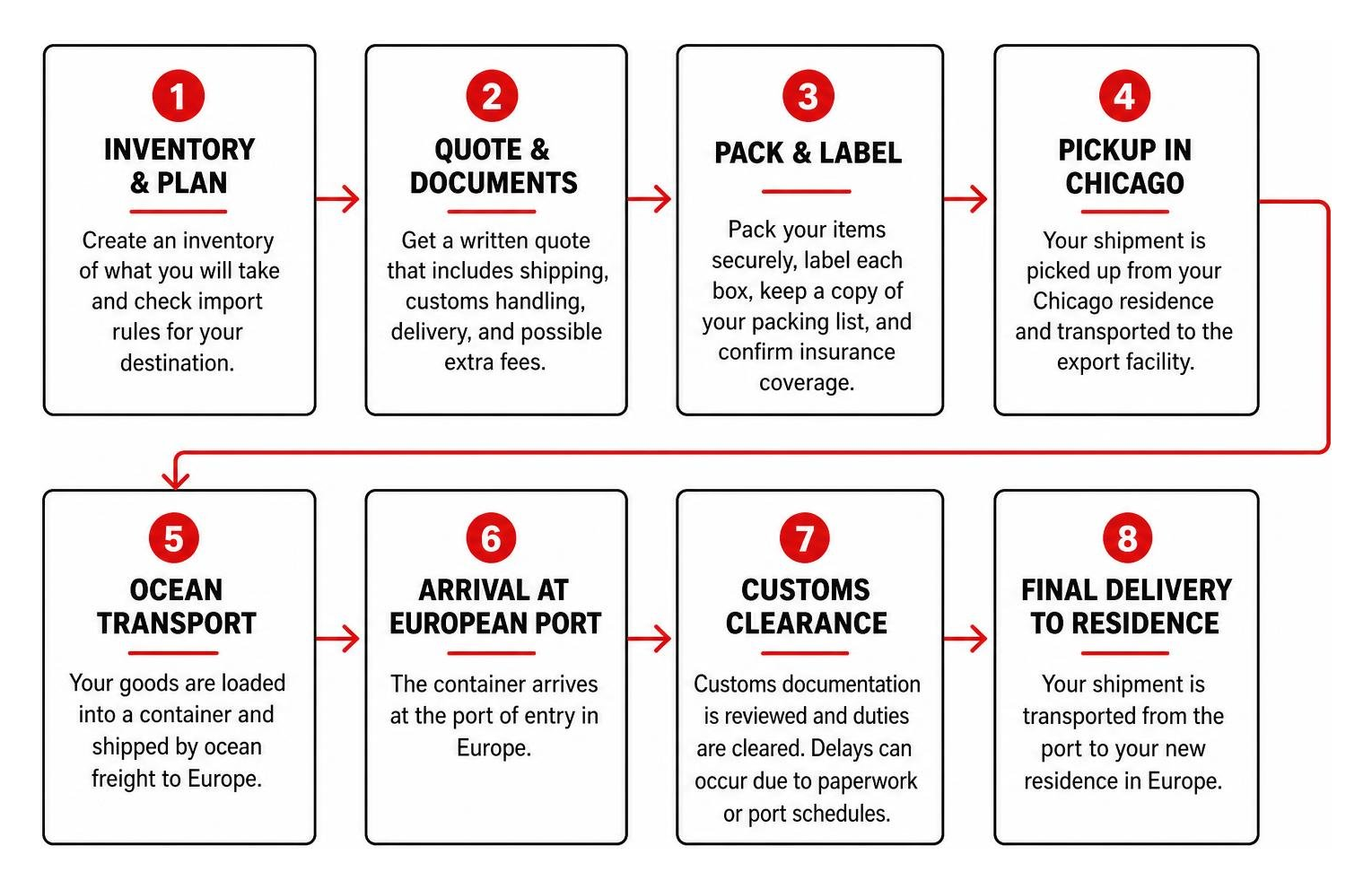
Discuss the current route estimate with the team. Distinguish collection, consolidation, vessel transit, customs processing and inland delivery rather than treating an ocean transit estimate as a door-to-door guarantee.

After booking, ask for the milestones that will be used to communicate progress, such as collection confirmation, consolidation, vessel departure, customs release, and local-delivery contact. Terminal dwell times and feeder connections between major North Sea transshipment hubs and regional Baltic ports can affect final arrival schedules, so a route estimate should be treated as a planning reference rather than a delivery promise.
Access at the origin and destination can affect collection and delivery. Tell the team about stairs, elevators, loading restrictions, parking, building appointments, narrow driveways, or an unready residence. The receiver should know who may accept delivery, how to be reached, and where the shipment can be placed safely.
Use a final handoff checklist before collection: reconcile the inventory against the cartons, photograph larger items and sealed boxes, verify the pickup contact and address, and keep passports, medication, valuables, and critical documents out of the shipment. Retain the booking confirmation, packing list, and collection receipt. At delivery, the receiver should compare visible carton counts and condition notes with the paperwork before signing any receipt.
Set a simple communication plan before the shipment moves. Name one contact for the sender and one for the receiver, confirm the preferred phone and email details, and ask when updates are normally provided. If a question arises at pickup, during customs processing, or before delivery, both contacts should know which booking or reference number to provide.
Proper preparation protects your valuables against moisture, pressure, and movement during ocean transit. When arranging household personal belongings shipping, each carton should be packed using heavy-duty, double-walled corrugated boxes designed for international freight.
Before shipping a vehicle, request the written preparation and export-document checklist for the selected method. Confirm fuel level, battery handling, loading and any special requirements with the shipping team.
When organizing shipping your car to Europe, vehicles can be securely blocked, braced, and strapped inside a dedicated container alongside household goods or shipped via specialized roll-on/roll-off ocean carriers. Complete inspection reports documenting vehicle condition prior to departure safeguard all parties involved in ocean transit.
Before selecting a protection option, review the booking-specific terms with the shipping team. Confirm the covered and excluded events, any photo or condition-note requirements before collection, the claim-submission process and deadline, and the contact who should receive formal problem notices. Keep the booking reference and relevant evidence in a shared file available to both the sender and receiver.
Relocation-related customs relief is conditional and must not be assumed. Check the applicable eligibility, evidence and customs procedure before dispatch. For a move to Poland, consult official Polish guidance on relocation goods and customs relief (in Polish), then confirm the requirements for your circumstances with the relevant authority and shipping team.
A freight provider may help coordinate customs support clearance and explain the information needed for the selected route, but customs authorities make the final decisions. Provide complete, consistent paperwork and ask the shipping team which forms or declarations apply to the shipment. This can reduce avoidable document questions, but inspections, assessments, storage, and release timing remain case- and authority-dependent.

Accurate paperwork helps customs review, but cannot prevent inspections or guarantee release times. Consult our comprehensive guide to Europe customs clearance to organize paperwork before freight departure:
European customs authorities maintain strict import prohibitions on specific item categories. You must avoid packing flammable liquids, firearms, ammunition, fresh agricultural produce, plants, soil, or unregistered pharmaceuticals within your household goods container. Alcohol collections, tobacco products, and commercial quantities of new goods must be declared separately and are subject to standard destination excise taxes.
Have the estimated shipment size, pickup and delivery addresses, building-access details, preferred collection period, and receiver contact information ready. If documents or an updated inventory are still pending, say so before the booking is confirmed. This gives the shipping team the information needed to identify open questions and explain what must be completed before collection.
Tell the shipping team before booking if the destination address may not be ready. Ask whether storage or later delivery may be available for the specific route, who would arrange it, and which access, handling, or release steps could apply. Availability, timing, and charges depend on the route and local arrangements, so request the scope in writing rather than assuming a service is included.
Tell the shipping team about changes before collection. A revised inventory, shipment volume, or restricted-item review may be needed, and the updated contents should be accepted in writing before the goods are handed over. Do not assume a change can be accommodated until the team confirms the revised scope.
An overseas household move is easier to manage when the inventory, quote scope, documents, access details, and receiver instructions are settled before collection. Chicago-area senders moving to Poland or another European destination can discuss end-to-end relocation arrangements with Doma Shipping & Travel, including whether a dedicated container or less-than-container-load shipping services fit the shipment. Confirm the route-specific requirements and service scope in writing so each party knows what to prepare before handoff.