
US to EU shipping involves more moving parts than a typical domestic parcel — but once you understand the basics, the process is straightforward.
Here is a quick overview of how it works:
Whether you are sending a personal package to family in Poland, shipping personal belongings abroad, or moving goods as a business, the fundamentals remain the same. The key challenges most shippers face are understanding customs rules, choosing the right transit method, and preparing the correct paperwork.
This guide walks you through each step clearly.
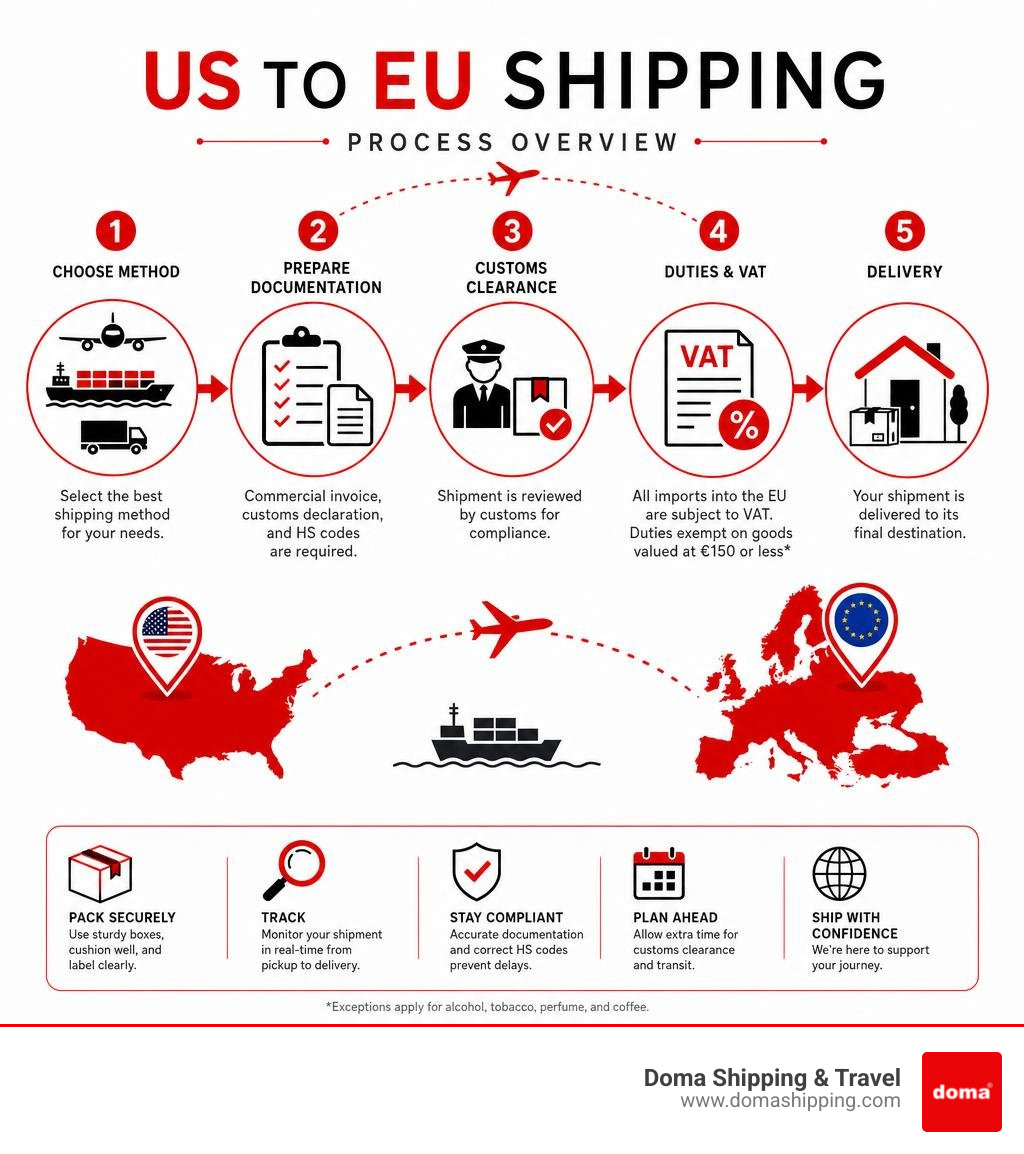
Easy us to eu shipping glossary:
Selecting the appropriate transportation method is the first major decision in the us to eu shipping journey. The choice between air and ocean transit depends entirely on your timeline, the volume of your goods, and your overall logistical requirements.
When navigating these options, we can utilize several key strategic approaches outlined in The Complete Guide to US to Europe Shipping to streamline the process. Understanding how to manage your shipments effectively is vital, whether you are utilizing From A to EU: Navigating the Best Ways to Send Your Goods Across the Pond or aiming for a Parcel Perfect: Navigating US to Europe Shipping Like a Pro.
To make an informed decision, let us compare the primary transit methods side by side:
| Feature | Express Air Freight | Standard Air Freight | Economy Sea Freight |
|---|---|---|---|
| Typical Transit Time | 3–10 business days | 1–2 weeks | 4–6 weeks |
| Primary Advantage | Rapid transit, priority customs | Balanced speed, reliable | Ideal for bulk and oversized |
| Best Suited For | Urgent documents, fragile goods | Standard parcels, gifts | Vehicles, household moves |
| Tracking Detail | Real-time, step-by-step | Regular milestone updates | Container-level tracking |
To further explore how these methods impact your logistics strategy, you can read about International Shipping Options and the Winner Revealed or learn about Smart Shipping: How to Compare Options and Prepare Every Parcel. Additionally, understanding the logistical side of international transit is made easier with our guide on Planning for Borders: Understanding Package Shipping from USA to Europe.
For time-sensitive shipments, express air freight is the premium standard. This method ensures your cargo receives priority handling at every stage of its journey.
When you choose express services, your packages are routed through major international hubs with expedited processing. We detail the mechanics of this high-speed network in Express Lane to Europe: Unlocking the Fastest International Shipping Options.
A key advantage of express delivery is priority customs clearance. Because these shipments carry complete digital documentation from the outset, customs authorities can pre-screen the cargo while it is still in transit. This significantly reduces the likelihood of administrative delays at the destination airport. For a step-by-step breakdown of how to prepare these high-priority shipments, refer to The Need for Speed: A Guide to Express Shipping from the USA to Europe.
While standard transit durations provide a helpful baseline, several external variables can influence the actual arrival date of your cargo.
Understanding these factors is essential for accurate planning, as discussed in Speedy or Steady: Your Guide to USA to Europe Package Transit Times.
Key factors that affect transit times include:
For shipments that do not require next-week delivery, standard air and economy sea freight offer excellent alternatives. Standard air freight typically delivers within one to two weeks, providing a reliable middle ground for standard parcels and gifts.
Economy sea freight, on the other hand, is the bedrock of large-scale international logistics. Taking between four and six weeks, it is the most practical method for transporting heavy furniture, entire household relocations, vehicles, and bulk commercial goods.
To understand how to leverage these methods, you can read From US to EU: Mastering Package Delivery Across the Atlantic.
Many shippers utilize package forwarding and consolidation services to streamline these shipments. By grouping multiple smaller parcels into a single larger shipment, you can optimize container space and simplify the import process. To learn more about this approach, read Seamless Shipping: How Package Forwarding Works from USA to Europe, Crossing the Atlantic: How to Ship Packages from the US to Any European Destination, and Ship Smart: Choosing the Right US to Europe Package Forwarding Service.
Crossing international borders requires strict compliance with the destination country’s import laws. The European Union operates as a single customs union, meaning that while individual nations may have minor administrative differences, they all adhere to a unified set of import regulations and tariff structures.
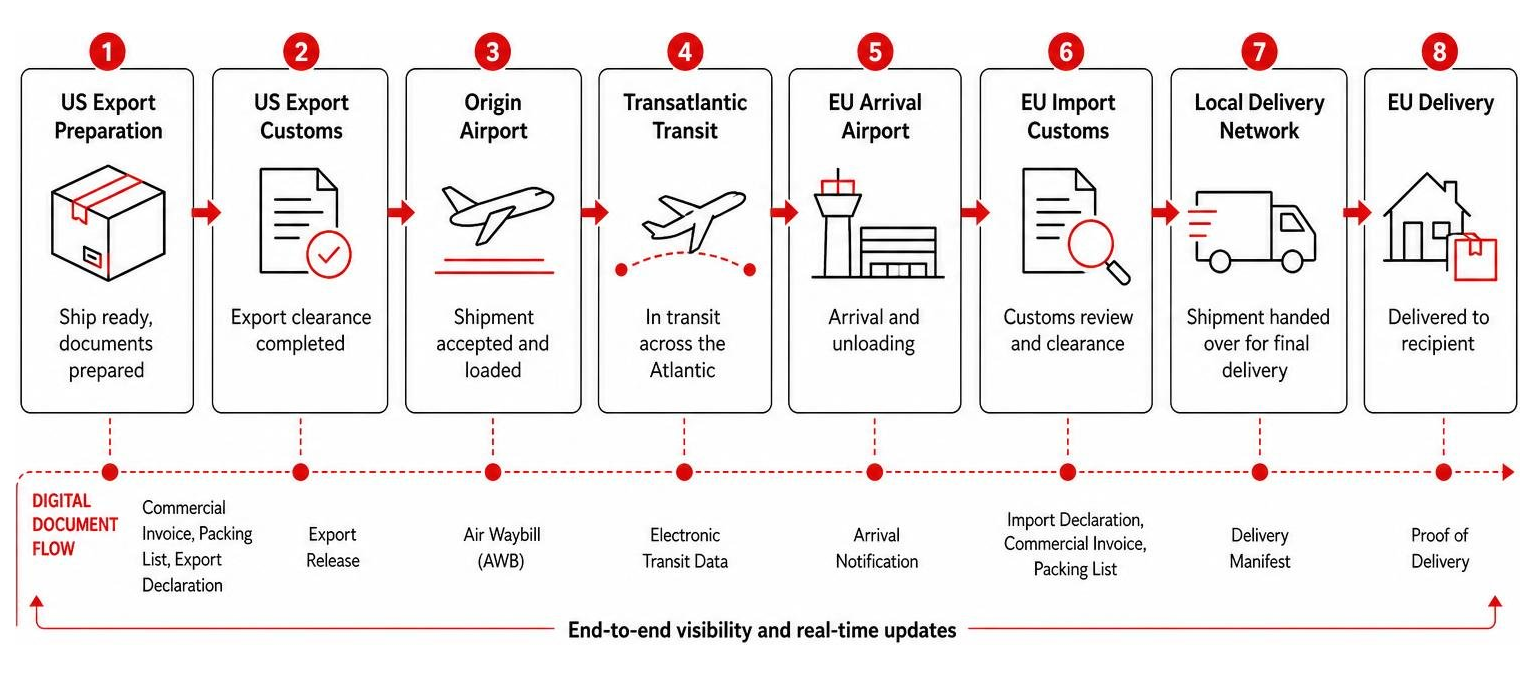
Understanding how these rules are applied at the border is critical to avoiding transit delays. We provide an exhaustive breakdown of this process in The Ultimate Guide to Europe USA Customs Clearance.
When shipping to the EU, keep these core financial rules in mind:
For businesses engaging in business-to-consumer (B2C) distance sales to European customers, the EU has introduced the Import One Stop Shop (IOSS) portal. This electronic platform simplifies the collection and payment of VAT for shipments valued at €150 or less.
By registering for the IOSS, a business can obtain a single VAT identification number that is valid across all 27 EU member states. Instead of the customer paying unexpected VAT fees upon delivery, the seller collects the appropriate VAT at the point of sale and remits it monthly through the portal. This creates a seamless delivery experience, as the package can pass through customs quickly without local tax collection holds.
Accurate paperwork is the single most important factor in ensuring your shipment clears European customs without delay. Every international parcel must be accompanied by a detailed customs declaration and a commercial invoice.
A critical component of this documentation is the Harmonized System (HS) code. These standardized numerical codes are used globally to classify physical products for customs purposes.
To ensure your paperwork aligns with current European standards, you can refer to the resources provided by I Ship to Europe.
As of recent regulatory updates, compliance requirements have become much stricter:
The physical safety of your cargo during its transatlantic journey depends entirely on how well it is prepared before leaving the United States. Your package will handle multiple sorting conveyors, warehouse shifts, and changes in atmospheric pressure.

To protect your items from damage, follow these professional packaging guidelines:
If you are shipping from the Chicago metropolitan area, you can drop off your prepared packages at our local offices across the suburbs, including Niles, IL, Park Ridge, IL, Des Plaines, IL, Glenview, IL, and Schaumburg, IL.
Once your package enters the regional logistics network, it is routed through major handling hubs. If you have ever wondered about the step-by-step processing that occurs at these regional centers, you can read about the daily operations of a Melrose Park Shipping Facility to see how international cargo is sorted and prepared for export.
For specialized advice on packaging gifts, holiday items, or delicate care packages, explore our dedicated guides:
Before sealing your box, you must verify that its contents are legal to import into the destination country. Each EU member state maintains its own list of prohibited and restricted goods, but several categories are restricted across the entire European Union.
Commonly restricted or prohibited items include:
Always check the specific customs website of the destination country before shipping to ensure compliance with local laws.
Transit times depend primarily on the shipping method you select. Express air freight typically takes 3 to 10 business days, standard air freight takes 1 to 2 weeks, and economy sea freight takes between 4 and 6 weeks. Delays in customs clearance or severe weather can occasionally extend these timelines.
Every shipment from the US to the EU requires a detailed customs declaration (such as CN22 or CN23), a commercial invoice outlining the value and description of the goods, and the correct Harmonized System (HS) codes for product classification.
Yes, all commercial imports into the European Union are subject to Value-Added Tax (VAT), regardless of their value. However, goods with a total declared value of €150 or less are exempt from standard customs duties, though VAT still applies.
Navigating us to eu shipping does not have to be an overwhelming process. By understanding your transit options, preparing accurate customs documentation with precise HS codes, and choosing sturdy packaging materials, you can ensure your cargo arrives safely at its destination.
At Doma Shipping & Travel, we bring over 30 years of specialized experience to transatlantic logistics. From our convenient locations across the Chicago area—including Bensenville, IL, Franklin Park, IL, Schiller Park, IL, Roselle, IL, Algonquin, IL, Palos Hills, IL, and Schaumburg, IL—we provide comprehensive international freight forwarding. Whether you are shipping individual packages, large containers, vehicles, or personal belongings, our team ensures a secure and efficient transit process. Beyond shipping, we support your international needs with specialized services like online shopping assistance, secure money transfers, and professional travel booking.
Ready to plan your next international shipment? Explore our specialized sea freight options and learn how we organize secure, shared container shipments by visiting our Less Than Container Load Shipping page today.