
Expat relocation services help people plan an international move. Depending on the provider, support may include visas, housing, schools, shipping, customs paperwork, and help settling in. Before hiring one, ask which tasks it handles, who coordinates the work, and what you must arrange yourself.
Start with your destination, move date, and a list of what you plan to take. Then check the rules for your belongings, especially if you are moving a car. If your move is from the USA to Poland or another European country, Doma Shipping & Travel provides international shipping services for that route. Housing, immigration, and other destination services should be confirmed separately with the appropriate providers. For broader context on how international relocation works, the expatriate overview explains the legal and practical status of people living outside their home country.
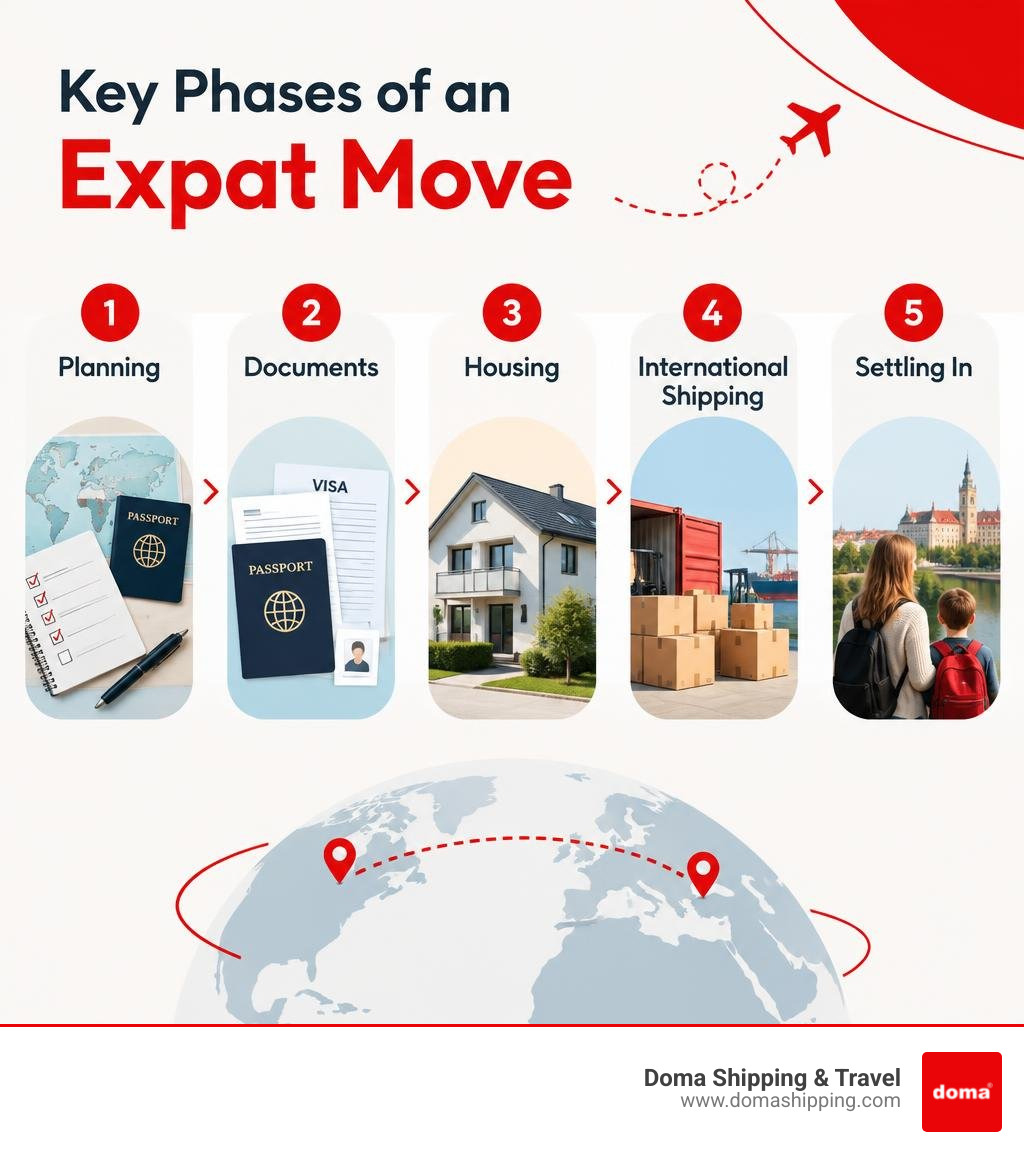
Expat relocation services vocab explained:
Relocating across borders involves coordinating personal timelines, legal frameworks, and physical logistics simultaneously. When organizing a transition to Europe, expats and mobility managers encounter two core areas of support: destination-based settling-in assistance and international transport logistics. Navigating these concurrent pathways requires clear planning, robust coordination, and reliable communication between logistics handlers, municipal bodies, and family members.
Comprehensive relocation support balances on-the-ground integration with reliable freight forwarding. Whether coordinating an executive assignment or a family return to Europe, preparing early ensures that documentation, housing timelines, and cargo shipments align without unexpected delays. For individuals planning a transatlantic move, understanding the process of moving overseas to Europe establishes a clear roadmap for every logistical milestone, from securing valid visas to receiving household goods at your new doorstep.
Settling into a new country requires managing numerous administrative tasks within the first few weeks of arrival. Destination consultants provide boots-on-the-ground assistance to streamline these formalities and bridge cultural and administrative gaps:
While destination specialists focus on living arrangements, the physical transfer of your belongings demands experienced logistics management. Shipping household goods overseas requires precise packing standards, maritime or air freight coordination, and thorough regulatory compliance.
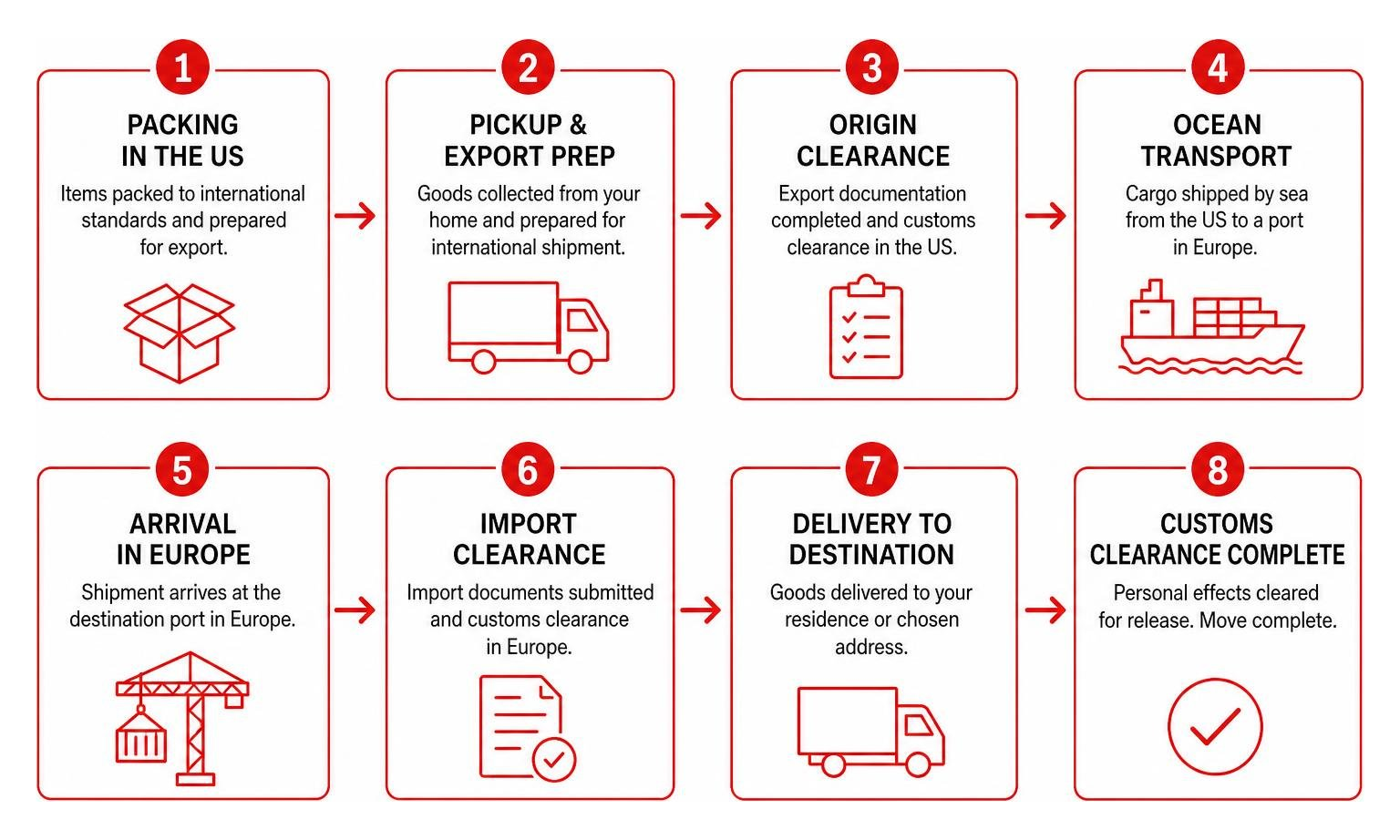
Transporting personal goods across the Atlantic typically involves full container loads (FCL) or less-than-container loads (LCL). FCL shipments are optimal for full household transfers, allowing sole use of a 20-foot or 40-foot ocean container, while LCL consolidation offers an efficient solution for smaller volume shipments. Utilizing door-to-door container shipping ensures that personal effects are secured in specialized maritime containers in the United States and delivered directly to the European residence, minimizing intermediate handling.
For many expats, moving personal vehicles is a critical part of the journey. Safely shipping a vehicle overseas requires vehicle export documentation, title validation, roll-on/roll-off (RoRo) or containerized securing, and compliance with destination vehicle emission standards. Furthermore, managing European Union import declarations demands a thorough understanding of international customs clearance procedures to correctly claim duty relief for personal relocation goods (such as Polish mienie przesiedleńcze), preventing unwarranted import duties and administrative holds.
Successful international mobility relies on structured timelines and clear operational division. Managing an overseas move requires balancing administrative lead times (visas, work permits, registrations) with logistics schedules (ocean transit, port customs inspections, and ground transport).

Prior to finalizing a permanent transfer, many corporate mobility programs and self-relocating professionals schedule “look-and-see” trips. These visits allow transferees to explore prospective neighborhoods, evaluate commute routes, inspect housing options, and visit local schools firsthand.
During the pre-move phase, gathering destination insights is vital. Transferees often consult resources that explain moving overseas to Europe to understand neighborhood dynamics, community amenities, and cultural expectations before arriving. At the same time, administrative teams coordinate long-term visa processing, work authorizations, and apostilled personal records to prevent legal delays at border control. Planning these visits several months in advance allows families to make informed housing decisions, align move-in dates with shipment arrival windows, and ensure smooth integration into their new environment.
Managing an international move involves deciding between a centralized relocation framework or contracting independent local vendors for each individual task.
| Strategy Component | Centralized International Provider | Multiple Dispersed Local Vendors |
|---|---|---|
| Point of Contact | Single dedicated coordinator managing all logistics | Separate contacts for movers, customs brokers, and realtors |
| Logistics Accountability | Direct oversight from US pickup to final European delivery | Fragmented responsibility between carriers, agents, and handlers |
| Documentation Handling | Unified customs declarations and export paperwork | Transferee must manually coordinate paperwork between parties |
| Communication Flow | Consistent bilingual updates and centralized tracking | Multiple communication channels with varied response times |
Working with specialized, certified international movers eliminates the confusion of fragmented supply chains. Centralized freight forwarding ensures that professional packing standards, ocean container shipping lines, and European customs clearance are managed cohesively under unified oversight, avoiding miscommunications that can lead to port demurrage or documentation delays.
Corporate human resource departments, global mobility managers, and individual expats evaluate several essential criteria when choosing an overseas shipping and relocation logistics partner:
An overseas move typically requires two to four months of advance planning. Securing visas, work permits, and destination documentation generally takes 4 to 8 weeks depending on the consulate. For international freight logistics, ocean transit from the US East Coast or Midwest to major European ports generally takes 3 to 6 weeks, followed by customs processing and final residential delivery.
Destination consultants evaluate family educational preferences, identify public, private, or international institutions with capacity within specific school districts, and guide parents through registration deadlines, academic record validation, and immunization record translations.
For household goods moving from the USA to Europe, required documentation typically includes:
Relocating across borders requires careful preparation, clear administrative coordination, and reliable transport logistics. At Doma Shipping & Travel, our over 30 years of experience serving the Polish-American community and clients across the greater Chicago area—including Chicago, Des Plaines, Niles, Park Ridge, Schaumburg, and surrounding suburbs—enables us to provide dependable international logistics support.
We specialize in ocean container shipping (FCL and LCL), vehicle transportation, full customs handling, and secure air freight exclusively from the United States to Poland and European destinations. For seamless overseas transitions, explore our international parcel and freight shipping services to plan your international move with confidence.