
Shipping from Canada to Europe is a common search topic for people trying to understand transatlantic logistics, but the correct process depends on where the shipment physically begins. Doma Shipping & Travel focuses on international shipping from the USA to Poland and other European countries, including parcel shipping, container shipping, customs handling, and overseas logistics support.
Here is a practical overview of the main international shipping methods used for USA-to-Europe and broader North America-to-Europe transport:
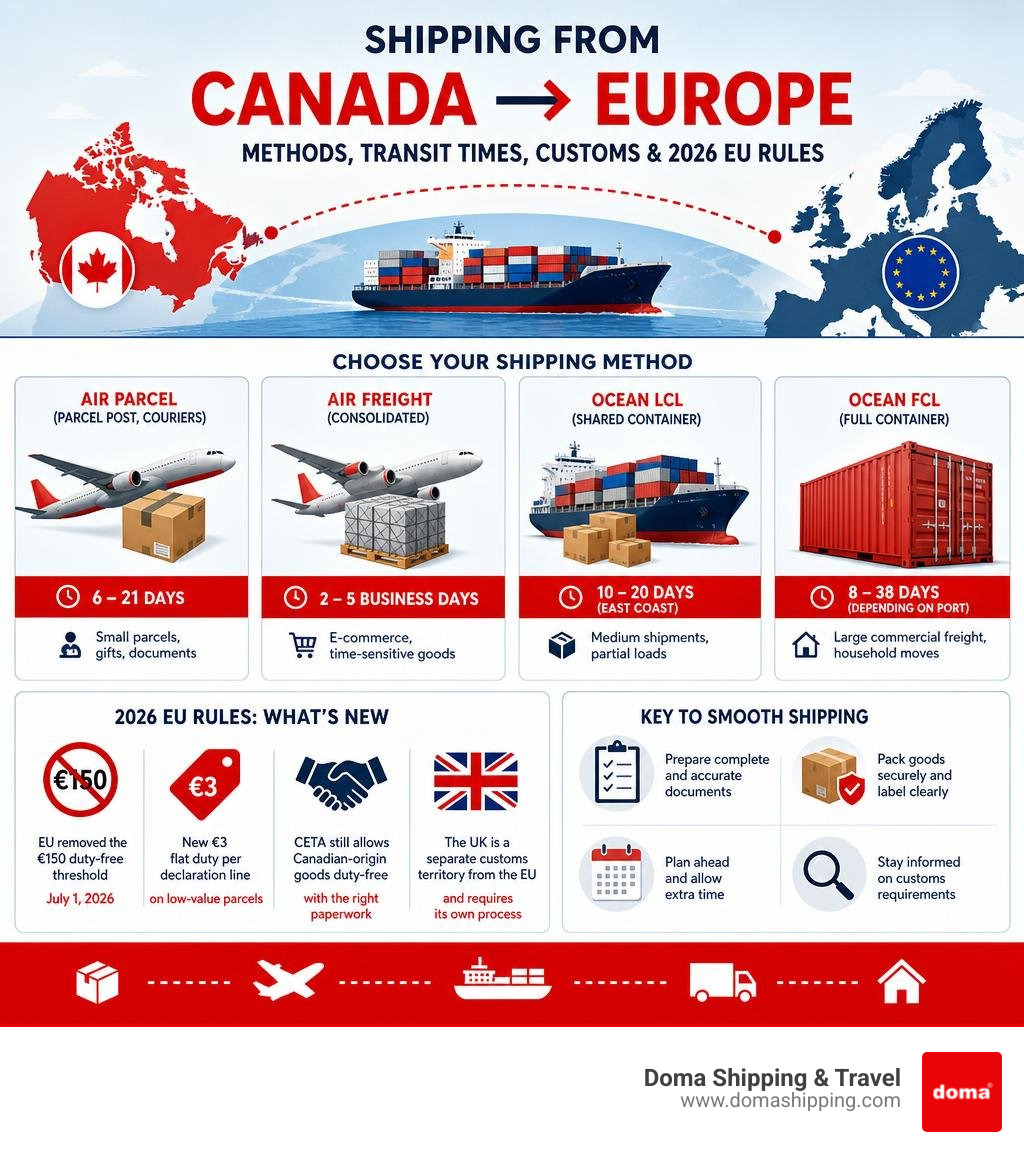
| Method | Transit Time | Best For |
|---|---|---|
| Air parcel | 6-21 days | Small parcels, gifts, documents |
| Air freight | 2-5 business days | E-commerce, time-sensitive goods |
| Ocean LCL (shared container) | 10-20 days from many East Coast gateways | Medium shipments, partial loads |
| Ocean FCL (full container) | 8-38 days depending on origin and port routing | Large commercial freight, household moves |
A few EU import rules in 2026 are especially important for shippers sending goods into Europe:
Whether you are comparing rules for shipping from Canada to Europe, sending parcels from the USA to Poland, moving household goods overseas, or preparing commercial freight for European customers, the process involves customs documentation, trade agreements, and destination-country regulations that must be addressed before departure.
This guide breaks down the key steps in plain language, with a focus on international shipping preparation, documentation, customs clearance, and transatlantic delivery planning.
Shipping from canada to europe terms made easy:
When planning transatlantic transport, selecting the appropriate logistics method is the foundation of a successful shipment. Shippers generally choose between air transport and ocean transport based on urgency, shipment size, and the nature of the cargo.
For smaller packages, documents, gifts, or time-sensitive items, air parcel delivery is the standard. International parcel networks use commercial and cargo aircraft to move shipments across the Atlantic before they enter customs clearance and final-mile delivery in the destination country.
Standard international air parcel services from the USA to European destinations often require one to three weeks for delivery, depending on routing, customs review, and local delivery conditions. For businesses requiring expedited delivery windows, express air networks can reduce this transit time to a few business days, though this requires more detailed coordination and documentation. To understand how businesses leverage these networks, you can explore The Ultimate Guide to Air Shipping: Faster Delivery for Your Business.
When cargo volume exceeds the practical limits of air transport, ocean freight becomes the primary alternative. This method is highly scalable and accommodates everything from single pallets of commercial goods to larger household relocations. Ocean carriers operate regular liner services connecting North American ports with European hubs.
Transit times for ocean freight depend on the origin warehouse, export port, destination port, carrier schedule, and whether the shipment moves as LCL or FCL. Shipments routed through East Coast gateways to Western Europe generally have shorter ocean passages than shipments routed from the West Coast, which may require longer vessel routing.
For shippers seeking a balance between speed and administrative structure, integrated international networks offer a practical alternative. These services use local receiving points, consolidation warehouses, export documentation workflows, and dedicated international channels to move parcels or freight from the USA to Poland and other European destinations.
For larger international shipments from the USA to Europe, ocean freight is organized into two primary categories: Less-than-Container Load (LCL) and Full Container Load (FCL). Selecting the correct option depends on the volume of your goods, the required handling process, and your security requirements.
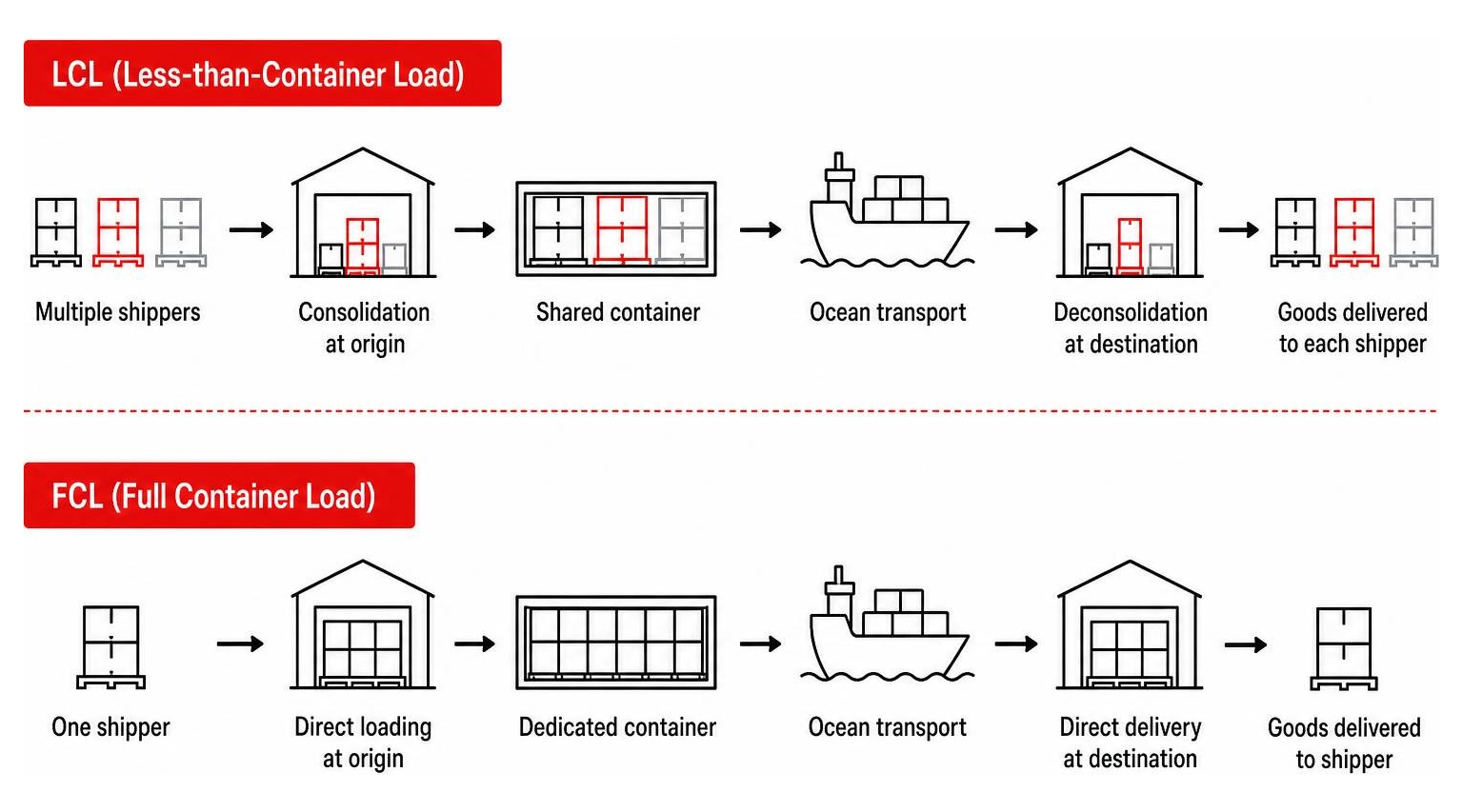
LCL shipping, also known as groupage, is designed for cargo that does not require the entire volume of a standard ocean container. Under this system, multiple shippers share the space within a single container. Your goods are measured by volume, usually cubic meters, or weight, and the shipment is consolidated with compatible cargo moving to the same region.
This method is efficient for medium-sized shipments, such as partial household moves or small commercial pallet shipments. However, because the container must be consolidated at the origin warehouse and deconsolidated at the destination facility, LCL shipments typically require additional handling time compared with direct full containers.
FCL shipping involves using an entire 20-foot or 40-foot container for one shipper. The container is delivered to the loading location, sealed after loading, and transported through the export and ocean freight process.
FCL is commonly used for large commercial exports, vehicle transport, and full household relocations. It provides a more direct handling process because the container remains sealed from origin loading through the international transport chain until it reaches the authorized destination point.
| Feature | Less-than-Container Load (LCL) | Full Container Load (FCL) |
|---|---|---|
| Cargo Volume | Best for 1 to 15 cubic meters | Best for over 15 cubic meters |
| Container Sharing | Shared with other shippers | Exclusive use of container |
| Handling | Multiple consolidation steps | Sealed at origin, opened at destination |
| Transit Speed | Slower because consolidation is required | Faster when direct routing is available |
| Standard Sizes | Calculated by fractional volume | 20’ Standard, 40’ Standard, 40’ High Cube |
For those interested in the historic and practical context of transatlantic maritime routing, our guide on Sailing from Canada to Europe the Old Fashioned Way offers a deeper look.
The regulatory landscape for shipping into the European Union has undergone significant modernization. As of 2026, the EU has implemented structural changes to streamline customs processing, enhance security, and standardize tax collection on imported goods. These rules matter for international shipments entering the EU from the USA, Canada, or any other non-EU origin.
Historically, many low-value parcels entering the EU with a declared value under €150 were not charged customs duty. Effective July 1, 2026, this threshold has been eliminated. Commercial imports, regardless of value, are now subject to customs duty review upon arrival in the EU.
To simplify the processing of low-value shipments under €150, the EU has introduced a flat customs duty of €3 per declaration line. This change requires careful attention to how shipments are documented:
Exporters must also comply with several key environmental and safety frameworks when entering the European market in 2026:
For a comprehensive overview of European import frameworks, refer to The Complete Guide to US to Europe Shipping.
Clear and accurate documentation is the most critical factor in preventing customs delays at European ports of entry. Every international shipment from the USA to Europe requires a standardized set of documents:
Value-Added Tax (VAT) applies to virtually all commercial goods entering the European Union. Understanding how VAT is assessed and collected is vital for maintaining a seamless supply chain.
Trade agreements play a significant role in transatlantic trade, but they apply only when the origin, destination, and product rules match the agreement. This distinction is important for anyone comparing USA-to-Europe shipping with shipping from Canada to Europe.
The Canada-European Union Comprehensive Economic and Trade Agreement (CETA) provides preferential tariff treatment for many qualifying Canadian-origin goods entering the EU.
To benefit from CETA, exporters generally do not need to obtain a formal, government-issued certificate of origin. Instead, a declaration of origin can often be printed directly onto the commercial invoice. This statement must confirm that the goods meet the specific rules of origin outlined in the agreement.
CETA does not apply to USA-origin goods. Shipments from the USA to Poland and other European countries require their own documentation, HS classification, commercial invoice details, and origin statements where applicable. For deeper insights into transatlantic parcel routing, see our guide on From US to EU: Mastering Package Delivery Across the Atlantic.
Following Brexit, the United Kingdom operates as a separate customs territory from the European Union. Shipments to England, Scotland, Wales, or Northern Ireland must be reviewed under UK customs and VAT rules rather than standard EU import procedures.
Trade between Canada and the UK is governed by the UK-Canada Trade Continuity Agreement, while USA-origin shipments follow separate USA-UK customs requirements. Shippers should maintain separate documentation streams for EU and UK destinations, especially when sending parcels or freight through different European entry points.
Proper physical preparation of your shipment is just as important as regulatory compliance. Secure packaging and accurate labelling help prevent physical damage, sorting problems, and customs delays during international transport from the USA to Europe.
Transatlantic transit subjects cargo to movement, temperature variations, and mechanical handling.
To learn more about preparing your packages for international transit, consult our Crossing the Atlantic: How to Ship Packages from the US to Any European Destination guide.
Every package must bear a clear, legible shipping label that includes:
Before preparing your shipment, verify that your items are permitted in the destination country. Common restrictions include:
Ocean transit times vary based on the origin warehouse, export port, destination port, sailing schedule, and customs clearance. Shipments routed through East Coast gateways to major Western European hubs can have shorter ocean passages, while shipments moving from inland locations first require domestic transfer to the export port. Shippers should also allow time for port handling, container consolidation, deconsolidation, and customs clearance at both ends.
Since Brexit, the UK and the EU represent separate customs jurisdictions. Shipments to the EU are subject to EU customs codes, EU VAT rules, and the €3 flat duty process for low-value parcels. Shipments to the UK require separate customs declarations and must comply with the UK’s independent VAT and product safety standards. When planning international parcel or freight flows, shippers should treat UK and EU destinations as separate regulatory processes.
Under the customs rules introduced in July 2026, commercial parcels entering the EU valued under €150 are subject to a flat €3 customs duty per declaration line. A declaration line is determined by the HS code of the product. If your shipment contains multiple items of the same category, they are grouped on one line and attract a single €3 charge. If you ship different categories of goods in one package, each distinct category requires its own declaration line, resulting in multiple €3 charges.
Navigating international logistics requires careful preparation, accurate documentation, and a clear understanding of customs requirements. At Doma Shipping & Travel, we bring over 30 years of experience serving the Polish-American community from our locations across the greater Chicago area, including Chicago, Melrose Park, Mount Prospect, Roselle, Palos Hills, Algonquin, Niles, Park Ridge, Des Plaines, Glenview, Franklin Park, Schiller Park, Bensenville, and Schaumburg.
We specialize in international logistics from the USA to Poland and other European countries, including parcel shipping, container shipping, vehicle transport, household relocation support, and customs documentation guidance. Our bilingual Polish and English support team helps customers prepare shipments correctly, understand documentation requirements, and follow the appropriate international delivery process.
Whether you are coordinating a commercial shipment or managing a household relocation, structured preparation is essential for a reliable transatlantic move. For more details on maritime cargo planning, learn more about Less-than-Container Load (LCL) shipping and review the shipping method that best matches your international logistics needs.