
Ahoy, Savings! The Cheapest Way to Ship Personal Belongings Overseas

Comparing Methods for Shipping Personal Belongings Overseas

When you are preparing to relocate across the Atlantic, choosing the appropriate transport method plays a pivotal role in keeping your overall moving strategy organized. Finding the right way to ship personal belongings overseas requires analyzing your total cargo volume, required delivery timeline, and destination requirements.

At Doma Shipping & Travel, we evaluate three primary transportation channels for overseas moves from the USA to Europe:

  1. Ocean Freight: The standard method for transporting medium-to-large household loads across the Atlantic, with strong volume capacity for personal belongings.
  2. Air Freight: Fast transit suitable for essential items, sensitive instruments, or urgent moves, classified based on actual or volumetric weight.
  3. Express Courier & Parcel Services: Practical for small boxes, single packages, or documents, but not intended for complete household moves.

For a detailed breakdown of global transport logistics, explore our guide on A Comprehensive Guide to International Shipping.

Options for Shipping Small Packages Overseas

If your move consists of only a few boxes of clothes, books, and lightweight personal items, full container transport is unnecessary. In these situations, selecting an efficient method to ship personal belongings overseas centers on optimizing parcel dimensions and weight limits.

When shipping individual boxes from the United States to European destinations, carriers evaluate both physical weight and space occupied:

  • Dimensional Weight (DIM Weight): Carriers compute DIM weight using the formula (Length x Width x Height in inches) / 139 for standard international parcel services. If your box is large but filled with lightweight items like winter jackets or bedding, the dimensional volume may determine how the shipment is classified.
  • Poly Mailers vs. Rigid Boxes: Soft goods like clothing or curtains should be packed in durable, weather-resistant poly mailers or vacuum-sealed bags whenever possible to eliminate excess box volume.
  • Box Standardization: Using standard heavy-duty corrugated cardboard boxes prevents structural collapse during transit while maximizing pallet space in cargo holds.

To understand how parcel sizes influence international shipment planning to European destinations, review our guide on international package planning from the USA to Europe.

Ocean Freight vs Air Freight: Selecting Transport for Large Volumes

When moving an entire home or a substantial furniture collection across the Atlantic, ocean freight is the primary choice for large shipments. Ocean transport provides significantly higher volume capacity than air freight for large household shipments.
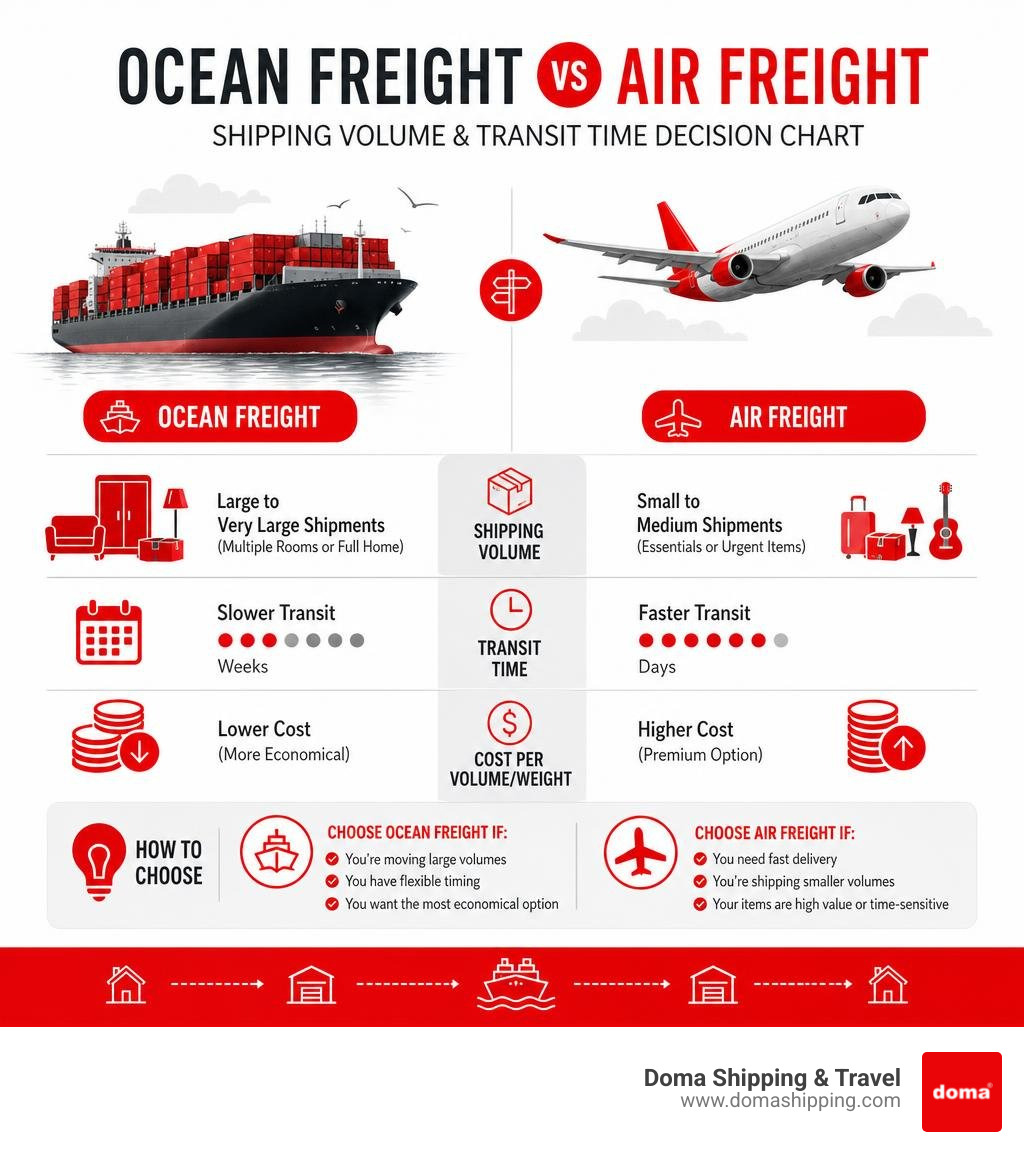
ocean freight vs air freight shipping volume and transit time decision chart infographic

Ocean freight operates under two distinct container service models:

  • Full Container Load (FCL): An entire ocean container is reserved exclusively for your household goods. This is ideal for moving a 2-to-4 bedroom home. FCL shipments offer faster transit times because the container is loaded at your doorstep or our hub and sealed directly for vessel departure without intermediate consolidation delays. You can learn more in our detailed resource on Full Container Load Shipping.
  • Less Than Container Load (LCL): If you are shipping a partial household—such as a single bedroom, dorm room, or a collection of 10 to 20 boxes—you share container space with other cargo headed to the same European destination. Your shipment is assigned container space according to its measured volume in cubic feet or cubic meters. Discover how this service works via our overview of Less Than Container Load Shipping.

The Decision Matrix: Evaluating What to Ship Overseas

Deciding what to carry across the ocean and what to leave behind is a practical planning process. Before packing every household item into boxes, evaluate transport logistics against destination compatibility, item condition, availability in Europe, and personal importance.

carefully labeled moving boxes packed inside a room prepared for international relocation loading

A simple framework helps determine whether an item belongs in your international shipment:

Transport Requirements + Insurance Needs + Customs Documentation + Destination Compatibility

If an item is essential, difficult to replace, compatible with European standards, or personally meaningful, it may belong in your shipment. If an item is fragile, incompatible, or easy to source after arrival, selling or donating it locally in the U.S. before departure may be the more practical decision. For a deeper breakdown of this approach, check out Expatsi’s relocation guide on shipping vs. selling.

Items Often Appropriate for Overseas Shipping

Certain items are frequently appropriate for transatlantic shipping due to quality, specialized use, or sentimental importance:

  • Family Heirlooms and Keepsakes: Photo albums, antique furniture, artwork, and sentimental family possessions cannot be replaced. Protect these valuable items by referring to Safe Passage The Ultimate Guide to Shipping Family Heirlooms.
  • High-End Solid Wood Furniture: Quality hardwood furniture made from oak, cherry, or maple can be difficult to source in the same style and condition abroad. If you already own well-made pieces, LCL or FCL ocean freight may be appropriate for your relocation plan.
  • Specialized Tools & Outdoor Equipment: Specialized trade tools, high-end musical instruments, or custom sports gear may be difficult to source after arrival and often require careful packing for overseas transit.
  • Dual-Voltage Electronics: Modern laptops, smartphones, camera gear, and high-end monitors built with 100–200V / 50–60Hz dual-voltage power supplies work seamlessly in European electrical outlets with a simple plug adapter.

Items Better Sold or Donated Before Relocating

Conversely, transporting certain items across the Atlantic often results in technical headaches:

  • Single-Voltage Major Appliances: American washing machines, dryers, refrigerators, and microwaves run on 120V / 60Hz power. European electrical systems operate on 230V / 50Hz. Heavy transformers are inconvenient, hazardous for high-draw heating appliances, and prone to causing motor failures over time.
  • Bulky Pressed-Wood or Flat-Pack Furniture: Inexpensive particleboard furniture rarely survives disassembly, international ocean transit, and reassembly. Transporting particleboard items is often impractical compared with sourcing suitable furniture after arrival.
  • Standard Kitchen Utensils & Basic Goods: Items like bath towels, plastic containers, curtain rods, and basic kitchenware consume valuable volume in a container while being simple to purchase fresh upon arrival in Europe.

Customs duties and import taxes can add unexpected complexities to an international move if not properly managed. Fortunately, proper planning and accurate paperwork allow many relocating individuals to import personal effects under applicable customs relief programs.

To avoid customs delays, explore our comprehensive guide on Your Stuff Their Country How to Ship Personal Belongings Without a Hitch.

European Union Transfer-of-Residence Relief

If you are relocating your primary residence from the United States to a member state of the European Union (such as Poland, Germany, or France), you may qualify for Transfer-of-Residence (ToR) Duty and VAT Exemption.
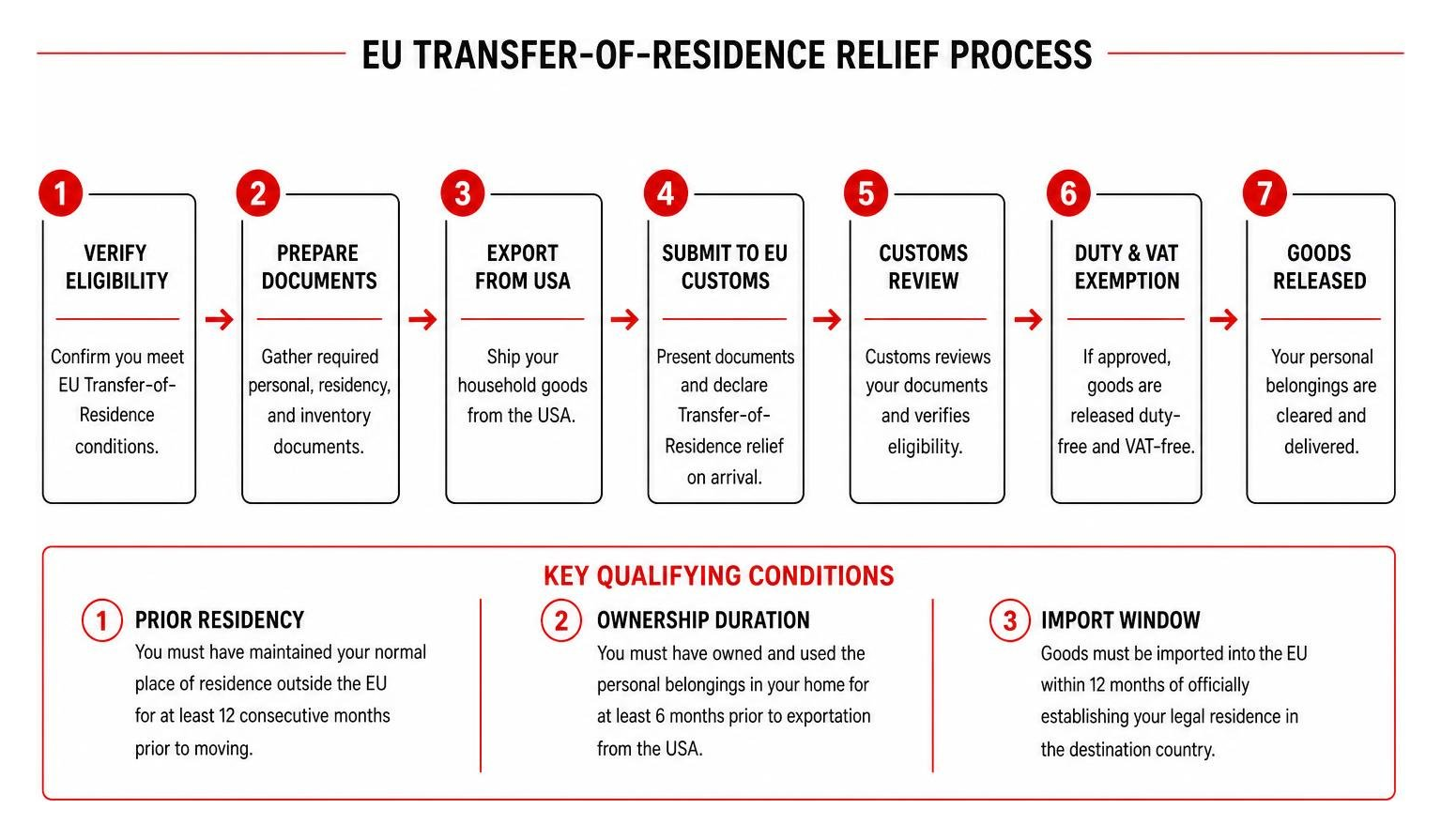
step by step European Union transfer of residence relief process diagram

To qualify for ToR relief under EU customs law, you must generally meet the following conditions:

  1. Prior Residency: You must have maintained your normal place of residence outside the European Union (e.g., in the USA) for at least 12 consecutive months prior to moving.
  2. Ownership Duration: You must have owned and used the personal belongings in your home for at least 6 months prior to exportation from the USA.
  3. Import Window: Goods must be imported into the EU within 12 months of officially establishing your legal residence in the destination country.
  4. Retention Restriction: Belongings imported under ToR relief cannot be sold, rented out, or transferred to another party within 12 months of customs clearance without addressing applicable customs obligations.

For destination-specific details across European borders, read The Complete Guide to US to Europe Shipping.

International Customs Documentation and Regulatory Rules

Proper documentation is essential for seamless customs clearance. Minor errors on cargo declarations can cause customs holds, inspections, and port storage delays.

Essential international documentation includes:

  • Detailed Packing List / Inventory: A comprehensive, line-item inventory listing every box and its contents (e.g., “Box #3: 12 Used Cotton Shirts”).
  • Copy of Passport & Visa/Residency Permit: Proof of legal right to reside in the destination country.
  • Proof of USA Residence Termination: Lease cancellation documents, property sale papers, or employment transfer letters confirming your move.
  • Customs Declaration Form: Specific country filings, such as the Polish customs declaration or equivalent EU entry forms.

Essential Planning and Managing Transit Logistics

Executing a smooth international move requires careful coordination, proper insurance protection, and precise packaging.

When selecting an ocean carrier from the United States, verify that your service provider is properly licensed with the Federal Maritime Commission (FMC). FMC registration helps confirm that an ocean transportation intermediary is operating under applicable federal maritime requirements.

Managing Transit Timelines and Packing Strategy

Ocean freight is well suited for substantial moves, but it requires advance planning. Ocean transit times from U.S. East Coast or Midwest ports to European ports typically range between 3 to 6 weeks, plus additional days for customs clearance and terminal transport.

To manage the timeline gap between your arrival and your belongings’ delivery:

  • Pack an Essential Travel Kit: Bring 3 to 4 weeks of clothing, essential toiletries, medications, vital documents, and primary electronics in checked airline luggage.
  • Use Heavy-Duty Double-Wall Boxes: Standard domestic moving boxes lack the structural integrity required for transatlantic marine ocean transit. Use double-wall corrugated cardboard boxes designed for international shipping.
  • Moisture Protection: Ocean transit exposes container cargo to humidity changes. Line cardboard boxes with heavy plastic liner bags and include silica gel packs in moisture-sensitive boxes (such as those containing electronics, shoes, or leather items).

For complete door-to-door transit planning, refer to A Complete Guide to Door to Door Container Shipping.

Additional Logistics Factors and Insurance Protection

Planning for unexpected events protects your household goods throughout transit:

  • Marine Transit Insurance: Standard carrier liability protection, often called released value protection, provides limited coverage under carrier terms. For broader protection against damage or total loss, consider All-Risk Marine Transit Insurance, with coverage reviewed according to your declared inventory and policy conditions.
  • Pet Relocation Logistics: If you are moving pets alongside household belongings, international pet travel involves separate veterinary health certificates, microchipping, rabies blood titers, and strict entry requirements. Pet travel logistics must be planned 3 to 6 months in advance.
  • Power Adapters & Plug Converters: Acquire heavy-duty plug converters and dual-voltage power strips before departure so you can charge your laptops, phones, and devices immediately upon arrival.

For regulatory information regarding ocean transportation intermediaries, consult the official guidelines from the Federal Maritime Commission.

Frequently Asked Questions About Shipping Belongings Overseas

How long does ocean freight take for international personal moves?

Ocean freight from standard U.S. ports (such as Chicago hubs through East Coast ports) to major European destinations usually takes 3 to 6 weeks port-to-port. When factoring in origin pickup, consolidation, customs processing, and final door delivery, you should plan for a total door-to-door timeline of 6 to 8 weeks.

Is air freight ever suitable for overseas household shipping?

Yes, air freight is well-suited for small, urgent shipments—such as essential work equipment, critical medical gear, or basic wardrobes needed immediately for a job start. However, because air freight is classified based on actual or volumetric weight, shipping a full home’s worth of furniture by air is rarely practical.

How does dimensional weight affect international parcel shipping calculations?

Dimensional weight reflects package density. Freight carriers multiply a package’s length, width, and height in inches and divide by a standard divisor (typically 139 for international express shipments) to calculate dimensional weight. If the resulting dimensional weight exceeds the actual physical weight on the scale, the carrier uses the dimensional weight for shipment classification.

Conclusion

Successfully shipping personal belongings overseas comes down to choosing the right international service for your volume, decluttering non-essential items, and preparing customs documentation for programs such as the EU’s Transfer-of-Residence relief. By choosing ocean freight for larger moves, protecting your goods with double-walled packaging and marine insurance, and evaluating item compatibility in advance, you can relocate your household across the Atlantic with a clearer logistics plan.

With over 30 years of experience serving the Polish-American community and clients across Greater Chicago, Doma Shipping & Travel coordinates international parcel shipping, container transport, customs documentation, and household relocations from the USA to Poland and other European countries. Our locations include Chicago, Melrose Park, Mount Prospect, Roselle, Palos Hills, Algonquin, Niles, Park Ridge, Des Plaines, Glenview, Franklin Park, Schiller Park, Bensenville, and Schaumburg.

For planning support related to shipments from the USA to Poland or Europe, explore international parcel shipping solutions with Doma Shipping & Travel.